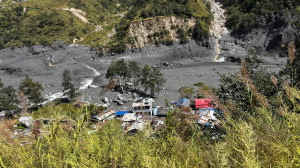
Indian TV coverage of Nepal floods criticised for sensationalism
Residents say some crews have turned their own difficulties at disaster sites into television drama and given less attention to those flood victims. Thumbnails of YouTube reels produced by Republic Bharat, News 24 Digital and News Nation on the Bhotekoshi floods.
When Indian television crews arrived in Rasuwa to cover the devastation caused by the Bhotekoshi floods, their presence was initially welcomed as a natural consequence of a disaster that had attracted international attention.
But within days, some of the crews had become the subject of anger among residents and criticism on social media, with accusations that they were turning the disaster into a television spectacle rather than focusing on the people who had lost homes, livelihoods and family members.
The anger peaked in Dhunche, the district headquarters of Rasuwa, where residents confronted Indian television crews before they left the area early on September 3.
“Who would spare people who go to a grieving family and tell them to do this and that, making them do all sorts of things?” said Dinesh Tamang, a resident. “We drove them away.”
Another resident, Rajkumar Ghala, said people had confronted the crews the previous day.
“They exaggerate many things and create more noise than necessary,” he said. “We shouted at them too. They all left early in the morning.”
The criticism has come as Nepal continues to grapple with the scale of the disaster. The Bhotekoshi floods have killed 1,385 people and left 5,130 missing, according to the latest figures shared by the country’s disaster management authority.
The disaster has drawn media organisations from around the world. But some of the Indian television coverage has focused less on survivors and the destruction around them and more on the reporters themselves: a foot sinking into mud, a shoe being pulled off, or a reporter speaking anxiously into a camera while struggling to get out.
In one widely circulated video, a News24 reporter is seen standing in muddy ground in Nuwakot’s Dhunge area and telling the camera, “My foot is stuck. I am continuously sinking.”
The video, posted on the channel’s X account at 1:31pm on August 29 under a headline about the reporter sinking while covering Nepal’s flood disaster, had been viewed more than 144,000 times.
Another video filmed in Dhunge by a Republic Bharat reporter showed her saying that her entire foot was stuck in mud before showing her dislodged shoe. The footage also showed local people helping her out.
A News Nation Digital reporter similarly filmed himself sitting in mud with his foot stuck. “I wanted to show you the situation from here, but my foot is already stuck,” he said, before pointing towards the mud and remarking that he wondered how much people trapped there must have screamed.
Such scenes have been criticised as examples of disaster reporting in which the reporter becomes the story.
The criticism has also extended to claims about rescue operations.
A US rescue team from Crisis Response International had travelled to Nepal to help with efforts to rescue people trapped inside a tunnel at the Chilime hydropower project in Rasuwa. The team was led by a person from Pokhara who asked not to be identified.
On the night of September 2, he said media attention and a lack of paperwork had complicated the team’s efforts.
“We did not get to go, even though the matter we discussed in the morning had already become news,” he said. “Some of the paperwork had not even been done. There was so much media noise here that everything was ruined.”
Footage subsequently circulated on some Indian television channels and YouTube platforms, appearing to show the team carrying out a rescue operation at the site.
A 2-minute-35-second video posted on September 2 on a YouTube channel called News X Live claimed that the team had gone in for a rescue. The team, however, had not been able to carry out the rescue, according to the person involved.
For media scholars, the pattern reflects weaknesses in the way some television reporters are prepared for disaster coverage.
Anand Pradhan, a professor at the Indian Institute of Mass Communication, said many television journalists were inadequately trained to report natural disasters.
“Many journalists working for television news channels are not properly trained to report natural disasters,” he said. “They try to compensate for their lack of ability and preparation by turning every event into low-grade drama and playing on the fears and psychology of viewers.”
Manisha Pandey, editor-in-chief of Newslaundry, an Indian independent media organisation, points instead to the commercial pressures facing television newsrooms.
The competition for television ratings and audiences, she said, puts reporters under pressure to produce dramatic images.
“There is pressure to put out something new every hour,” Pandey said.
She said sensational coverage was not limited to Nepal.
“Indian television channels sensationalise floods, heavy rain, forest fires and earthquakes not only in Nepal but also within India,” she said. “Indian citizens themselves are victims of this kind of journalism.”
That distinction is important in Nepal, where criticism of Indian television coverage is shaped not only by the current disaster but also by a longer history of contentious coverage.
During the 2015 earthquake, Indian television channels faced criticism in Nepal for allegedly prioritising dramatic on-camera performances over the experiences of survivors and for asking insensitive questions of people who had just lost homes and relatives. The hashtag #GoHomeIndianMedia circulated widely on social media.
In 2020, Indian television channels aired controversial reports about then-prime minister KP Sharma Oli and then Chinese ambassador Hou Yanqi. Nepal’s cable operators subsequently stopped broadcasting Indian news channels on June 29 that year.
Indian media again faced hostility during the Gen Z protests of September 8-9 last year. Reporters covering events outside Nepal’s Parliament were confronted by demonstrators who accused them of being “Godi Media”—a term used in India to describe media outlets perceived as overly supportive of the Narendra Modi government. A Republic Bharat reporter was slapped by protesters, while a TV9 Bharatvarsh team was told to stop filming.
Thumbnail of a YouTube report by News 24 Digital on the Bhotekoshi floods.
The intensity of the reaction is partly explained by the reach of Indian television in Nepal.
According to the Department of Information and Broadcasting, 91 international television channels are broadcast in Nepal, 80 of them from India.
“Not all 80 channels are news television channels,” said Anup Nepal, the director general at the department. “They include cartoon and sports channels as well.”
Media researcher Tilak Pathak said India’s geographical proximity and the large number of Nepalis who live in or have connections with India help explain why Indian media organisations are particularly active during major events in Nepal.
But the sensitivity is also linked to the style of reporting, he said.
“This issue is more about the style of media reporting than relations between the two countries,” Pathak said. “When one or two media organisations adopt a poor style, there is a tendency to lump everyone in the same basket without distinguishing between responsible and irresponsible media.”
Pandey also sees a political dimension in the coverage of neighbouring countries.
“Television channels have become almost like mouthpieces for the ruling party in New Delhi,” she said. “Instead of trying to understand Nepal, Bangladesh or Pakistan and the people there, they report through a political lens from New Delhi.”
Yet the criticism of Indian media during the Bhotekoshi disaster has not come only from Nepal. Some Indian social media users have also objected to the coverage.
On the News24 video, an X user named Amir Singh Chauhan wrote that Indian news channels had sent reporters to make “reels” rather than cover rescue operations. “Slipping in mud for the camera is not journalism,” he wrote.
The criticism of sensational disaster coverage has also extended to Nepali media.
Press Council Nepal President Umesh Shrestha said many Nepali media organisations had published graphic images from the disaster and that some had asked traumatised survivors deeply insensitive questions.
“We also had videos taken down in which children who had lost their parents were asked, ‘Did you see your parents being swept away?’” Shrestha said. “We have also received complaints about Indian media asking victims questions such as, ‘How do you feel?’ in ways that can trigger them.”
The Press Council, however, has jurisdiction only over media organisations operating from Nepal and cannot directly regulate Indian media.
The council did intervene after an Onlinekhabar report published on September 1 carried what it considered a misleading headline. The headline was subsequently changed.
Media professionals also caution against lumping all Indian journalists and outlets together.
Pandey said some individual reporters from major channels, independent media organisations and YouTube journalists had travelled to Nepal and produced fair and commendable coverage.
Journalist Smita Sharma was among those who travelled from India to cover the floods. She also passed through mud and difficult terrain to reach affected areas, but did not make her own physical struggle the centre of her coverage.
Her reports focused on conditions at the disaster sites, conversations with residents and relief distribution. Sharma is a former foreign policy editor and anchor with several leading Indian TV news channels in the past.
On August 29, her channel, Smita Sharma Journalist, published interviews with residents of Nuwakot.
Sharma, who has worked in Indian television, said the deeper problem lies with newsroom leadership.
“The main reason for the decline of television journalism in India is weak editorial leadership,” she said. “Unfortunately, with a few exceptions, established television newsrooms are choosing the easier route of pleasing those in power.”
She acknowledged that the flood-hit areas were filled with mud, debris and destruction. But she said those images should not obscure the scale of human suffering.
“Thousands of people have died, and thousands are still missing,” Sharma said. “Families have been torn apart and are searching for their loved ones. In such a situation, how can a journalist’s shoe or foot getting stuck in mud become the main news?”




 18.34°C Kathmandu