Diversion sends traffic surging along Tribhuvan Highway
Thousands of vehicles diverted from the blocked Prithvi Highway are overwhelming the narrow, winding road, turning routine journeys into gruelling ordeals.
Mankumari Lama and her two sons boarded a Kathmandu-bound bus from Hetauda Buspark at 5pm on Thursday. Expecting a routine journey, they did not reach their destination until 10am the next morning. It took them a gruelling 15 hours to reach Kalanki in Kathmandu. The bus crept along the Tribhuvan Highway, navigating heavy traffic of freight trucks and long-distance passenger vehicles.
The route presented severe operational hazards. Long-haul trucks and oversized buses were repeatedly forced to reverse on hairpin bends to negotiate sharp turns. By the time Lama’s bus reached Simbhanjyang in Thaha Municipality—after passing the treacherous Barhaghumti, Chuniya and Suryamod—it was already 11 pm.
Lama’s hopes of an easy journey to Kathmandu were shattered before the bus reached Tistung Deurali in Ward 11 of Thaha Municipality. Traffic came to a complete halt. At Aapchaur, a heavy container truck had veered off the road and was left dangling over the edge. The vehicle blocked the narrow road.
“We spent the entire night trapped inside the bus without food or water,” said Lama, recounting the ordeal. “The bus was stuck in a forest area on both sides. There were no shops, houses or vendors nearby where we could even buy drinking water.”
According to Govinda Bhandari, inspector at the Area Police Office in Palung, the blockade lasted for 11 hours. Authorities had to deploy heavy cranes and bulldozers to safely pull the dangling container back onto the road before traffic could resume.
However, the container accident was not the sole reason for the wider delays. Due to the high volume of traffic on the ageing and fragile highway, the typical journey from Hetauda to Kathmandu via the Tribhuvan Highway now takes at least 10 hours for passenger buses and cargo trucks.
“Somewhere there is traffic congestion, somewhere vehicles are stuck because they cannot clear sharp turns without reversing, and elsewhere tyres get trapped in roadside drainage ditches,” said Sher Bahadur Budhathoki, a night-bus driver. “Truck and tanker drivers simply cook their meals by the roadside during long blockades. But for passenger bus commuters, the situation becomes extremely miserable.”
Police Inspector Bhandari noted that the lack of hotels, eateries and basic facilities along major stretches of the Tribhuvan Highway aggravates the plight of passengers during prolonged gridlocks.
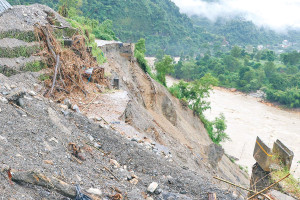
The sudden surge in vehicular traffic follows a catastrophic landslide at Krishnabhir in Dhading, which has completely closed the Prithvi Highway—Kathmandu’s primary lifeline—for the past two weeks. The diversion has funnelled thousands of capital-bound vehicles onto alternative routes, including the Tribhuvan Highway, Kanti Lokpath and the Hetauda–Bhimphedi–Kulekhani shortcut through Phakhel and Sisneri.
As the country’s oldest highway, the Tribhuvan Highway is bearing the brunt of heavy freight traffic. Drivers report that operating 12-wheeler multi-axle trucks and large buses on the narrow corridor is exceptionally challenging.
“At many bends, the turning radius is insufficient, requiring us to reverse continuously to align the vehicle,” said Hareram Karki, a driver of a 12-wheeler freight truck. “With steep ascents, narrow turning points and continuous winding roads, travelling from Hetauda to Kathmandu currently takes anywhere between 10 and 15 hours.”
Karki added that drivers unfamiliar with the Tribhuvan Highway face severe difficulties, leading to frequent mechanical breakdowns that leave disabled vehicles stranded along the highway shoulders.
On Saturday, the highway was blocked for three hours from 6am after a bus broke down at Barhaghumti along the Tribhuvan Highway.
The Tribhuvan Highway stretches 132 kilometres from Hetauda to the Thankot entry point to the capital. The unprecedented congestion on the narrow road has caused frequent accidents and severe gridlocks.
Yadav Subedi, spokesperson and engineer at the Division Road Office in Hetauda, highlighted the historic nature of the crisis. “This highway, which typically accommodates only 50 to 60 vehicles a day, is currently handling over 6,000 heavy freight trucks and passenger buses daily,” said Subedi. “The high volume of heavy traffic on such a narrow road structure is causing immense pressure.”
Superintendent of Police Shyam Bahadur KC of the District Police Office in Makawanpur confirmed that around 6,000 cargo and passenger vehicles are using the Tribhuvan Highway daily to enter the capital.
Meanwhile, the District Administration Office in Makawanpur has managed traffic by routing heavy trucks and buses with more than 14 seats via the Tribhuvan Highway, directing smaller vehicles through the Bhimphedi-Kulekhani road and instructing empty returning vehicles to use the Kanti Lokpath.




 19.15°C Kathmandu