Farmers in Bidur Municipality, Nuwakot, had spent the past two years adopting climate-resilient farming practices. Alongside paddy, they were growing millet and soybean.
Thirty farmers in the area had also received training to promote indigenous crops through a collaboration between the Food and Agriculture Organisation and the National Agriculture Genetic Resources Centre, commonly known as the gene bank. They had been provided with new varieties of paddy seeds, while machines and ovens had recently been distributed to help turn locally produced millet into bakery products.
But some farmers may never get to use the equipment.
Six farmers involved in the project have been missing since the Bhotekoshi floods, said Sudha Sapkota, head of the monitoring and evaluation division at the Nepal Agricultural Research Council. Other farmers have also lost their fields and crops to the floods.
The floods have dealt a major blow to efforts to promote indigenous crops as a way to help farmers cope with climate change, she said after returning from an inspection visit.
“Many farmers have lost their fields and crops, while some no longer have farmland to cultivate,” Sapkota said. “Farmers who were planning to start production and increase their income are now anxious and unsure about how to move forward.”
Farmers had been encouraged to expand climate-friendly paddy varieties such as Ram Dhan and Sabitri. But the floods have weakened the foundation of local food production, Sapkota said.
“The floods have severely affected farmers’ hopes of earning an income from their produce and have also affected local food consumption,” she said. “This is likely to weaken the supply system.”
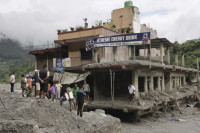
The Bhotekoshi floods have caused extensive damage to agriculture and food production. With large areas of farmland, fields and crops damaged, stakeholders warn that food production in the affected areas will fall.
According to a preliminary report by the National Disaster Risk Reduction and Management Authority, 1,806 hectares of agricultural land have been damaged by the floods.
The authority’s initial rapid assessment of damage and needs estimates that the loss of agricultural land will also reduce food production.
Food production in the affected areas is expected to fall by 7,686 tonnes, said Shanti Mahar, spokesperson for the authority.
“These figures are from the preliminary assessment,” she said. “We will update the figures and publish a more detailed report once the full assessment is completed.”
Ram Prasad Pyakurel, a leading farmer in Bidur municipality, said paddy fields had suffered extensive damage. Both hybrid and indigenous varieties of paddy were being grown there, Mahar said. Soybeans and pulses planted along the field bunds have also been destroyed.
“Paddy has suffered the most damage,” she said. “The pulses and soybeans planted along the field bunds have also been wiped out.”
Experts warn that damage to farmland and crops during the main farming season will disrupt food supplies. It could also increase Nepal’s dependence on imports and put upward pressure on consumer prices.
Prakash Kumar Shrestha, a former vice-chair of the National Planning Commission, said damage to agricultural land and productive assets could have wider economic consequences.
The fall in agricultural production could force Nepal to increase food imports to meet domestic demand, he said.
“The floods have had a major impact on agricultural land. Once production falls, domestic output will not be enough to meet demand and imports will inevitably rise,” Shrestha said. “That creates a risk of higher food prices and broader inflation.”
The floods have damaged not only agricultural output but also productive assets, potentially affecting investment in the coming years, Shrestha said.
According to Department of Agriculture data, 98.48 percent of paddy planting had been completed this year. With planting completed on time compared with last year, officials had expected paddy production to increase.
But the destruction of crops has now raised the risk of higher imports, Sapkota said.
Nepal imported paddy and rice worth more than Rs32.5 billion in the last fiscal year, 2025-26.
“Food imports are already rising in Nepal. With crops washed away by the floods, there is a further risk that imports will increase,” Sapkota said.




 15.48°C Kathmandu