Floods revive questions over an abandoned mountain airstrip
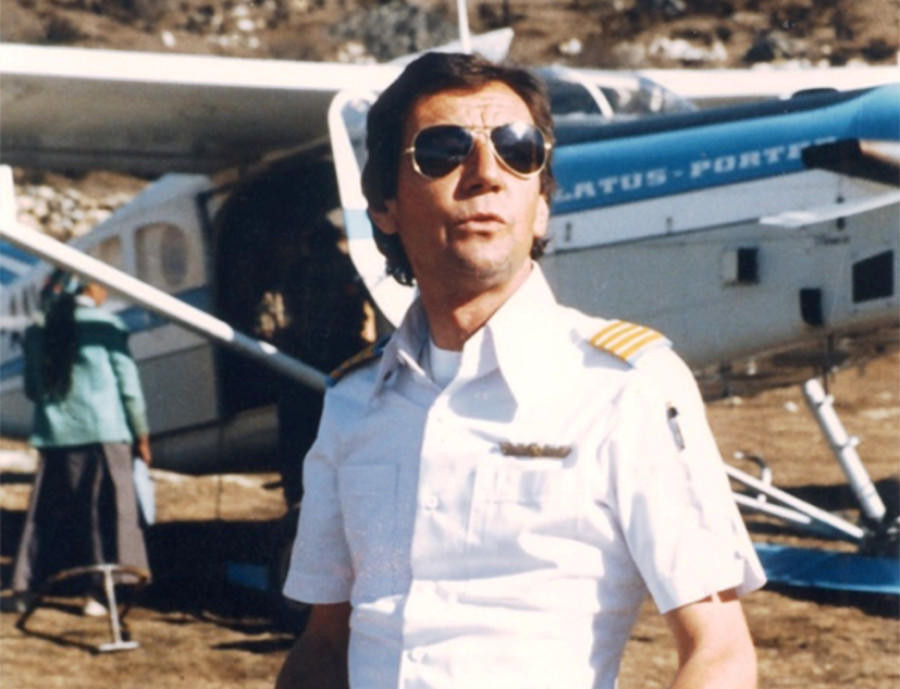
Langtang airport sits at an elevation of 3,658 metres above sea level. Captain Hardy Furer returning in the Pilatus Porter aircraft after rescuing an injured person. Photo: Courtesy of UNDP
When devastating floods tore through the river basins lying at Rasuwa and Nuwakot last week, reaching the affected areas by air became a challenge of its own.
The landscape had been altered by landslides and flooding, while there was no air traffic control tower to coordinate the dozens of military and civilian helicopters involved in the rescue effort. During the emergency, helicopters had to operate under military supervision from an open area at the Nepal Army’s training centre in Trishuli.
The disruption has revived memories among veteran aviation officials and pilots of an airstrip that has been largely forgotten by a younger generation: Langtang airport.
For those who came of age after Nepal’s political transition in 1990, the airport is little more than a name in official records. But for older aviation professionals, its short, rough runway in the mountains of Rasuwa represents something that could have been valuable during the latest disaster.
The crisis has revived debate over whether an operational Langtang airport could have eased the pressure on helicopter rescue operations.
Five helicopter trips carrying people or relief supplies could potentially have been replaced by a single small aircraft flight, while an operational airport with communications and air traffic management infrastructure could also have helped organise helicopter movements more efficiently.
“If the Langtang airport had been operational, it could have provided significant support for relief and rescue operations,” said Gyanendra Bhul, an information officer for the Civil Aviation Authority of Nepal and an air traffic controller.
The scale of the aviation operation during the disaster illustrates the potential value of such an alternative. Military and civilian flight records show nearly 1,000 take-offs and landings in Trishuli and surrounding areas over the course of a week.
With an airstrip capable of handling small, 19-seat aircraft and equipped with communications facilities, authorities might have reduced some of their dependence on helicopters to search for hundreds of missing people, transport relief supplies and carry out charter flights.
It could also have created room for more helicopter operations by taking some of the transport burden off them.
That makes the story of Langtang more than the history of a closed airport. It raises a broader question about how governments assess infrastructure in a country repeatedly exposed to earthquakes, floods and landslides.
Lalit Bikram Shah, a former director general of the aviation department, said the value of an airport should not be judged only by the revenue it generates during normal operations.
The lives it can help save during a disaster also have to be considered, he said, even though such a value cannot be measured in cash.
Several decades ago, single-engine Pilatus Porters operated from the airstrip, carrying tourists, project supplies and charter passengers into a part of Rasuwa that had no road access.
At the time, the airport itself was major infrastructure.
Today, Langtang remains listed in the official records of the Civil Aviation Authority of Nepal, including with an International Civil Aviation Organisation airport code, merely as “airport not in operation”.
The airport sits at an elevation of 3,658 metres, or about 12,000 feet, above sea level. Its runway is 420 metres long and 30 metres wide and has an unpaved surface.
There is no fuel facility, rescue service or fire-fighting service, according to the authority’s current airport records.
On paper, the airport still exists. In an emergency, however, it cannot be used as an operational air link.
That distinction has become particularly stark after the latest floods.
Langtang’s aviation history began not with large aircraft but with the small, single-engine Pilatus Porter, a rugged aircraft capable of operating from short mountain runways.
Shah, 81, who became the first Nepali to serve as a regional director of the International Civil Aviation Organisation, remembers the airport before it fell into disuse.
Regular scheduled passenger services were not necessarily its most important function. Charter flights, development projects and flights operated for various organisations were central to its role.
“Passenger charter flights were also operated,” Shah told Kantipur on Friday, recalling the period before 1990.
Foreign development projects used the airstrip to transport equipment and supplies. Essential goods, including food, could also be flown into the remote mountain region.
Shah remembers four Pilatus Porters operated by then Royal Nepal Airlines, as well as aircraft operated by the United Nations Development Programme and the US government, conducting specialised operations from Langtang.
The aircraft were suited to the short runway and difficult terrain.
Former Nepal Airlines pilot Kundan Giri remembers a similarly active airstrip, with flights carrying tourists as well as local charter passengers, project supplies and relief material.
“If the airport had remained operational, this disaster would have been easier to manage,” said Giri, a senior captain. “An airport from which aircraft can operate is a lifeline.”
Giri said the runway could be approached from either direction and that there had been potential to extend it if necessary.
A larger aircraft was once considered
There had even been attempts to determine whether Langtang could accommodate a larger aircraft.
Veteran pilot Phizo Nath Nepali said studies were carried out in the late 1980s on the possibility of operating Twin Otters from Langtang and other mountain airstrips, including Syangboche.
Nepali himself landed a Pilatus at Langtang as part of efforts related to the proposal.
The transition to Twin Otter operations never materialised. After the political changes of 1990, Nepal Airlines did not have enough aircraft to start the service, Nepali said.
According to his recollection, the airport had begun operating in the 1970s, initially with foreign pilots flying the Pilatus Porter. As those pilots left Nepal, the pool of Nepali pilots willing to fly single-engine aircraft became smaller.
“The end of the Pilatus Porter in Nepal was not simply a runway issue,” Nepali said. “The generation of aircraft and pilots was also changing.”
Nepali said other pilots, including Bishal Dewan and Manoj “Juju” Shrestha, later flew Pilatus aircraft from Langtang and other short mountain airstrips.
A study around 1988 examined whether relatively modest improvements could allow Twin Otters to operate from Langtang.
According to Nepali, the conclusion was that the runway could accommodate the aircraft with some extension and improvements.
“If the runway had been extended a little, a Twin Otter could have operated there quite comfortably,” he recalled.
Local residents supported the idea, unlike in Syangboche, where some tourism operators opposed it. They feared that allowing tourists to fly directly into Syangboche would reduce the two-day trek and hurt local hotels and other businesses.
Langtang did not face the same resistance, Nepali said.
Suraj Kunwar is a senior correspondent with over two decades experience covering Aviation, Tourism and Mountaineering. He received the IFJ Tolerance Award in 2005.




 22.94°C Kathmandu