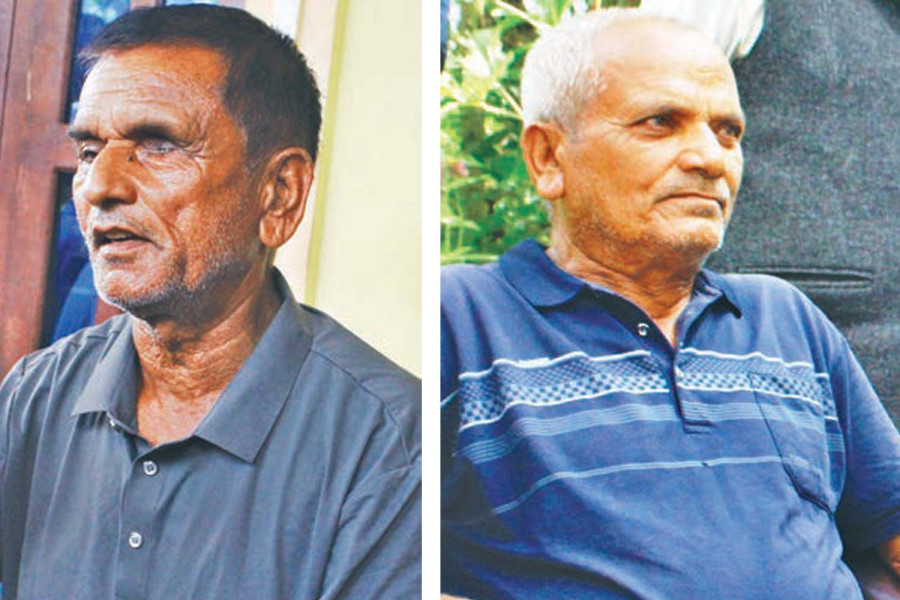
Six passengers jumped off a bus carrying 36 pilgrims from Palungtar, Gorkha, to Gosainkunda as the Bhotekoshi flood struck in Nuwakot. Two bodies have been recovered, while 28 remain missing. Badri Prasad Devkota (left) and his cousin brother Tularam Devkota of Palungtar in Gorkha saved themselves by jumping off their pilgrimage bus last Wednesday. Their families and neighbours travelling with them to Gosainkunda remain missing. Hariram Upreti/TKP
When the sacred festival of Janai Purnima approached, the residents of Majhtar in ward 5 of Palungtar Municipality in Gorkha decided to embark on a holy pilgrimage to Gosainkunda in Rasuwa. Early on Wednesday morning, 36 people boarded a chartered bus, their hearts filled with devotion. Hours later, as the vehicle reached Bhainse in Nuwakot, a sudden, violent flood on the Bhotekoshi river swept the vehicle away.
Five days after the disaster, the bus with the registration number Ga 2 Kha 1152 remains missing. Authorities have recovered two bodies, six passengers survived by jumping off the moving vehicle, and 28 remain missing. Among the survivors are Badri Prasad Devkota and his cousin Tularam Devkota, who returned home to Palungtar on Friday bearing deep bodily injuries and agonising grief. Both men survived, but their wives and neighbours remain missing along with the bus.
Back in their quiet village, Badri Prasad breaks down whenever he speaks of his wife Samjhana, while Tularam is inconsolable over his missing wife Tej Kumari.
"I was sitting right behind the driver when a passenger in another seat asked him to stop so he could relieve himself," Badri Prasad recalled. "The driver did not stop because we were travelling at speed. But as we reached the bend at Bhainse, the driver froze upon seeing the floodwaters ahead. The passenger who needed to step out immediately jumped off. Tularam moved forward to see why he had jumped."
Badri Prasad looked out the window and saw a wall of murky water rushing towards them. "I saw a dark plume of water that looked as if it would cover the entire sky," he said. "Thinking that I had to leap whether I lived or died, I stood up. My wife grabbed my hand and pleaded, 'Do not jump.' I told her, 'We will die here,' broke free from her grip, stepped over a bag in the aisle, and threw myself out the door."
Moments after Badri Prasad landed, the bus engine stopped. He scrambled to run, but a violent wave crashing against the vehicle knocked him into a roadside drainage ditch. "Even as the heavy mud struck me, I did not lose consciousness. Then a second wave surged over us. I looked up and saw my brother Tularam clinging to a bush on the hillside," he said. "I grabbed onto a shrub and looked back just in time to see the bus submerged completely. It never surfaced again."
Perched on the steep hillside just two cubits above the roadside drain, the survivors watched helplessly as the torrent swallowed their loved ones. "Covered in thick mud, we looked like wooden logs," said Badri Prasad. "My wife was inside that bus. My neighbours were inside. I immediately felt immense regret for leaping out. My family was gone. I screamed at the top of my lungs, but there was no one to hear us."
Clinging to bushes, Badri Prasad and Tularam dragged themselves up the cliffside, scanning the Trishuli river in vain hopes of spotting survivors. "After climbing about 20 metres, we reached a small patch of grass and stayed there for two hours," said Badri Prasad. "Looking down at the site where the bus vanished, we saw people stranded on rooftops crying for help, while others had only their hands protruding from the mud. When the immediate torrent subsided, a helicopter finally arrived. Realising an immediate rescue was unlikely, we climbed higher to Hilekharka village."
In Hilekharka, compassionate locals provided them with tea and biscuits before assisting them to Suryagadhi Rural Municipality for basic first aid. Driven by desperate hope, the survivors returned to Bhainse the following day to search for their families. Finding no trace, they travelled back to Gorkha on Friday via Kulekhani in Hetauda.
Tularam's anguish matches his cousin's. "When we planned the pilgrimage, neighbours sent their wives, daughters, and daughters-in-law, believing they would be safe with us," said Tularam. "I am consumed by regret that I could not bring them back." Before returning home, Tularam visited the disaster site twice, searching in vain.
He believes early warnings could have averted the catastrophe. "If the government had issued timely alerts to downstream areas as soon as the flood began upstream, human losses would have been significantly lower," said Tularam. "We only realised the danger when the water hit the road and touched our vehicle. Effective communication along the Trishuli corridor could have prevented this immense tragedy."
Tularam noted that the disaster has devastated the entire village in Gorkha. "There is no one left to unlock the doors of many homes. Some children have been left behind while both their parents are missing," he said.
Silence now hangs over Naukhor settlement in Palungtar. Search parties have scattered across riverbanks from Nuwakot to Nawalpur. Those offering condolences to grieving families invariably pass the silent home of Dil Bahadur Khatri and his wife, Murari.
At Dil Bahadur Khatri’s house, corn remains spread out in the courtyard, untouched for five days. The front porch light, switched on before the couple departed early Wednesday morning, remains lit. “There were only the two elderly occupants in this house, and both went missing during the pilgrimage,” said neighbour Ram Chandra Khatri. “The doors remain locked, and we have deliberately chosen not to break the lock. We come in the morning and evening, look at the house, and return.”
Dil Bahadur’s two daughters live abroad—the eldest in the United Kingdom and the youngest in the United States. “It was easy for the elderly couple to travel because they had no livestock to tend to,” said Ram Chandra. “We decided not to break the lock because their eldest daughter is currently preparing to fly back to Nepal from the UK.”
For the grieving families of Palungtar, the lack of timely warnings has transformed a holy pilgrimage into an enduring nightmare, leaving an entire community searching for answers along the muddy banks of the Trishuli.




 15.61°C Kathmandu
.jpg)