Washed-out bridges force flood-hit communities to rely on choppers
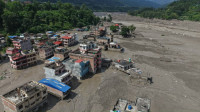
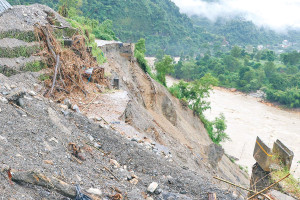
Damage to key roads and bridges has disrupted relief, healthcare, education and trade across Rasuwa, Nuwakot and Dhading.The bridge over Phurkekhola that connected Gajuri and Siddhalek in Dhading was smashed and swept away by floodwaters, Wednesday. Nepal photo library
When floodwaters swept away the bridge over the Trishuli river, a routine journey between neighbourhoods in the same municipality became a helicopter operation.
As many as 40 students and teachers stranded at the Tribhuvan Trishuli Secondary School in Trishuli Bazar were airlifted to Bidur on Friday by a Nepali Army chopper. Another 10 to 15 students and teachers were still waiting to be evacuated, said school principal Rajendra Dawadi.
“We have reached a point where a helicopter is needed to travel between wards of the same municipality,” Dawadi told Kantipur. “The helicopter that came to evacuate us also carried students and residents stranded in Trishuli Bazar back to Bidur.”
Those unable to leave have taken shelter in community buildings and covered halls that survived the flood. The school has lost contact with the Trishuli Hospital area and parts of Bidur.
“The river is flowing through the school grounds. We have students on both sides. There is no way we can resume classes immediately,” Dawadi said.
The school had 1,400 students.
Prabha Bogati, deputy mayor of Bidur Municipality, said about 100 children stranded on either side of the Trishuli were rescued on Friday.
“We were able to bring around 100 schoolchildren stranded on both sides of the Trishuli river back into their parents’ arms,” she wrote on Facebook.
But the evacuation was not complete. Rabindra Nepal, ward 7 chair, said another 40 to 50 people could not be moved across the river.
“The lack of roads and bridges has made even relief and rescue operations difficult,” he said.
The Trishuli-Betrawati road, the main route to Rasuwa, has been extensively damaged. In Dhading, the bridge over the Trishuli river at Phurke Khola near Malekhu was also swept away, cutting off access to the district headquarters from the Prithvi Highway.
The Baireni-Mugling section of the Prithvi Highway, which had been blocked for three days, reopened on Friday evening, said Shuvaraj Neupane, spokesperson for the Department of Roads.
The Department of Roads said the Bhotekoshi flood had damaged about 40 kilometres of road between Rasuwagadhi and Malekhu and destroyed or damaged 41 bridges. Damage to roads, bridges and related infrastructure alone has been estimated at Rs20 billion.
The government has sought help from India and China to install 42 Bailey bridges to restore connectivity.
Neupane said the department was working to repair alternative roads and reopen routes into the flood-hit districts.
“A committee has been formed to conduct a full assessment of the damage. For now, we are working to open an alternative route up to Dhunche in Rasuwa,” he said. “Once we receive the assessment report, we will determine how the damaged infrastructure should be rebuilt.”
Roads gone, patients stranded
In Rasuwa’s Uttargaya Rural Municipality, the destruction of roads and bridges has also made it difficult to evacuate sick and injured people, said Madhav Lamichhane, a teacher at Nilkantha School.
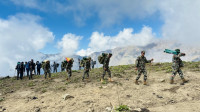
“Every bridge between Trishuli and Betrawati has been washed away. The road has been buried under mud, and in many places there is barely any trace of it left,” Lamichhane said by telephone. “Relief supplies have not been able to reach the village either. An Armed Police Force team arrived only today [Friday], to help with the rescue.”
Injured people from Betrawati have been sent to Kathmandu through Dhunche for treatment, he said.
Students who normally cross the river to attend school in Shanti Bazar have also been trapped at a school for three days because there is no road or bridge.
“We have been feeding about 450 students and residents with food bought under the school’s midday meal programme,” Lamichhane said. “Relief supplies have not been able to reach us from the army barracks in Bidur.”
Chameli Gurung, deputy chair of Uttargaya Rural Municipality, said Rasuwa had effectively been cut off from the rest of the country, disrupting relief and rescue efforts.
“Some medical supplies were flown in by helicopter today. With the roads completely blocked, relief and rescue operations have also become extremely difficult,” she said. “A large number of people are trapped across the rural municipality because they cannot travel to their destinations. We are providing them with food and shelter.”
The devastation has also severed the road connecting Nepal with Tibet.
About 80 Nepali container truck drivers are stranded in Kerung, Tibet, with their vehicles because the road has been cut off.
Krishna Bahadur Lamichhane, one of the drivers stranded in Kerung after travelling there to collect cargo, said the group had registered their names with Chinese authorities.
“About 80 stranded drivers have given their names to the Chinese administration. We are waiting in the hope that the government will make arrangements for us to return to Nepal,” he told Kantipur over WeChat.
Rasuwa Chief District Officer Narendra Pariyar said the exact number of Nepali citizens stranded in Kerung was not known, but returning through the Rasuwagadhi border was currently not an option.
“It is not possible to bring them back through Rasuwagadhi. The road linking Rasuwagadhi to Dhunche has suffered extensive damage, and many bridges have been washed away. It could take months just to reopen the road,” he said. “We have also been carrying out relief and rescue operations by helicopter.”
The Rasuwa administration said it would coordinate with the Home Ministry to explore an alternative route for bringing the stranded drivers back home.
The drivers are in Kerung, about 30 kilometres from Rasuwagadhi.
Searching for a lifeline to Dhadingbesi
The disruption has left residents of Dhading cut off from Kathmandu and other parts of the country.
Ran Bahadur Sikarmi of Chainpur in ward 7 of Jwalamukhi Rural Municipality had set out for Kathmandu three days ago for treatment of a wound on his foot. He had visited Dhading Hospital the previous week and been advised to seek treatment at a better-equipped hospital in the capital.
Instead, he has been stuck in Dhadingbesi.
“The road is blocked, and I have no idea how long I will have to stay here. I am now trying to find some way, somehow, to get to Kathmandu,” he said.
Pratik Simkhada of Siddhalek who studies in Kathmandu, has also been unable to return to the capital. He is increasingly worried about missing classes.
Their problems are shared by residents across Dhading. Patients cannot reach Kathmandu for treatment. Students and workers cannot get back to the capital. Vehicles are stranded on roads, while vegetables and fruit ready to be taken to market are piling up in villages. Supplies of basic goods arriving from outside the district headquarters have also been disrupted.
Dhadingbesi was cut off from the national highway after the devastating flood swept away bridges over the Trishuli river.
Three concrete bridges between Galchhi and Malekhu were destroyed, severing the main road linking the district headquarters with Kathmandu and other cities.
The loss of road access has disrupted transport and supplies, although there is no immediate shortage of food in Dhadingbesi, said Tilak Simkhada, general secretary of the Dhading Chamber of Commerce and Industry.
“Stocks in the market are enough to meet immediate needs, but if the road remains closed for much longer, pressure on supplies will increase,” he said. “The big concern now is how to maintain transport and supply until the bridges are rebuilt.”
At Malekhu, the concrete bridge over the Trishuli at Phurke Khola was washed away. Two other bridges between Galchhi and Malekhu were also damaged.
The collapse of the bridges has shut the main road to Dhadingbesi through the Prithvi Highway. Landslides have blocked several sections.
Clearing landslides alone will not solve the problem. With the bridges gone, regular traffic cannot resume in the immediate future.
The disruption has hit both the district headquarters and rural communities. Vehicles travelling from Kathmandu and other cities to Dhadingbesi have been stuck. This has disrupted deliveries of basic goods.
The impact has reached farmers’ fields as well.
Since the highway was blocked on Wednesday, farmers have struggled to get vegetables and fruits to markets, and much of their produce has spoiled.
Anjana Tamang of Chamabas, near Malekhu, said her bananas were ripening faster than she could sell them. She has already distributed bananas to a nearby old-age home, security personnel involved in rescue work and travellers stranded along the road.
“They were ready to be sold, but after the road was closed the bananas began ripening and are now at risk of going to waste,” she said.
The blockade has created a two-way supply problem. Farmers cannot get their produce to market, while essentials and goods from outside cannot reach consumers.
The longer the disruption continues, the greater the losses are likely to be for farmers producing perishable crops, Tamang said.
The impact has been particularly severe for patients travelling to Kathmandu. People referred by district health facilities to hospitals in the capital and other cities have been unable to travel.
Authorities are now searching for alternative routes to keep Dhadingbesi connected to the country.
The most practical option appears to be the road from Galchhi via Phosretar and the old district headquarters at Sunaula Bazar to Dhadingbesi.
A team including businessman Ashok Adhikari reached Dhadingbesi by jeep using this route on Thursday. Adhikari said the road could carry light and medium goods vehicles if landslides that occurred during the monsoon are cleared and the surface repaired.
The route is about 60 kilometres from Galchhi to Dhadingbesi.
Opening it as an emergency alternative to the main highway could help restore supplies of food and other essentials to the district headquarters, Adhikari said.
Another option is the road from Galchhi through Mashtar and Siddhalek to Dhadingbesi. Parts of that route have also been damaged and currently allow only motorcycles to pass.
Sabita Aryal, deputy chair of Siddhalek Rural Municipality, said work was under way to clear the worst obstructions and make the route usable by other vehicles.
“It is essential to upgrade local roads immediately so they can serve as alternative routes to the district headquarters. Priority should be given to vehicles carrying food, medicines and emergency services,” she said.
A third option is the route from Benighat through Gorkha’s Ghyalchok and Arughat, then via Salangtar in Dhading. The route is about 100 kilometres long.
The road from Benighat to Salangtar is gravelled, while the section beyond Salangtar is blacktopped. Regular vehicles are currently operating between Benighat and Aarughat.
For communities cut off by the flood, however, even these routes are more than transport links. They are increasingly the only remaining lifelines for food, medicine, patients, students and families waiting to be reunited.




 14.61°C Kathmandu