Barrier lake near China border breaches, raising fresh flood threat in Nepal
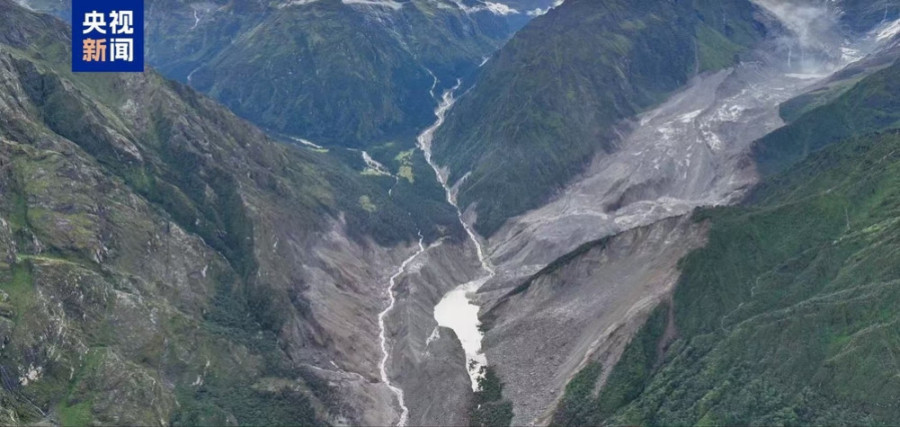
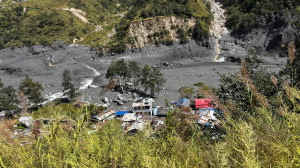
Nepal prepares aerial reconnaissance in Rasuwa after a report that the lake, formed by floodwaters near the Chhochen Khola-Purepu Tsangpo confluence, has breached.A barrier lake formed near the confluence of the Chhochen Khola and Purepu Tsangpo rivers. Photo: CCTV
A large barrier lake formed near the confluence of the Chhochen Khola and Purepu Tsangpo rivers has reportedly breached, raising fresh concerns of another surge of water into Nepal’s Bhotekoshi river.
Rasuwa Chief District Officer Narendra Pariyar said on Friday that the Nepali Army had just informed him that the lake had breached.
The development comes a day after Chinese authorities warned that the lake, formed by flooding near the confluence, was already overflowing and faced a high risk of breaching as more water flowed into it.
National Disaster Risk Reduction & Management Authority said the water level in Bhotekoshi river has surged.
Nepal is now preparing to conduct aerial reconnaissance over the Bhotekoshi and surrounding areas in Rasuwa to assess the potential impact of the reported breach.
An official at the Rescue Coordination Centre at Tribhuvan International Airport said helicopters already stationed in Dhunche and other parts of Rasuwa would be deployed for the reconnaissance. No additional helicopters will be sent from Kathmandu for the operation, the official said.
“Information has come that the lake on the Chinese side has breached. So, preparations are underway to send helicopters stationed in Dhunche and Rasuwa for reconnaissance,” the official said.
The reconnaissance is intended to assess the situation along the Bhotekoshi and identify areas that could face additional risks following the reported breach.
China’s Ministry of Water Resources had estimated the lake’s volume at about 2 million cubic metres as of Thursday morning. Another 3 million cubic metres of water was expected to enter the lake over the following three days, according to Chinese state media reports cited by the Global Times.
Chinese authorities had said they were closely monitoring the lake, conducting flood simulations and carrying out hydrological analysis to assess the consequences of a possible breach and prepare for emergency rescue and flood-control operations.
The Chhochen Khola and Purepu Tsangpo originate in Tibet and merge before crossing into Nepal, where the river is known as the Bhotekoshi. The Bhotekoshi is the principal upper tributary of the Trishuli river.
The reported breach comes two days after a sudden and powerful flood swept through areas along the Nepal-China border, killing people, destroying infrastructure and leaving hundreds missing.
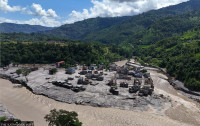
The flood struck the Bhotekoshi river in Rasuwa on Wednesday morning. The torrent swept through Timure and Syaphrubesi, damaging roads, bridges, buildings and other infrastructure before moving downstream towards the Trishuli river.
Nepali security forces and rescue teams have been searching for people swept away by the flood, while bodies have been recovered from several districts downstream. Authorities have restricted movement along key highways and moved residents from vulnerable areas as they assess the possibility of further flooding.
The reported breach of the newly formed lake adds another complication to the rescue operation. A sudden release of water could generate another surge downstream, potentially affecting settlements, roads, bridges and other infrastructure along the Bhotekoshi and Trishuli river systems.
Meanwhile, coordination of helicopter rescue and relief flights has been strengthened at the Rescue Coordination Centre at Tribhuvan International Airport following complaints that coordination had not been effective enough in the immediate aftermath of Wednesday’s flood.
The centre is now coordinating helicopter operations under the leadership of Law Minister Sobita Gautam, according to the airport official.
The RCC was previously operated under the leadership of a colonel from the Nepali Army’s 11 Brigade on Thursday. On Wednesday morning, when the flood struck, a joint-secretary from the Home Ministry coordinated the centre after a deputy secretary initially took responsibility. The joint-secretary continued to oversee the centre from Wednesday evening.
The RCC includes representatives from helicopter operators, Tribhuvan International Airport, Nepal Police, the Nepali Army, the Armed Police Force and weather-related agencies. It is activated during disasters, particularly to coordinate aerial rescue and relief flights.
Nepali authorities have yet to release a detailed assessment of the reported lake breach or confirm the volume of water released into the Bhotekoshi. The planned aerial reconnaissance is expected to provide a clearer picture of the situation and the potential risks to downstream communities.
Suraj Kunwar is a senior correspondent with over two decades experience covering Aviation, Tourism and Mountaineering. He received the IFJ Tolerance Award in 2005.




 14.95°C Kathmandu