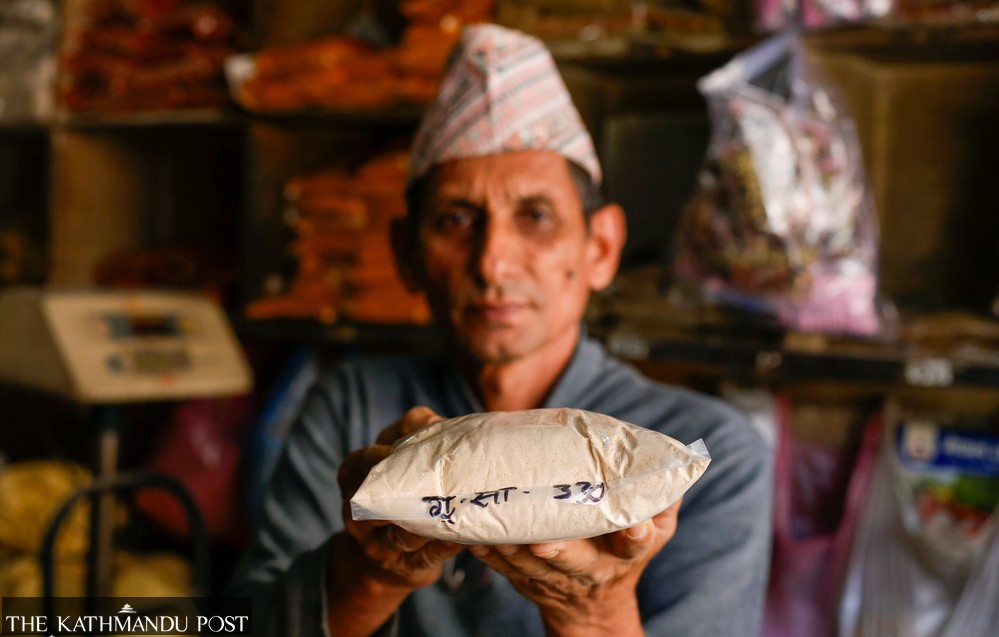
Once a humble village staple, satu is finding a new market among health-conscious urban consumers, with producers expanding into supermarkets and even overseas markets. Packets of different varieties of satu can now be found lined up in grocery stores, organic farmhouses and large marts across the Kathmandu valley.
Durga Baral of Kathmandu Greenland says she gives satu to her daughters as a morning snack every day.
“It is not good to give children biscuits all the time. I usually give them satu as a snack,” she said.
Baral said she and other members of her family also consume satu.
“We buy satu from a farmhouse. We can see them making it right in front of us. That makes us trust the product, so we buy and eat it from there,” she said.
Made by combining roasted maize, soybeans, chickpeas and barley into a snack mix or a multigrain powder, satu was once a common source of nutrition, particularly for children and elderly people in villages.
In the modern era, however, the fibre-rich traditional food lost its charm as fast-moving consumer goods (FMCG) and packaged foods made their way into villages and quickly gained dominance.
Now, satu is finding favour among urban consumers as a healthy snack. Demand for satu began to grow in urban areas after the Covid pandemic, as people increasingly started looking for healthier diets.
Packets of different varieties of satu can now be found lined up in grocery stores, organic farmhouses and large marts across the Kathmandu valley. Producers say demand has also been growing in other urban areas, driven by busy lifestyles, growing health consciousness and the search for alternatives to junk food.
Asbin Sapkota is an engineer by profession, but the 37-year-old from Baglung runs Dhikijanto Pvt Ltd, one of the leading retail stores selling traditional foods in Banasthali, Kathmandu.
Sapkota and his friends jointly started the business in 2021. The store sells satu along with a variety of agricultural products.
“Nowadays, mixed and special varieties of satu are popular among customers. The special satu contains dry fruits such as almonds, cashews and walnuts as well.”
The startup has expanded beyond the Kathmandu valley and reached overseas.
Sapkota said the company sends satu to markets such as Biratnagar, Chitwan, Butwal and Pokhara. “It is not just in Nepal. Nepalis living in countries such as Australia and New Zealand also order satu,” he said.
Dhikijanto sells between 300 and 400 kilograms of satu a month. “Sometimes demand is much higher. Once, an organisation ordered 2,000 kilograms of satu at once for children’s nutrition,” Sapkota said.
Dhikijanto purchases grains from districts including Mustang, Rasuwa, Jumla, Mugu and Dolpa. Sapkota says the store stocks around 70 to 80 types of products, including buckwheat, millet, wheat and maize flour, chyankhla, lentils and various pulses, as well as potatoes and garlic from Mustang.
Another familiar name among satu enthusiasts is “Kainla Dai Ko Satu”, based in Kapan Dhungedhara.
Narayan Raj Chaulagain, known as “Kainla Dai”—a traditional Nepali birth-order name given to the fourth son in a large family—has been in the satu business for the past six years. In the early days, Chaulagain sold pulses, spices and other local products. As demand for satu began to grow, he started commercially producing the ordinary satu traditionally made in villages.
“We initially started the business by selling local pulses and spices,” he said.
Chaulagain produces different varieties of satu based on customer preferences. He says he sources maize, chickpeas and other pulses needed to make satu from local farmers whenever possible.
“We bring products from districts such as Dolakha, Sindhupalchok and Kavrepalanchok. During the off-season, we bring maize from the Tarai. Our objective is to promote local production,” he said.
Chaulagain has also observed that health-conscious customers have increasingly started consuming satu as a light meal. As the business has expanded, he says they have also focused on maintaining the quality of their satu.
“At first, we mixed the ingredients based on our own experience. Later, we began producing satu after conducting laboratory tests for protein, calories and carbohydrates,” he said. “We maintain the same quantity and quality every time we make satu.”
Based on sales and conversations with consumers, Chaulagain said satu is popular among people ranging from children to the elderly.
It has also become easier for businesses to promote their products in recent years. Chaulagain said orders often come after promotional content about their products is posted on social media.
“Because of social media, the business has started reaching customers across the country and Nepalis living abroad, beyond the local market. It makes us happy,” he said.
“Kainla Dai” produces around 100 kilograms of satu a day and employs five people. He said mixed satu is sold for Rs550 per kilogram, while barley and chickpea satu costs Rs300 per kilogram.
The production and sale of satu is no longer limited to small and cottage industries. Some businesses have begun producing it on an industrial scale and taking it to international markets.
Producers say demand has also been growing in other urban areas, driven by busy lifestyles, growing health consciousness and the search for alternatives to junk food.
Poshilo Foods Pvt Ltd, established by Prithvi Kalyan Parajuli in Pokhara-18 in 2021, has been producing satu. The company, which began operations with an investment of Rs10 million, recently expanded its production facility to Jhapa as well. The company exports its products to the United States via India. Through a partnership with exporter Manaram Group, a major exporter of dog chew to the US, Poshilo has carved out its own space in the international market.
During the Covid pandemic, Parajuli had completed his BBA in Business and Market Management. Rather than seeking a job, he aspired to start his own business.
After conducting market research for a year, he founded Poshilo Foods at the age of 23. He raised Rs10 million by selling shares, seeking family support and taking a bank loan.
The company began production with an initial output of 100 kg of satu on its first day.
Gradually, production increased to 150 kg, then 200 kg and eventually 400 kg.
According to Parajuli, between September 2025 and February 2026, more than 1.5 tonnes of satu were shipped to the United States, where it is now available in around 200 stores.
Panu Paudel, chief operating officer of Bhat-Bhateni Supermarket, Nepal’s largest supermarket chain, also says sales of satu are growing.
“Many people buy it to eat at home. People used to drink Coca-Cola, but now demand for mohi [buttermilk] has increased. Satu is also gaining popularity in a similar way,” he said.
Satu has emerged as an example of an effort to connect traditional food culture with the modern market.
Nutritionist Ruju Khadka says although satu can be beneficial for health, its quality, production process and consumption method are important.
“Satu is something we consume by mixing it directly in water rather than cooking it. Therefore, the most important things are its packaging and hygiene,” she said. “Nutritionally, satu contains protein, carbohydrates, fibre, small amounts of fat, iron, magnesium, potassium and other nutrients. But if something goes wrong during processing, its nutritional benefits may not be effective.”
Khadka says consumers should be particularly careful when eating satu containing a large number of ingredients.
“Each ingredient in a mixed satu has its own nutritional value. If it contains dry fruits, pumpkin seeds, maize, wheat and other ingredients, it can provide good overall nutrition,” she said. “But because all ingredients have different shelf lives, this needs to be taken into consideration during production.”
Khadka says satu can be consumed by people of all age groups, including children above six months, but the quantity needs to be adjusted.
“Children, older people and young adults all have different nutritional requirements. The amount of satu should be determined based on what else a person eats throughout the day and how much physical activity they engage in,” she said.
She advises people with certain health conditions to be particularly careful when consuming satu.
“If someone has gastritis, they should consume a very small amount of satu and do so carefully. For people with diabetes, satu containing a high proportion of maize or carbohydrates is not considered very suitable. In mixed satu, consumers should also pay attention to which ingredient is present in the highest proportion,” she said.
She also cautions against treating satu as a complete food or a substitute for a balanced diet.
“Satu is a good option, but it cannot be considered a complete source of nutrition,” she said. “It contains both carbohydrates and protein. Therefore, one should not consume large amounts of chickpea satu simply because it is considered a source of protein. Other sources of protein are also necessary.”




 14.72°C Kathmandu