Department to operate in two shifts to ease passport delivery
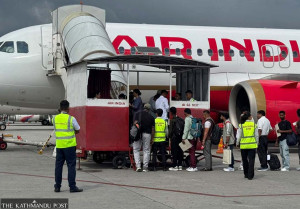
Applicants seeking passports for South Korea’s EPS complain of long waits, technical glitches and missed deadlines as the department extends working hours to tackle the surge. Service seekers queue at the Department of Passports in Tripureshwar, Kathmandu, on Thursday. Dipesh Darshandhari/TKP
Sagar Chhetri travelled to Kathmandu from Dhangadhi solely to obtain his passport. But 12 days after his arrival, he is still waiting to receive the document.
Chhetri, who plans to travel to South Korea through the Employment Permit System (EPS), said he is uncertain whether his passport will be issued before the deadline for submitting the application for the Korean language test.
“Each day, I was told that the passport would be ready soon, but so many days have already passed,” he said. “I have spent significantly on food and accommodation at a hotel.”
Questioning the government’s failure to deliver the service on time, Chhetri asked whether the state would compensate applicants for the expenses they incur while waiting due to administrative delays.
Chhetri’s experience is not unique. Bharat BK, who travelled to Kathmandu from Kalikot to apply for a passport, has also been facing similar difficulties. He arrived in the capital a week ago and is still waiting.
“I paid Rs12,000 for an emergency passport after being told it would be ready within three days,” BK said. “But a week has already passed, and I still do not know when I will receive it.”
As complaints from applicants mounted over delays, technical glitches and long queues, the Department of Passports announced a series of emergency measures, including operating in two shifts and keeping passport services open on Saturdays, Sundays and public holidays to clear the backlog.
The department said the temporary arrangement follows a sharp surge in demand triggered by applications for South Korea’s Employment Permit System (EPS), which exposed bottlenecks in appointment booking, application processing and passport issuance.
According to a notice issued on Wednesday, the two-shift service will run from Thursday until August 7. Services will be available from 7:00 am to 2:00 pm and 2:00 pm to 9:00 pm. The department will also keep its electronic passport (e-passport) services open on Saturdays, Sundays and public holidays from 10:00 am to 4:00 pm.
The Department of Foreign Employment recently opened applications for the Korean language test under the EPS, under which South Korea is seeking 7,200 Nepali workers. The quota includes 5,000 jobs in manufacturing, 2,000 in agriculture and livestock, and 100 each in the service and forestry sectors. Online applications will remain open from July 27 to August 2.
As a valid passport is mandatory for EPS applicants, thousands of prospective migrant workers have rushed to obtain or renew their passports, significantly increasing demand over the past week.
On Wednesday, Chief Adviser to the Prime Minister Kumar Byanjankar (Ben) held discussions with Foreign Secretary Amrit Bahadur Rai and DoP Director General Deepak BK, urging authorities to make immediate alternative arrangements after widespread complaints from applicants struggling to obtain passports.
The department said it has expanded its passport production capacity and is currently printing around 1,500 e-passports a day, with plans to further increase production to ensure timely service.
In a statement, the department said it has continuously been strengthening both its service delivery system and production capacity to provide faster, safer and more efficient passport services.
The department attributed the recent spike in demand largely to applications under South Korea’s EPS programme, while noting that passport demand has also continued to rise because of increasing foreign travel for employment, education, tourism, medical treatment and other purposes.
Officials acknowledged that the recently introduced passport management system has yet to be stabilised fully. Nepal has migrated to a new German-developed passport system, replacing the previous French platform, and the transition has resulted in technical glitches affecting application processing, payment services and passport printing.
Applicants have also complained that only a limited number of online appointment slots are available each day, forcing thousands to wait or repeatedly attempt to submit applications.
The department said technical issues are being addressed on a priority basis in coordination with its technical partners. It expects most of the current problems affecting service delivery to be resolved within a month, while the entire system is expected to become fully stable within three months through ongoing technical and administrative improvements.
The department also said applicants requiring passports urgently for foreign employment, education, medical treatment, family emergencies or other critical reasons would continue to receive priority.
The department has urged citizens to apply for passports during the ongoing system stabilisation period only if their need is urgent.
Anil Giri is a Chief Sub Editor covering diplomacy, international relations and national politics for The Kathmandu Post. Giri has been working as a journalist for more than two decades, contributing to numerous national and international media outlets.




 20.83°C Kathmandu