Roads department deploys heavy machinery as monsoon landslides disrupt highways
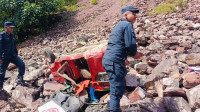
Authorities position 155 machines along vulnerable highways as monsoon landslides repeatedly disrupt traffic across the country. Every monsoon, highways passing through steep hills and river corridors become highly vulnerable to landslides. This year is no exception. Ramesh Kumar Paudel/TKP
The Department of Roads has deployed 155 pieces of heavy equipment along major highways across the country as monsoon-triggered landslides continue to disrupt traffic on key road corridors, with another 122 machines on standby to respond to emergencies.
The move comes as landslides have repeatedly blocked highways in several parts of the country, forcing road closures, traffic diversions and travel restrictions during the peak monsoon season.
Among the worst-hit routes is the Narayanghat-Muglin road, where frequent landslides at Tuin Khola have become an almost daily occurrence, repeatedly bringing traffic to a halt.
Road officials say excavators and technical teams have been stationed at vulnerable locations to clear debris immediately after landslides occur and restore traffic as quickly as possible.
With the landslide risk escalating, the Chitwan District Administration Office has also begun suspending night-time traffic along sections of the Narayanghat-Muglin road based on weather forecasts issued by the Meteorological Forecasting Division.
Following forecasts of heavy rainfall on Saturday night and Sunday, authorities imposed a complete ban on night-time movement along both the Narayanghat-Muglin and Nagdhunga-Muglin road sections.
The threat extends well beyond Chitwan.
Every monsoon, highways passing through steep hills and river corridors become highly vulnerable to landslides. This year is no exception.
Road officials have identified several high-risk routes, including the Kanti Highway, BP Highway, Nagdhunga-Muglin road, the Koshi, Karnali and Kaligandaki corridors, the Sanfe-Martadi, Bhalubang-Pyuthan and Surkhet-Nepalgunj roads, the Mechi Highway, the Galchhi-Trishuli-Syabrubesi-Rasuwagadhi road and other major arterial routes.
The under-construction Nagdhunga-Muglin road remains particularly vulnerable.
Landslide-prone locations along the highway include Furke Khola, Jhyaple Khola, 13 Kilo, Char Kilo, Ratamate, areas around Shitalbazar and Bishal Bazar, Jyamireghat, Jawang Khola, Mauwa Khola and Ghoptebhir.
The route witnessed one of Nepal's deadliest landslides in recent years when a massive slide at Jhyaple Khola in September 2024 buried parked buses and microbuses, killing 35 people.
Road officials say preventive measures have since been introduced at the site, while heavy equipment has been pre-positioned to respond immediately if fresh landslides occur.
Saujanya Nepal, chief of the Federal Highway Supervision and Monitoring Office under the Department of Roads, said the widening project itself has increased the risk of fresh landslides in some stretches.
“Because construction is ongoing, landslides are occurring not only at known vulnerable sites but also at new locations,” Nepal said.
“So far, the major landslides have been confined to a few highway sections. We have stationed machines at those locations, and once the rain stops, debris is cleared and traffic resumes.”
He said prolonged rainfall remained the biggest challenge.
“Roads have not remained blocked for long solely because of landslides. Clearance naturally takes longer if rainfall continues for an extended period. Otherwise, because excavators have been stationed strategically, traffic disruptions have generally been short,” he said.
Elsewhere, the Araniko Highway continues to face repeated disruption at Kodari, where landslides frequently block access to the Tatopani border crossing with China.
The Kanti Highway has also experienced near-daily disruptions.
Landslides regularly occur on both the Lalitpur and Makwanpur sections of the highway, a crucial route for transporting milk, vegetables and other agricultural produce to Kathmandu.
Rajan Pandey, an engineer at the Kanti Highway Road Project Office, said the highway carries more than 500 vehicles a day despite the recurring disruptions.
“On the Lalitpur side, Kalche, Takuche, Bhaise and Bhalukhola remain the most vulnerable locations,” Pandey said.
“On the Makwanpur side, landslides frequently occur at Bhattepakha, Simat and Thingan.”
He said most landslides are cleared within 15 to 20 minutes, allowing traffic to resume quickly.
“Debris falls almost every day during the monsoon, but machines are mobilised immediately,” Pandey said.
The highway suffered landslides at more than 18 locations during the September 2024 floods. Slope stabilisation and road improvement works are currently underway.
In eastern Nepal, traffic along the Rajduwali section of the Mechi Highway has remained completely blocked for a week after massive landslides.
Pawan Bhattarai, chief of the Road Division Office in Ilam, said reopening the road would take at least another week because reconstruction work is already underway.
“The contractor is working continuously, including on public holidays, but the road cannot be reopened immediately,” Bhattarai said.
Vehicles are currently being diverted through the Tilkeni-Simalgolai road, which has been repaired to serve as a temporary alternative route.
Bhattarai said persistent rainfall has also triggered landslides along the Kechana-Kanchenjunga road under the Mechi Corridor.
“Ilam has received heavy rainfall this monsoon. Frequent landslides and muddy road conditions have made maintenance particularly challenging,” he said.
To minimise prolonged road closures, the Department of Roads has strategically positioned heavy machinery along vulnerable highway sections instead of keeping equipment at regional depots.
According to the department, its Mechanical Division has deployed 155 excavators, loaders, trucks and tippers across the country, while another 122 machines remain on standby.
The division operates a total fleet of 277 heavy machines through 16 Heavy Equipment Divisions and Mechanical Offices nationwide.
Bhuwan Adhikari, deputy director general of the Department of Roads and chief of its Mechanical Division, said machinery had been positioned on every highway identified as highly susceptible to landslides.
“We have deployed excavators, loaders, tippers and trucks wherever they are needed,” Adhikari said.
“At present, the most serious problem is at Kodari on the Araniko Highway, where part of the road itself has collapsed.”
He said debris clearance could begin only after rainfall subsides and falling rocks or soil no longer threaten workers and machinery.
“It is not possible to operate heavy equipment while landslides are still active,” he said.
“Although continuous rainfall increases the risk, we have not encountered any landslide that could not eventually be cleared.”
The department has also tailored deployments according to terrain.
“In highly vulnerable locations, we have stationed two loaders and two tippers,” Adhikari said.
“In most places, one machine is sufficient. In narrow sections where debris cannot simply be pushed down the slope, we have also deployed trucks and tippers to transport the material.”
Heavy equipment has been stationed along the BP Highway at Nepalthok and Bhiman, the Khurkot-Ramechhap and Kinartar-Ramechhap sections, and several locations on the Araniko Highway and the Kaligandaki Corridor.
Machinery has also been positioned along the Balkhu-Dakshinkali road, the Naubise-Gajuri and Malekhu-Muglin stretches of the Prithvi Highway, the Chhahare-Gurjubhanjyang road and multiple landslide-prone sections of the Narayanghat-Muglin highway.
Similar deployments have been made on the Hilepani-Halesi-Diktel, Jayaramghat-Halesi, Dharan-Bhedetar, Chatara-Barahachhetra and Bhedetar-Mulghat roads, as well as along the Koshi Highway, Mechi Highway, Khandbari-Num, Phidim-Basantapur, Lahan-Kadamaha-Gaighat, Mirchaiya-Katari-Ghurmi and Saune-Gaighat-Diktel roads.
In western Nepal, machinery has been stationed along the Siddhartha Highway, the Naudanda-Nayapul-Kusma and Putalibazar-Waling roads, the Maldhunga-Baglung and Baglung-Beni sections, Dumre-Lamjung-Besisahar, Abukhaireni-Gorkha-Ghyampesal, Besisahar-Chame, Gorusinge-Sandhikharka, Tansen-Tamghas and Daunne-Butwal.
Further west, equipment has been pre-positioned along the Pili-Kalikot, Nagma-Bhulbhule-Gamgadhi, Khulalu-Salisalla, Bhalubang-Chakchake-Liwang, Hilsa-Simikot, Humla-Kalikot, Sahajpur-Phaltude, Sanfebagar-Achham, Chheda-Matela-Jajarkot and Jajarkot-Dolpa roads, as well as the Bhasu Bhir section of the Bhimdatta Highway and vulnerable stretches of the Rapti, Mid-Hill, Koshi and Madan Bhandari highways.




 17.79°C Kathmandu