Balendra Shah renewed curiosity for Badimalika. But will he make it easily accessible?
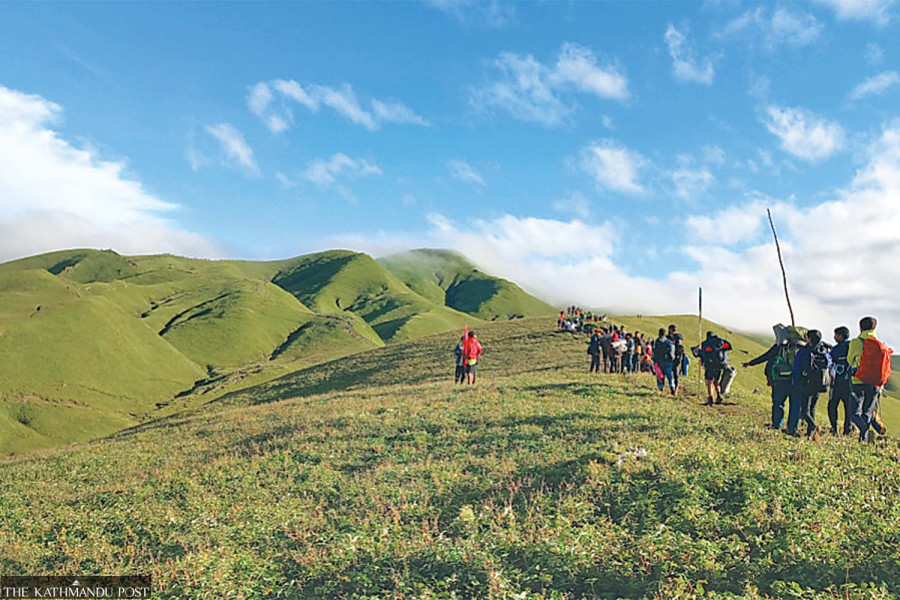
Badimalika and Ramaroshan drew Balendra Shah’s attention as he toured Nepal’s far-west for election campaign. Point 72 of the new government’s agenda promises a study for mass tourism in Badimalika, including the development of trekking routes. Post photo
In a bid to promote tourism, the federal government has officially prioritised the development of Badimalika and Ramaroshan, the virgin highlands of Sudurpaschim. These hidden gems—praised by Balendra Shah as unmissable tourist destinations during his election campaign—are high on his 100-point work plan for effective governance. The prime minister aims to transform them into world-class religious and scenic sites.
The initiative follows a surge of public interest triggered by Shah’s remarks during his campaign in Dhangadhi for the March 5 elections. Shah, now the prime minister, said European landscapes pale in comparison to the ‘pinnacle of natural perfection’ in Bajura and Achham.
Badimalika, where faith meets the clouds
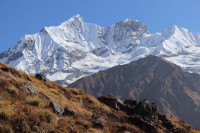
Badimalika’s elevation ranges from 2,000 to 4,200 metres above sea level and sprawls Triveni, Badimalika and Budhinanda municipalities, and Jagannath Rural Municipality in Bajura district; Sanni Triveni Rural Municipality in Kalikot district; and Ramaroshan Rural Municipality in Achham district. Badimalika Temple is not merely a place of worship but a structural marvel. According to preliminary studies by the Nepali Army, which recently completed a meticulous restoration of the shrine, it is believed to be the temple of artistic value at highest elevation dedicated to a Goddess (Shakti Peeth) in the world.
For the restoration completed last July, the army deployed specialised artisans—some of whom had previously worked on royal palaces in Bhutan—to ensure the temple met strict archaeological standards while withstanding the region’s harsh snowfall. Experts believe that building a temple of such artistic complexity at 4,200 metres, where snow covers the ground for half the year, was an immense challenge.
Shah’s remarks regarding Badimalika went viral well before his election. After he became the prime minister, the first Cabinet meeting approved a 100-point agenda for governance reform. Point 72 of the agenda specifically mandates a study for organised tourism in Badimalika—including the development of trekking routes—and calls for an actionable framework within a month.
Tourism entrepreneurs and locals believe this decision highlights the religious and touristic significance of Badimalika, as well as its immense development potential. However, the detailed methodology and progress of the study are still not public.
Simultaneously, the Sudurpashchim provincial government is working to promote the area by forming 'Action Plan Preparation Task Force'. In November last year, the provincial government formed a 14-member task force chaired by Padam Bahadur Shahi, a provincial assembly member representing Bajura. According to Dan Bahadur Thapa, officer at the provincial Ministry of Industry, Tourism, Forest, and Environment, the task force has already conducted several stakeholder meetings in Bajura and multiple internal sessions at the Ministry. "The primary goal of this task force is to review previous programmes in Badimalika and draft short-term and long-term action plans for infrastructure development and tourism promotion," he said.
Thapa further clarified that provincial and federal agencies would coordinate during the implementation of the federal government's 100-point agenda. "While the specific federal agency responsible for the Badimalika project has yet to be identified, we will coordinate our efforts once that clarity is established," he said.
Under the Badimalika Development Plan currently being drafted, the task force is focusing on a framework that prioritises easy access, trail development, and essential amenities such as accommodation and food services. These plans aim to be nature-friendly and rely on local resources for infrastructure. Additionally, Janak Raj Giri, a member of the House of Representatives from Bajura, recently briefed the finance minister on the prospects of tourism in the area and requested that necessary projects be prioritised and advanced.
The spiritual significance of Badimalika is rooted in the Skanda Purana of the Hindu scripture. Priests and local historians, such as Netra Raj Padhya, recount the ancient lore of Sati Devi. It is believed that as Lord Shiva wandered the earth with her remains, her left shoulder fell upon the Mallagiri Parbat (Badumalika), thus establishing it as a powerful Shakti Peeth.
Historical records maintained by the priestly lineage suggest that the first structure was built by Deep Raj Chhatyal of Bajura. Later, King Bhirabhadra Shahi of the of Jumla commissioned the transport of stones from Kalapani to erect a more permanent structure.
Visitors returning from Badimalika say its natural beauty is indescribable. At an altitude of around 4,200 metres, the spiritual fulfilment and breathtaking scenery feel to instantly erase the exhaustion of an arduous climb.
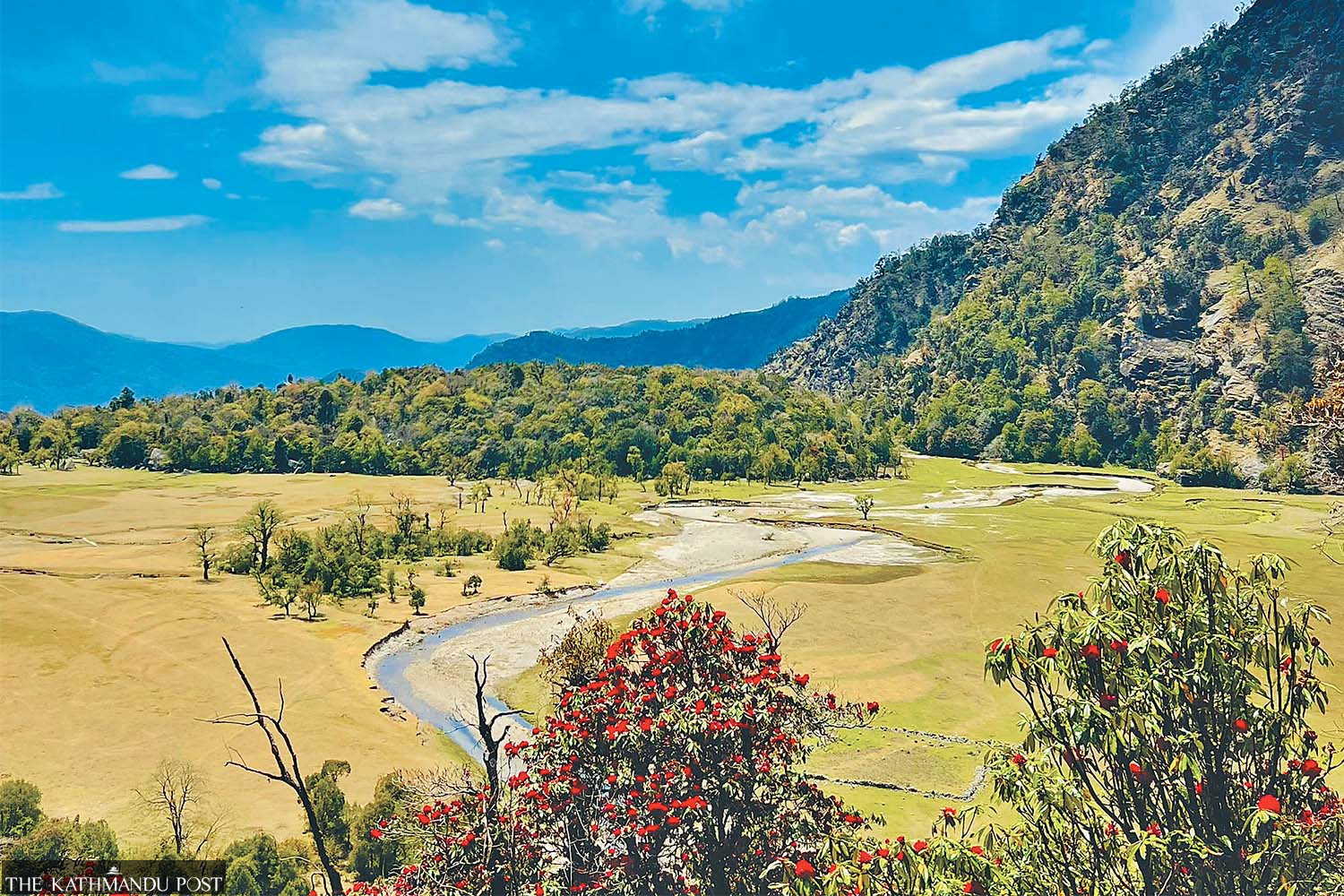
Spread over 52 bighas, Ramaroshan is the largest meadow in Achham, with the Kailash stream snaking around. Post photo
The region is famous for its vast, flat grasslands known locally as patans. "Seeing flocks of white sheep and horses grazing on these green meadows, alongside various species of birds and deer, is truly uplifting," says Bharat Shah, who cycled to the peaks two years ago to promote the area. For the faithful, the landscape feels divine, while for nature lovers, it is an unmatched destination.
Tourism entrepreneurs believe that establishing Badimalika as a major destination could transform the economy of Sudurpaschim. The area boasts 22 major plateaus, vibrant floral gardens, and sacred sites like Triveni and Dharmadwar. Padam Bikram Singh, a tourism entrepreneur, noted the potential for ice skating at Triveni Patan during heavy snowfall in winter.
Furthermore, Badimalika is a sanctuary for biodiversity. It is a vital habitat for rare wildlife, including snow leopards, musk deer, and Himalayan thar. Historically, the region was rich in over 45 species of valuable medicinal herbs, such as Panchaunle and Kutki.
However, experts warn that a lack of conservation is leading to encroachment. Unmanaged grazing, indiscriminate herb collection, and illegal poaching threaten this delicate ecosystem. Local resident Deepak Aidi observes that the region's beauty has already noticeably declined, stressing the need for an immediate protection plan.
A grand fair is organised in the Badimalika shrine every year on Janai Purnima, a Hindu festival that generally falls in the month of August. Visitors from not only Nepal but also India come here with the belief that visiting the shrine fulfils one’s wishes. Regardless of where one starts in Bajura, it takes around three days on foot to reach Badimalika Temple.
Ramaroshan: the land of 12 lakes and 18 grasslands
Adjoining the heights of Badimalika lies the Ramaroshan area in Achham, a grassy highland sitting between 2,000 and 4,000 metres. Known locally as 'Bara Banda, Athara Khanda' (literally means 12 lakes, 18 grasslands), the region offers a landscape unparalleled in the Himalayas.
Spreading in 52 bighas (around 35 hectares) of land, the Ramaroshan area is the largest meadow in Achham, with the Kailash stream snaking through its centre. However, the true wonders are the lakes. Jingale lake is uniquely shaped like the English letter 'C', spanning three kilometres in length. Nearby, the Lamadaha lake offers a surreal experience where the ground beneath one's feet appears to vibrate or 'wobble' near the water’s edge.
"Standing by Lamadaha, you can feel the earth move. It is a natural phenomenon that leaves tourists breathless," says Purna Bahadur BK, executive officer of the Ramaroshan Area Tourism Development and Management Committee. "During spring, the forests bloom with twelve species of rhododendrons, and the air is filled with the calls of the Danphe, our national bird."
Despite the optimism, local stakeholders remain cautious about the limitations. "Since the prime Minister spoke about Ramaroshan, we have seen an influx of tourists from Pokhara and Kathmandu," says Gopi Khanal, chairman of the Ramaroshan Development Committee. "But the road from Mujabagar to Ramaroshan is narrow and perilous. It is unpaved and completely shuts down during the monsoon.”
Khanal expressed his concerns that the drying up of natural lakes, the illegal extraction of medicinal herbs, and the unabated rise in wildlife poaching remain critical concerns.
Due to poor transport connectivity, locally produced herbs and organic delicacies—including millet, buckwheat, stinging nettle, and honey—have struggled to find a reliable market. "If the road network is upgraded, this region has the potential to become a premier hill station for tourists arriving from Dhangadhi and Surkhet," he said.
Khanal further explained that while some hotels are operating on a temporary basis, the lack of clarity regarding land use for permanent hospitality establishments has hindered organised development. "It is a matter of great pride to be on the prime minister’s priority list. This time, we are confident that the progress will be visible on the ground, not just on paper,” he said.
Following the prime minister’s remarks regarding Ramaroshan, the region has seen a steady stream of tourists from as far as Butwal, Pokhara and Kathmandu.
"The surge in visitor numbers is significant. I personally act as a guide to show outsiders the way and escort them through the local lakes and grasslands," said Shamsher Bahadur Bohora, a tourism entrepreneur, enthusiastically. "Visitors often remark that the beauty of Ramaroshan far exceeds their expectations."
However, the plight of travellers from distant locations caused by poor infrastructure is as usual.




 14.81°C Kathmandu