



 14.33°C Kathmandu
Mon, Nov 2, 2026
Money
Sudurpaschim showers state funds on temples, skimps on free medicines
The provincial government has allocated funds for 921 temples, while public health facilities face a severe shortage of funds to buy essential medicines.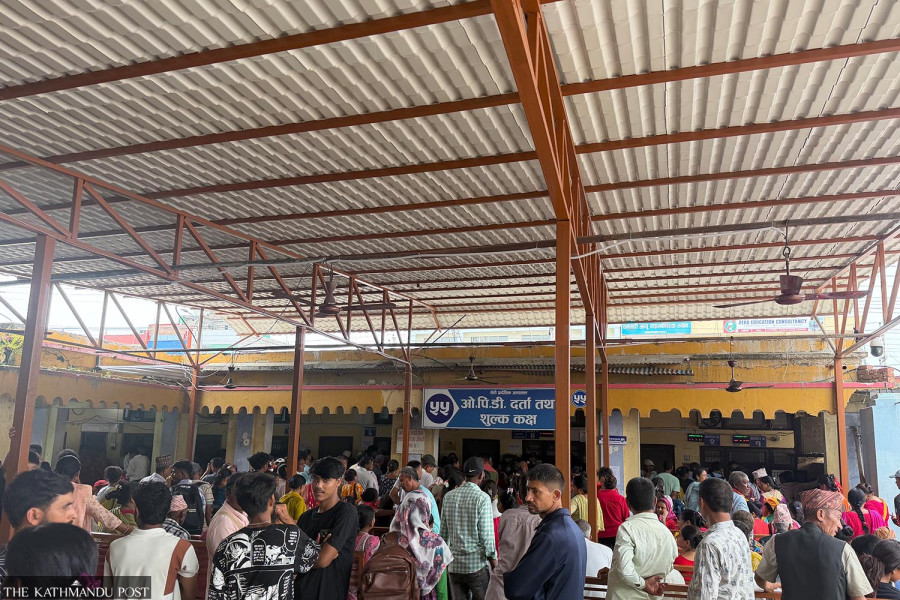
bookmark
Arjun Shah
Published at : November 2, 2026
Updated at : November 2, 2026 07:23
Dhangadhi
The Sudurpaschim provincial government has allocated just Rs30.1 million to buy free medicines for public health facilities this fiscal year and more than Rs1.15 billion for 921 temples across the province.
The meagre allocation has raised concerns about medicine shortages at the province’s health facilities, which need an estimated Rs100 million to Rs120 million annually to provide basic healthcare services, which are provided free of charge. The provincial government, which went nearly three months without an approved budget, has allocated far less than what is needed to fulfil its responsibility for supplying essential medicines.
Including funds received from the federal government, the total allocation for medicine procurement across the province stands at just Rs50 million, said Jhanak Dhungana, chief of the Provincial Health Supply Management Centre.
The amount is insufficient to purchase 56 types of free medicines that must be distributed through health facilities in all nine districts of the province, he said. Providing these medicines is a mandatory responsibility of the provincial government under the basic healthcare programme.
The provincial government procures and distributes medicines through the Provincial Health Supply Management Centre, district health offices, and hospitals under the Ministry of Social Development.
Dhungana said the province needs between Rs100 million and Rs120 million annually to purchase the 56 categories of medicines it is responsible for supplying.
“An annual budget of Rs100 million to Rs120 million is needed to procure free medicines,” he said. “But only Rs50 million has been allocated, including Rs20 million received from the federal government for the supply centre. The district health offices and hospitals have also received very limited allocations.”
He said health facilities would have no choice but to distribute only as many medicines as they can afford to purchase.
“We are likely to face repeated complaints from health facilities about shortages of even basic medicines such as paracetamol,” Dhungana said.
Under the basic healthcare programme, the federal government is responsible for supplying 23 types of vaccines and medicines under various programmes, the provincial government for 56 types of free medicines, and local governments for 69 types, Dhungana said.
The Provincial Health Supply Management Centre, under the Social Development Ministry, manages the 23 categories of vaccines and medicines supplied by the federal government as well as the 56 categories falling under provincial responsibility. It then distributes them to district health offices.
Those offices subsequently supply medicines to provincial and district hospitals, basic hospitals, primary healthcare centres, and health facilities across all 88 local units in nine districts, said Jayendra Bogati, a pharmacy inspector at the supply centre.
“This is the lowest budget allocated for medicine so far,” Bogati said. “We are already worried about how we will manage supplies this year.”
Health workers say shortages of free medicines often force patients to buy them from private pharmacies out of their own pockets.
“We have been unable to procure medicines because the budget was released late,” said Nupraj Giri, information officer at Bajura Hospital. “Free medicines have been in short supply for a long time.”
According to the budget details, the health offices in Bajura, Bajhang, Baitadi, Doti, Dadeldhura and Achham have each been allocated just Rs100,000 for medicine procurement. Various hospitals have received allocations ranging from Rs1.3 million to Rs2 million.
Dr Niraj Aryal, chief of the Hospital and Medical Services Division at the Social Development Ministry, said the ministry’s requests for adequate funding for medicines were routinely cut during the budget process.
“This year, the situation will be even worse. We are already under pressure over how to manage supplies,” he said.
By contrast, the provincial government has allocated more than Rs1.15 billion for 921 temple-related projects, including construction, renovation, repair, and maintenance in the current fiscal year.
According to details obtained from the Ministry of Economic Affairs, the allocation has been made through the Ministry of Industry, Tourism, Forest, and Environment. Most of the money has been earmarked for agencies under the ministry and local governments through fiscal transfers.
Kanchanpur has received the largest allocation, with Rs256.449 million set aside for the construction of 220 temples. It is also the home district of Industry, Tourism, Forest, and Environment Minister Prakash Bahadur Rawal.
Baitadi has been allocated Rs170.8 million for 148 temples, followed by Bajhang, which has received Rs159.7 million for 131 temples.
Doti has been allocated Rs143 million for 99 temples, while Kailali has received Rs118.65 million for 92 temples. Dadeldhura has been allocated Rs83 million for 72 temples, Achham Rs105.5 million for 67 temples, Darchula Rs60.3 million for 57 temples, and Bajura Rs37.7 million for 33 temples.
A further Rs21.5 million has been allocated for two temples, but the budget documents do not specify which districts they are located in.
Minister Rawal said the ministry had initially been given a budget ceiling of Rs1.16 billion by the Provincial Policy and Planning Commission, comprising Rs490 million in capital expenditure and Rs770 million in recurrent expenditure.
The capital budget was subsequently reduced to Rs200 million, with the remaining amount shifted to recurrent expenditure. The Ministry of Economic Affairs later added Rs450 million to the capital allocation, taking it to Rs650 million.
“I had drawn up capital expenditure programmes worth only Rs650 million, including the additional Rs450 million later provided by the Ministry of Economic Affairs,” Rawal said. “I was surprised to find that the final budget allocated more than Rs1 billion just for temples, even though I had submitted capital programmes worth only Rs650 million for the entire ministry.”
Rawal suggested that the large allocation could be linked to the practice of community groups and lawmakers seeking funds for temple construction in their villages and communities.
Chief Minister Khagaraj Bhatta said that around 60 percent of those who approached him seeking programmes and budget allocations had requested funding for temple construction.
The budget was delayed after the UML withdrew from its coalition with the Nepali Congress. As a result, the budget presented on June 15 by the government led by then chief minister Kamal Bahadur Shah could not be passed.
A new government led by Nepali Communist Party leader Khagaraj Bhatta subsequently presented the provincial budget on October 13.
Finance Minister Chakra Bahadur Malla presented a budget of Rs37.696 billion for the current fiscal year, which was approved by the provincial assembly in the second week of October.
Of the total allocation, Rs17.296 billion has been set aside for recurrent expenditure and Rs20.327 billion for capital expenditure. Another Rs72.7 million has been allocated for financial management.
Arjun Shah
Arjun Shah is the Kailali correspondent for Kantipur Media Group.


Most Read from Money
Nepal seeks recognition for six more 8,000-metre peaks
Nepal plans temporary bridges to reopen flood-hit Rasuwagadhi border crossing
Kathmandu Valley to consume 5.18 million flower garlands this Tihar

Banks and government agencies take websites offline over PHP security flaws
Users turn to Nepal Telecom as private ISPs raise internet prices
Editor's Picks

What Balendra Shah can learn from Zohran Mamdani
Explained: The leaked WhatsApp chats that have shaken Nepal’s judiciary
Who is Inam Sapkota, the man linked to Cholendra Rana and top police officials?
The police chief who objects, delays—and ultimately complies
Shabana Azmi on acting, equality and the power of cinema
E-PAPER | November 02, 2026

×