14 years after initial deal, China proposes joint committee to manage border ports
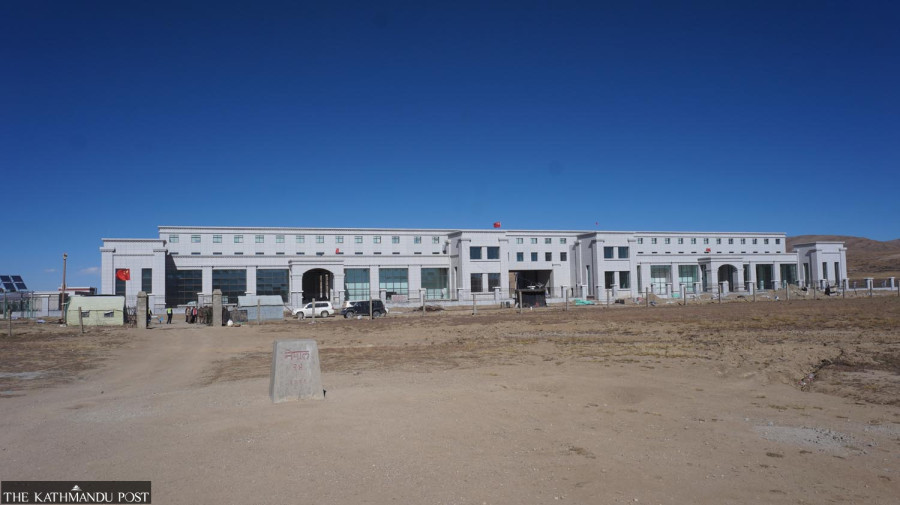
Chinese envoy recently forwarded a draft agreement proposing better customs clearance, smart-port systems, border security, and the opening of new crossings. Korala border point. Post file photo
Fourteen years after Nepal and China agreed to establish a mechanism for managing ports along their shared border, China has proposed a draft agreement to set up a bilateral Nepal-China Port Management Cooperation Committee. The proposed committee aims to strengthen border port management, facilitate trade, streamline customs clearance, and ease the movement of people and goods between the two countries.
In January 2012, Nepal and China agreed to establish the committee. However, the details of the proposed mechanism have yet to be worked out.
During a recent meeting with Industry Minister Deepak Kumar Shah, Chinese Ambassador Zhang Maoming handed over the draft proposal. The ministry is conducting internal consultations, an official at the Industry Ministry told the Post. “We will discuss this proposal with other stakeholders as well,” the official added.
The 2012 agreement defines “ports” as designated areas on either side of the Nepal-China border, supervised and managed by the respective authorities and serving as entry and exit points for people, vehicles, cargo and goods. The term covers both bilateral and international ports.
When they signed the initial agreement in 2012, the two sides agreed to upgrade existing trading points along the border into ports. On the Nepali side, Yari, Nechung, Rasuwa, Kodari, Olangchung Gola, and Kimathanka were identified for upgrading, while Pula, Lizi, Jilong, Zhangmu, Riwu, and Chentang were identified on the Chinese side.
“The opening duration and working hours of the ports shall be agreed through consultations between the administrative authorities of the two parties where the ports are located or through the ports contact mechanism, subject to confirmation by the two parties. The two parties shall consult on the opening of new ports or closing of existing ports through exchange of diplomatic notes between the two parties. Such notes shall be an integral part of this agreement,” the 2012 agreement states.
The proposed committee would serve as a formal mechanism for information exchange, consultation and coordination on border port-related issues. It would bring together relevant authorities from both countries to address operational challenges, improve infrastructure, and promote cooperation in trade facilitation, border security, and cross-border transportation, according to the new draft forwarded by the Chinese side.
The draft identifies several priority areas, including improving customs clearance procedures, increasing the capacity of border ports, coordinating operating hours, developing smart-port systems, making port fees more transparent, and strengthening cooperation to combat smuggling and other cross-border crimes.
In cases of force majeure or other special circumstances, the two parties may open temporary ports. This would require mutual agreement and confirmation through an exchange of diplomatic notes. People, vehicles, cargo and goods awaiting entry or exit would have to comply with the procedures prescribed by local laws or the bilateral agreements in force between the two parties.
According to the draft, the joint committee overseeing port management would comprise chairs, vice-chairs, and members representing both countries. Each side would appoint its representatives in accordance with its national laws and procedures and notify the other side of the appointments.
China's National Office of Port Administration under the General Administration of Customs will serve as the lead department on the Chinese side. The corresponding agency within Nepal's Ministry of Finance has not been specified in the draft.
“Its primary responsibility will be to coordinate the implementation of the existing bilateral agreement and facilitate consultations on the planning, construction, operation and development of border ports. However, matters involving amendments to the underlying agreement, including opening or closing ports and changing their locations, types or operating periods, will be addressed through diplomatic channels,” the new text forwarded by the Chinese side states.
One of the key proposals is to assess the need for and feasibility of opening new border ports or adjusting the status and operating hours of existing ones in response to cross-border trade and passenger movements.
Trade between Nepal and China has been disrupted following the August 26 Bhotekoshi flood. The Kerung border at Korala has served as a limited trade route as China has also closed the Tatopani border. Other proposed border points are currently used mainly by local residents crossing the border, due to inadequate infrastructure on the Nepali side, an official at the Industry Ministry said.
“We need to do more serious homework before opening new border points with China,” the official added.
After the Bhotekoshi flood severely damaged the Rasuwagadhi-Kerung border crossing, China offered to develop Korala as an international border point. Nepal, however, has yet to accept the proposal.
“The two parties shall strengthen the construction of infrastructure and inspection facilities of the ports, improve the passage conditions and enhance the capacity of passage. The future development needs of the Ports shall be considered while designing and constructing the port facilities,” the 2012 agreement stated.
The new draft emphasizes that port development should be coordinated to ensure that infrastructure and operational arrangements complement each other. Regular consultations will allow both countries to identify gaps in existing facilities and discuss potential improvements.
The committee would also provide a platform for sharing development plans and coordinating the agencies involved in border management, according to the new draft.
“Improving customs clearance efficiency is another major priority under the agreement. Both countries will strengthen communication between port management departments, inspection offices and other relevant agencies to streamline clearance procedures. The two sides will discuss measures to simplify inspection and verification processes, improve operational coordination and harmonize port working hours. These efforts are intended to reduce avoidable delays and improve the efficiency of cross-border movement,” the new draft states.
Both countries will also work towards establishing dedicated international road transport channels to support the movement of vehicles and goods across the border. Local working groups will help implement decisions related to infrastructure construction, regional and overall development planning, and the exchange of import-export information, the new draft states.
The draft places equal emphasis on preventing cross-border crime and facilitating legitimate movement. Nepal and China will cooperate to prevent and combat illegal immigration, the trafficking and smuggling of weapons and ammunition, drug smuggling, the illegal trade in endangered wildlife and wildlife products, and other cross-border criminal activities, according to the text.
The two sides would also coordinate the movement of residents in border areas, standardise the issuance of exit-entry passes for people along the Nepal-China border areas, and conduct public awareness and educational activities related to border management.
The proposal also calls for enhanced cooperation in port inspection, quarantine, and public health to ensure food safety and sanitation, and prevent the cross-border transmission of diseases and epidemics.
The agreement would enter into force on the date of signing and remain valid for 10 years. It would automatically renew for successive five-year periods unless either party requests termination by giving the other written notice at least six months before its expiry.
Anil Giri is a Chief Sub Editor covering diplomacy, international relations and national politics for The Kathmandu Post. Giri has been working as a journalist for more than two decades, contributing to numerous national and international media outlets.




 18.31°C Kathmandu