Saptari childbirth on street outside hospital raises questions over Nepal’s free maternity care
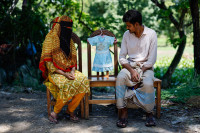
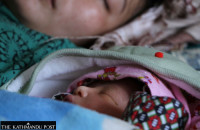
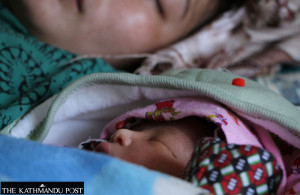
A woman giving birth on a pavement outside a government hospital after her husband could not afford Rs3,200 in tests exposes the gap between Nepal’s free maternity care and access to emergency healthcare. Babita Kumari Paswan of Parsahi, Saptari, at hospital after delivering a baby on the street. Post photo
A woman delivering a baby on a pavement outside a government hospital in Rajbiraj, eastern Tarai, has raised serious questions about whether Nepal’s free maternity-care system is actually reaching the poorest when they need it most.
People count on hospitals and health facilities to respond swiftly and efficiently, particularly in emergencies, as the lifeline for survival and the backbone of support. But the ordeal of Babita Kumari Paswan, 30, of Parsahi in Rajbiraj, shows how a poor family can still be left outside the healthcare system despite reaching a government hospital for childbirth.
Paswan gave birth to a baby on a pavement outside the state-owned Gajendra Narayan Singh Hospital after her husband could not pay for an investigation fee.
According to her statement recorded by Kantipur TV, she and her husband Hareram Paswan, accompanied by a neighbour, reached the hospital at 1 am on Thursday after she went into labour.
As part of the hospital’s procedure, staff sought Rs3,200 for tests, including blood tests, before proceeding with her treatment.
Hareram, however, had only Rs2,000 with him and fell short by Rs1,200—the amount he needed to arrange if he wanted his wife to deliver on a hospital bed.
The woman, her husband and others then left the hospital, with Hareram later saying that he ran from place to place trying to borrow the amount, to no avail.
They waited on the pavement for more than three hours for a shopkeeper that Hareram hoped would lend him the shortfall to arrive.
But then Babita’s labour pains became severe. At around 4:30 am, she delivered a baby boy on the pavement, lying over a roadside drain.
The Thursday morning incident, captured in videos that later went viral, has been described by health experts as inhuman and cruel—an unimaginable ordeal that should never unfold at a state-run health facility where tens of thousands of people arrive every year with the hope of receiving treatment and surviving medical emergencies.
The incident is also a major embarrassment for a government whose campaign promises placed issues of utmost concern to citizens—including health, education and employment—at the centre.
Maternal health experts say they were shocked by the news of a woman giving birth on a pavement even after reaching the emergency department of a hospital. For them, the incident exposes the reality on the ground despite years of government efforts to expand institutional childbirth and provide free maternity services.
Health workers at the hospital did not assess the woman’s condition properly, and she is believed to have been around 6–7 cm dilated when she was allowed to leave the hospital to look for money, according to the preliminary report of the committee assigned to investigate the case.
“Thank God, both mother and child survived,” said Dr Ajaya Kumar Shah, a member of the Nepal Medical Council who is in the team deployed to Rajbiraj to probe the incident.
“We have inquired with health workers and relatives of patients. We checked CCTV footage.”
The full report may take a few days to be ready, but investigators say that apart from the inhumane behaviour shown by some health workers and security guards, Nepal’s vague and unclear health policy is also to blame for the incident.
Whatever the eventual findings of the investigation, the image of a woman giving birth on a roadside outside a government hospital exposes the gap between health policy on paper and healthcare services that common people receive.
On Friday, Gajendra Narayan Singh Hospital handed suspension letters to six people, including Dr Usha Dev, for the period until the probe is completed.
The decision came amid mounting pressure from various sections of society, visible particularly on social media platforms that were abuzz with criticism of the incident. People began posting videos and photographs, and the images and videos soon reached millions of viewers.
Hospital workers, however, say they were simply following the process that the hospital has been implementing for years.
Medical professionals say a hospital’s responsibility is not simply to provide a service but also to ensure that a vulnerable patient does not fall through the cracks in the system.
“A woman who should have been surrounded by trained health workers, sterile equipment and basic dignity instead delivered a child on the roadside. This is a cruel, inhuman and criminal act,” said Dr Sudha Sharma Gautam, a former health minister.
“How can any health worker deny service to a patient in an emergency, when the service itself is free?”
Every hospital—public or private—has a social security unit to provide free services to needy patients who cannot afford to pay.
On Friday, Health Minister Nisha Mehta told Parliament that she had taken the incident seriously.
“Initially, after a health check-up, she was admitted to bed number 24. Since the necessary test reports were not available, it was suggested that urgent tests be performed. After that, she and her husband left the hospital and gave birth outside the main gate of the hospital at around 4:45 in the morning,” she said.
After the baby was born, the woman was brought back to the bed but they left again, she told lawmakers.
“After the delivery, the mother and the newborn returned to the maternity ward with the umbilical cord, and despite being requested to remain in the hospital for necessary health care and treatment after delivery, the hospital received information that she had left the hospital,” Mehta said.
“We have instructed the hospital to take care of the mother and the child. It has been reported that the health of the mother and the baby is normal.”
What’s the Safe Motherhood Programme then?
The government declared delivery services free at state-run health facilities years ago, with the Ministry of Health and Population reimbursing health facilities for providing the services.
In the mountain region, the government even provides helicopter facilities where the healthcare system is fragile and, in many places, where there is not even a basic health office.
There is a catch.
Delivery services have been declared free. But laboratory services required before delivery have to be paid for by the patient and are not included in the free-service package, leaving poor patients unable to afford the tests they need during emergencies.
Nepal’s constitution mandates health as a fundamental right of the people. The National Health Policy aims to implement this right by ensuring equitable access to high-quality healthcare services for all.
The government declared institutional delivery free in 2009 and started providing free medical treatment to mothers and their newborn babies.
The institutional delivery rate, which was around 16 percent at the time, has increased to more than 90 percent at present.
Along with free treatment, women receiving institutional delivery services also receive transportation allowances and cash incentives for antenatal checkups. These measures have been instrumental in bringing women to health centres and hospitals.
The programme is credited with reducing the maternal mortality rate from 539 per 100,000 births in 1996 to 239 per 100,000 births in 2016—for which the country even received the Millennium Development Goals award.
Since 2000, Nepal has reduced maternal deaths by more than 70 percent, according to a report by the World Health Organisation.
The report stated that currently 142 Nepali women die from maternity-related complications per 100,000 live births.
Under the programme, health facilities are reimbursed Rs2,500 for a normal delivery, Rs4,000 for a complicated delivery and Rs10,000 for a cesarean section. Of this amount, the hospital must provide Rs300 to the nurses involved in the delivery.
Health officials say neither the Safe Motherhood Programme nor the Basic Health Service Act says anything about the cost of tests required before delivery.
“Health workers serving in some hospitals use their discretion and provide services free of charge to people who cannot afford to pay for investigations through the hospital’s social service fund,” said Dr Gauri Shrestha, chief of the Safe Motherhood Programme at the Family Welfare Division of the Department of Health Services.
“Other hospitals charge patients for such services. The government has not declared laboratory services free, which has created confusion among health workers. They fear being held accountable during audits.”
The Paropakar Maternity and Women’s Hospital, Thapathali said women seeking delivery at the hospital have to pay for laboratory tests before they are admitted to the emergency ward.
“Most tests are carried out before admission to the labour room, and patients have to pay for it as it is not reimbursed by the government,” said Dr Shree Prasad Adhikari, director at the hospital.
“But in our hospital, we do not force any patient to pay or deny services. If they cannot afford to pay, we provide all services free of cost.”
Dr Sharma, a former director of Thapathali Hospital and former health secretary, said free maternity services mean all services are free, and she questioned how laboratory services could be excluded from free services.
She said that even if laboratory services have been excluded from the Safe Motherhood Programme, the free basic health services programme covers blood testing and other services.
“It’s a lame excuse. Denying emergency care cannot be justified by any argument or pretext,” said Sharma.
“The government must be sensitive towards these kinds of flaws.”
Dr Aruna Karki, a maternal health expert, said that even if a patient cannot afford to pay, health facilities cannot deny services.
“Even private hospitals do not deny services. This is against the constitution, prevailing law and the government’s commitment to stopping all preventable deaths. The government needs to do more for the poor and marginalised people.”
It is also the responsibility of the government to make sure whether the target population is getting benefits from the free programme or not, said Karki.
“For that, people should be told about the services and facilities, awareness programmes should be launched and even health workers should be oriented accordingly.”
The healthcare service in Madhesh Province, where the Rajbiraj hospital lies, however, is poor, according to a comparative data analysis by the government.
In the fiscal year 2026-27, 16 women died from maternity-related complications in Madhesh Province, according to the Family Welfare Division.
The institutional delivery rate in Madhesh is only 83.2 percent, the lowest in the country, according to the Nepal Multiple Indicator Survey 2024-25.
Still, 20.5 percent of women in rural areas and 15.5 percent of women in the province give birth at home.
Arjun Poudel is a health reporter for The Kathmandu Post. Before joining the Post, he worked for Sagarmatha Television, Naya Patrika, Republica and The Himalayan Times.




 23.57°C Kathmandu