Nepal fell in love with EVs. It forgot to regulate them
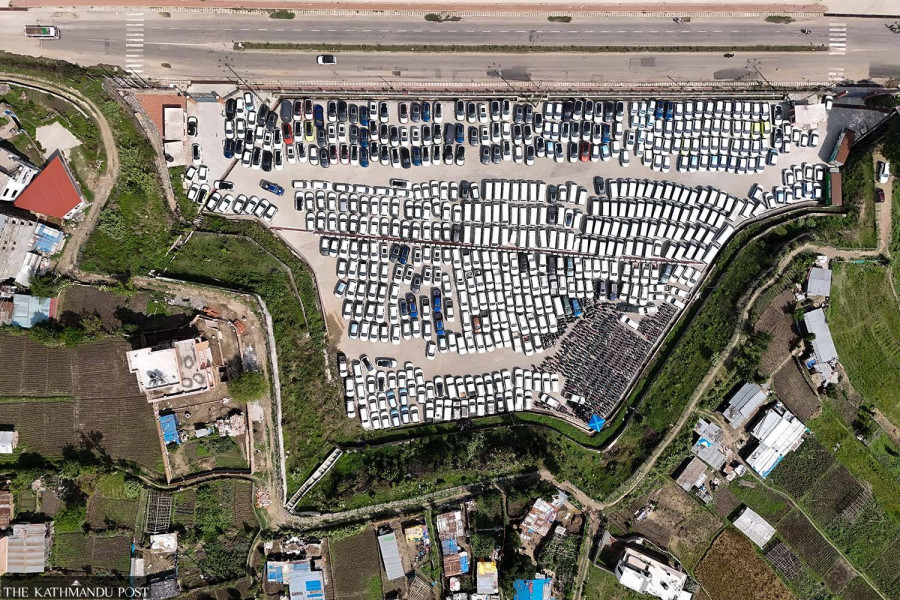
Countries certify a battery before it’s sold. Nepal certifies almost nothing. That gap needs fixing. The customs yard of Chobhar Dry Port in Kathmandu is full of electric vehicles imported from China in this file photo. Post file photo
Early Friday morning, in Bharatpur, a 55-year-old former school director lost his life inside a burning electric car while driving home. By the time firefighters reached him, there was nothing left to save. What remained was a wrecked car, a grieving family, and a country suddenly unsure whether the electric vehicles now filling its roads and showrooms are safe to drive.
Investigators have not yet determined why the car caught fire. It may prove to be a fault in the charging system, a mechanical failure unrelated to the battery, damage from a prior collision, or a battery fire—several plausible explanations that experts have declined to rule in or out before the forensic work is done. That restraint in drawing a conclusion should be a model for the rest of the country. A single tragic video, however disturbing, is not evidence of a systemic flaw in EVs.
It is, however, evidence of a gap in oversight that has existed since Nepal’s EV market began to grow. In two previous electric car fires recorded in Nepal, the causes were traced outside the battery itself: a short circuit in charging equipment in one case, external combustible material in the other. Global data tells a similar story. Electric cars catch fire at rates comparable to, and by some measures lower than, internal combustion engine vehicles. The danger, when it does occur, is called thermal runaway—a breach in the separator inside a battery cell, triggered by a crash, a manufacturing flaw, or overcharging, that sets off a chain reaction of heat capable of overwhelming an entire pack.
The risk is still controllable if measures are taken to manage it. Firefighters need training to cool a battery fire with sustained water rather than conventional extinguishers, and to watch for reignition hours after the flames appear to be out. Owners need to know where a car’s mechanical door release sits, since electronic locks that guard against doors swinging open in motion can, in the worst circumstances, fail along with the rest of a car’s electronics. None of this is exotic knowledge. It simply has to reach people before an emergency, not after one.
The deeper fix lies upstream, at the border, before a single vehicle is sold. Much of the world has already built that wall of protection. More than five dozen countries, among them the European Union, the United Kingdom, Japan and South Korea, require every electric vehicle sold within their markets to pass UN Regulation 100, a battery-safety standard covering crash resistance, overcharge protection and fire containment. China has gone further still, moving from a rule requiring only a five-minute warning before a battery fire to one demanding that a battery produce no fire or explosion at all for two hours after the onset of a fault. Nepal has adopted neither this framework nor an equivalent of its own. It has, by its own regulators’ admission, no dedicated mechanism to test whether the electric vehicles entering the country meet any international safety benchmark at all.
Nepal should require type approval against an internationally recognised standard, such as UN R100, as a condition of import, extend the same scrutiny to chargers and cables, and fund the training that lets firefighters and owners respond to a battery emergency with knowledge rather than guesswork. Nepal’s shift toward electric transport has been one of its genuine policy successes, cutting fuel imports and easing the capital’s chronic air pollution. Protecting that progress means insisting the vehicles carrying it forward are held to the same standard the rest of the world already demands.




 21.92°C Kathmandu