



 14.69°C Kathmandu
Sat, Oct 24, 2026
Columns
Literary festivals: Quest for energy
They are alternate meeting spaces away from Nepal’s regular political forums.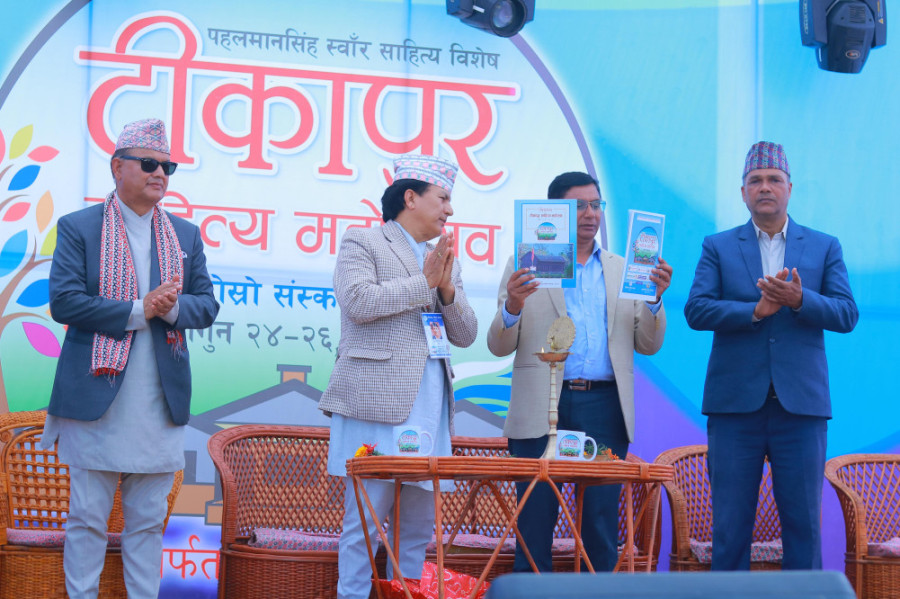
bookmark
Abhi Subedi
Published at : March 16, 2025
The recent Tikapur Literary Festival offered two attractions for me. One, the region has gone through some traumatic experiences in recent history, so its attempt to overcome that with creative activity, education and developmental work is commendable. The other was the Sudurpaschim Province’s desire to create a space of hope and regeneration by using alternate modes of energy.
An excellent fiction writer and a well-known figure from Tikapur, Mahesh Bikram Shah, who took up the cudgel to organise a literary festival by creating awareness among the locals, sent out invitations to attend the festival from March 8-10. I was drawn by a desire to witness how the revival of energy in Tikapur brought together hopes, dreams and personal experiences. Literature is an apt metaphor for that. A new term, the ‘season of festivals’, has recently become popular among literary writers and other enthusiasts. Several good articles discussing these festivals have appeared in the newspapers and other media outlets.
Sitting on the unstable rafts controlled by a few children in the dim light of the evening, I felt that we would better understand the space by capturing moments in the currents of history. Literary festivals are quests for alternatives, thus they become performative. This is evident in the celebratory modalities of the festivals. They familiarise the locals with larger forms of performativity. They are glocal in character. The rafting imagery captures that experience for me. The literary festival introduces the generic forms of literature as its functional categories. Reviving the waning interest in festivals and creative gatherings that declined due to the Covid-19 pandemic is a crucial function of literary festivals.
Setting and geographical location are essential to literary festivals. At the centre lies the dynamics of reading. Literary festivals are mediated and organised by both literary and non-literary persons. Are literary festivals then the spaces where books are launched, read and consumed? A literary festival encompasses far more than that, interestingly.
A specific modality of literary festival has emerged over the years in Nepal. A tacit understanding among the concerned people has been established. These include local leaders, primarily literary writers, readers, and locals who wish to meet writers and listen to them. Besides, the social power players, including politicians and those eager to project their images, have become essential components of festivals. Festivals are settings and spaces architected to accommodate performers, audiences and locals. These gatherings bring together the scattered, disorganised, or invisible crowd to galvanise their energy.
Alternate meeting spaces
Literary festivals in Nepal are quests for alternate meeting spaces that deconstruct the regular politically oriented forums. The minuscule literary festivals connect writers, readers and publishers. Together, they create a nouveau communication culture that has no familiar pattern—a free-form meeting with attendees of diverse nature and character.
The literary festivals organised in different places of Nepal, from the Nepal metropolis to the mofussil areas, have a few common features. They put the literary place at the centre and organise forums to discuss related subjects. They incorporate theatre, folk traditions, cinematography and local cultures. But the latest addition is politics and the country’s burning issues. Such matters can be discussed at literary festivals only if we are clear about our goals.
We should understand that political parties have been carelessly bandying about discussion topics in their domains. They have threatened the efficacy of their forums by ceaselessly flouting the norms and decency of speeches. Their reckless use of language in the political forums has rendered the political forums ineffective. So, it is natural for politicians to look for forums that bring a creative and free atmosphere. The attendees at the literary festivals come with open minds, forgetting their parti pris; they know that the preconceived views will be inappropriate there.
Creative expression
Tikapur literary festival brought many poets, writers and media thinkers from the country’s capital and western regions. The participation and presentation of women writers and social workers were significant. I must confess I had not read the brilliant poetry written by the young poets of that area before. The discourses dramatised the energy, plans and hope espoused by Tikapur and the region.
In the opening address, political scientist Hari Sharma highlighted how the space acquires positive energy from its hope and action. In an hour-long session, I faced challenging questions from academic Shiva Rijal. The questions were related to how the creativity of a space should be understood by alluding to the meeting of locals and writers from outside.
To take one crucial example, a writer like dramatist Pahalman Singh Swanr of that region was thus a very important subject of discussion. Issues related to fiction and non-fiction, travel, women in literature and politics, faith, theatre, cinema, Dalits and regional culture formed the programme’s basic structure.
I also addressed the academics at Tikapur Multiple Campus of the Far Western University and had interesting interactions. Writer Mahesh Bikram Shah explained how Tikapur is rising like a phoenix. He showed me spaces and indicated at the monuments of hope. However, he also mentioned that despite all these efforts, people are leaving Tikapur. This subject evokes a different problem. So, it is essential to question the role of programmes like literary festivals in this issue. The organisers believe that they generate creative energy and create forums of interaction. I was deeply moved to see their faith in literature and quest for creative energy.
Tikapur Literary Festival was a quest for meaning and solutions to problems generated by recent historical events. It also formed the great traditions, culture and creativity in this region.
Abhi Subedi
Abhi Subedi is a poet, playwright and a columnist.


Most Read from Columns


Editor's Picks





E-PAPER | October 24, 2026

×