Collared kingfisher sighted in Dhanusha, a first for Nepal
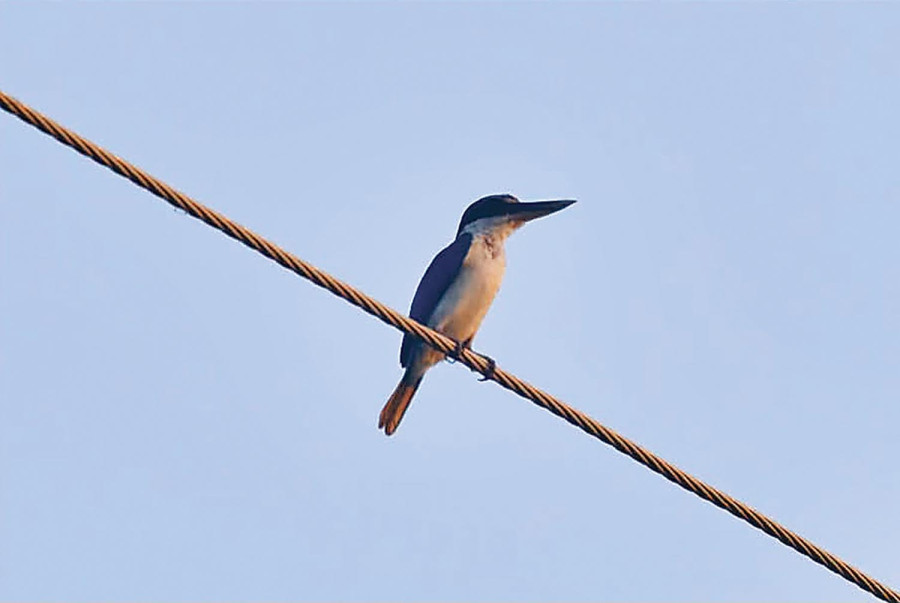
The bird was photographed at a farm in Janakpur. This takes Nepal’s recorded bird species tally to 904.A collared kingfisher pictured in Dhanusha. Courtesy of Anil Mandal via Nepalese Ornithological Union
A bird usually associated with coastal and marine habitats has been recorded for the first time in Nepal. A local bird enthusiast photographed a collared kingfisher in Dhanusha.
Anil Mandal captured the bird in his camera at around 5:30 pm on September 29 while it was perched on an electricity wire amid farmland at Kuwa Mangalaiya Phatak in ward 12 of Janakpurdham Sub-metropolitan City. He sent the photograph and details to the Nepal Bird Record Committee the following day.
After studying the photograph and consulting national and international ornithologists, the committee concluded that the bird was a new record for Nepal.
Nepal Bird Record Committee Chairman Tulsi Subedi, in a statement on Sunday, confirmed the sighting of the new species. The record takes the number of bird species documented in the country to 904.
The bird, collared kingfisher or white-collared kingfisher (Todiramphus chloris), belongs to the kingfisher family Alcedinidae. Subedi said the individual photographed in Dhanusha belongs to the subspecies Todiramphus chloris humii. Fourteen subspecies of kingfisher are recognised globally.
“The collared kingfisher, which is mainly found along coasts and marine areas, is an extremely rare record for the landlocked Nepal,” said Subedi.
The species is widely distributed across South and Southeast Asia, Australia and the Pacific islands. It is also found along coastal areas of Oman, Saudi Arabia, the United Arab Emirates and eastern Africa. In Bangladesh, it is mainly resident in coastal and wetland areas, including the Sundarbans.
In India, its habitat includes the Sundarbans in West Bengal, Odisha, the Andaman and Nicobar Islands, Gujarat, Maharashtra, Goa, Tamil Nadu and Andhra Pradesh, according to the committee.
The nearest established habitat to Dhanusha is the Sundarbans region of Bangladesh and West Bengal, said Subedi. He believes the bird may have reached Dhanusha while wandering along the Ganga-Brahmaputra river system or after being blown off course by weather and strong winds.
The sighting highlights the value of observations by local people in documenting Nepal’s bird diversity. Recent records have also shown how photographs taken by birders and wildlife enthusiasts can help experts verify species previously not recorded in the country.
In December 2024, Naumann’s thrush had taken Nepal’s bird tally to 897 after the Nepal Bird Record Committee consulted national and international experts. The purple-backed sunbird was recorded in Jhapa in February 2025 and the violet cuckoo was confirmed in Ilam in April 2025.
In February 2026, Nepal had records for 903 species—about eight percent of the world’s bird species. Ornithologists have also stressed that Nepal’s varied landscape makes it an important destination for birdwatching.
The Nepal Bird Record Committee lauded Mandal for documenting the collared kingfisher and contributing to the country’s official bird count. The committee said the record underlines the need for continued bird monitoring nationwide.
Nepal has been a haven for birding. Given the variety of bird species the country hosts, a good number of foreign tourists have started visiting the country, exclusively to watch birds. Ornithologists suggest that bird conservation can be quite helpful to promote overall tourism development in the country.
However, bird conservation in Nepal is not without challenges. Loss of habitat, mainly due to human encroachment, haphazard extraction of riverbed materials, shortage of food and excessive fishing threaten the survival of birds in the country. Bird hunting, chemical poisoning, land fragmentation, climate change and lack of awareness among the local residents are other major threats to bird conservation efforts.




 16.53°C Kathmandu
1.jpg)