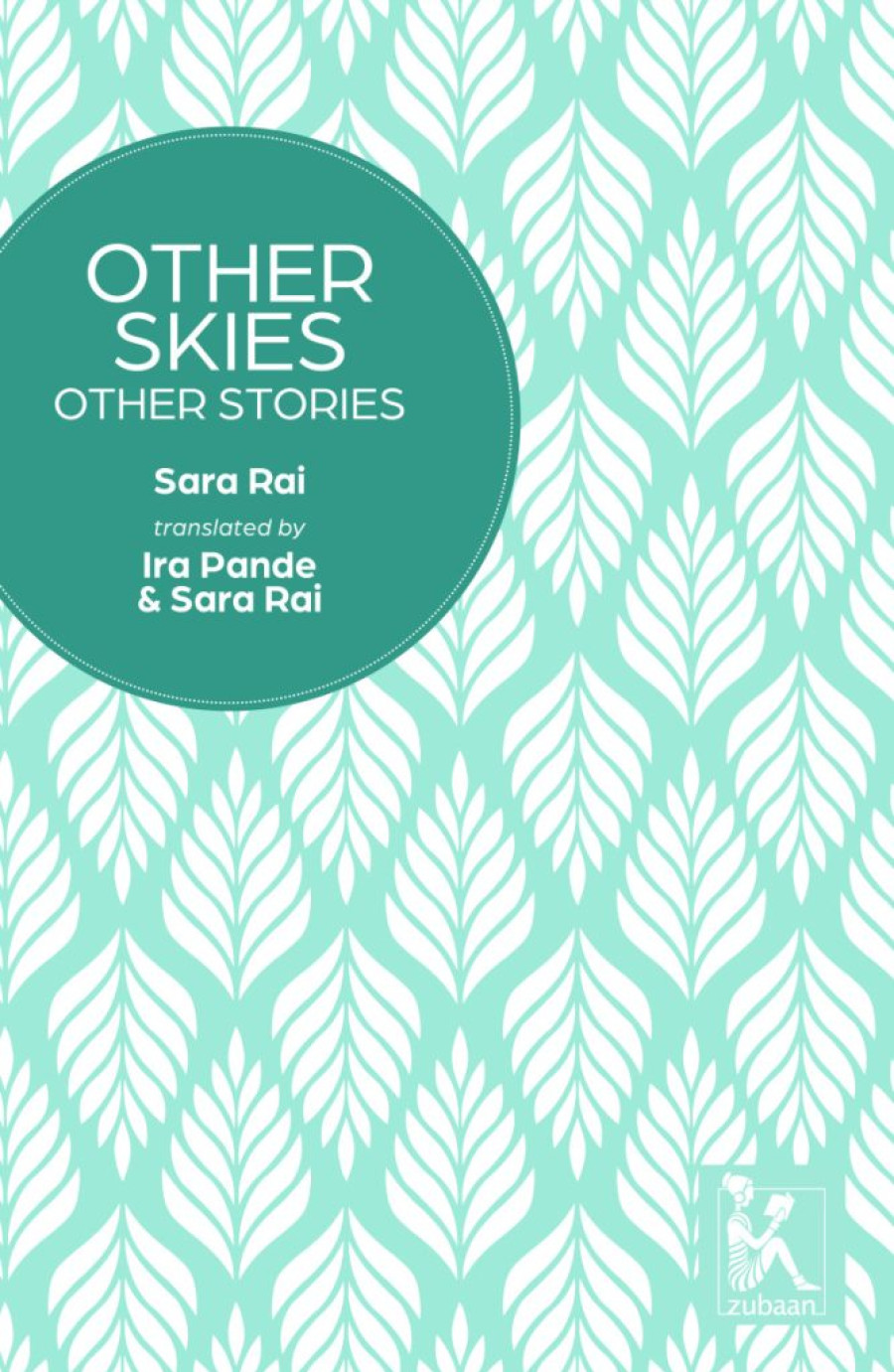
In Sara Rai’s ‘Other Skies, Other Stories’, language is both atmosphere and home. It is atmosphere in that it is a mode of attention, the medium through which her characters register what the seam-split business of living usually leaves no room to notice. And it is home, in that language is where they must live, though it is a house that rarely satisfies its tenants.
A man sits down to write his family’s genealogy and produces only a longer account of the dead. The narrator of “Catching Butterflies”, an entire story woven around a man mistaking butterflies for autumn leaves scattered about the ground, lifts his pen to write the moment the butterfly flies off his shoulder. Badri, an old school friend of the narrator in the collection’s titular story “Other Skies”, carves the narrator’s name into a block of ice, knowing it will have melted by evening. The reaching never closes its palm.
And yet Rai stakes these stories, written across nearly three decades, on a single wager: that the reaching is itself a form of dwelling. To be housed in language, for her, does not mean to possess the world it points at. It means to keep casting the net, and to make a life in the throw.
What keeps this from curdling into melancholy is that Rai never pretends the ground under the house is solid. In her introduction, she tells us that the stories are oriented towards a real place, not an invented one. The book remains faithful to the Allahabad she has lived in nearly all her life: the Ganga and the nallah behind the house, the tamarind streets, the colonial bungalows slumping toward ruin. The city and its locales hold firm, but the lives and the languages inside them do not.
Rai writes, by her own admission, in a comfortable mixture of Hindi and Urdu. Yet some mornings, and somethings in dreams, she catches herself composing in English instead, the words of one tongue percolating into the other. Some of these stories she carried into English herself; others she translated with Ira Pande. Pande, a seasoned translator from the Hindi whose rendering of Manohar Shyam Joshi’s T’ta Professor won the Sahitya Akademi Award, lends the collection an ear attuned to its every shift of register. To write between languages is to know that no single tongue will render the world in its wholeness. This is the translator’s oldest condition, and Rai, being one herself, writes from inside it rather than about it.
The English on the page is a net thrown across a gap, which she neither hides from us nor grieves. We reach for one another across languages precisely because we cannot be transparent to one another, and it is that reaching, and never any arrival, that Rai is willing to call home.
Untranslatability offers the purest demonstration of this reaching, and it gathers at the proper noun, the one word each of us is promised will cross any border intact. Rai’s people cannot even hold on to that. But what interests the author is not the loss of a name, but the obliqueness it opens within a life.
In one story, the gardener of Khusro Bagh goes by Dilip Kumar. As a boy, he was so besotted with the cinema that he gave away his birth name, Ghulam Rasool, and took to a film star’s instead. Rai sets the fact down without comment and it turns strange only when held to light: the star called Dilip Kumar was himself Muhammad Yusuf Khan, a Muslim who worked a lifetime under a Hindu name.
In Rai’s story, a Muslim caretaker of the Mughal dead wears his chosen, or borrowed, name as a shelter someone else had built. He is a man who has learned to inhabit, quite tenderly, a self that was always partly on loan. That loan, in turn, is what frees him to pour his whole inner life into a ruined garden and its buried princes. So when the ghost of a Mughal queen rises from her tomb to tell him that this earth, and no promised world beyond it, is all there is, he takes it not as terror but as a kind of grace.
And then the story refuses to end on him.
Rai grants him a vision no one else in his world will ever have, and then pulls the frame back to two schoolboys who watch him bowing before an empty mausoleum and decide he has “a screw loose.” The lens widens; the mystic appears now as a local eccentric, and the grace he has just touched is left without a single witness to confirm it.
Rai’s gesture would be easy to read it as deflation, the punchline puncturing the vision. It does the opposite. But to hold the close-up, to make us go on marvelling at the gardener, would turn his private grace into our spectacle. By widening the frame, she refuses him the centre of his own story, and in that refusal, she hands him back his ordinariness, his right to remain partly unread.
This widening is Rai’s fiction at its most searching. When she draws the frame back from a mystic to two bored boys, from a marriage of 50 years to a single stubborn moon, she refuses the hierarchy in which human life outranks the moon, and vision outranks the joke.
The slice of life is not smallness for its own sake. It is a levelling of attention, an insistence that the ant on the wall, the butterfly on the narrator’s shoulder and the ghost in the tomb belong to one continuous world and deserve the same quality of looking. To read Rai is to be slowly taught how to attend to the world, until the ordinary stops serving as the backdrop to meaning and we see that it is meaning itself.
The titular story, “Other Skies,” shows that this attention is an ethic and not a stylistic choice.
Altaf Ahmad is a Muslim man in the years after 2002, frightened by news of a massacre hundreds of miles away. He catches himself working out how quickly a fire could consume a beard or a burqa. His old friend Badri, a Hindu man forever hatching absurd schemes to get rich, sends him a slab of ice from his father-in-law’s factory to keep him cool through the heat, with Altaf’s name cut into it in large letters, like an announcement.
To the mob in Altaf’s mind, his name marks a man for death. To Badri it is his friend’s name, worth engraving.
Then the ice melts into the roots of an old banyan and the unbearable days shrink to a moment in the long life of the tree. The kindness is written on water and cannot be made to last. For Rai, impermanence disqualifies neither care nor love nor truth.
However, interestingly, Rai’s very first story in the collection, “Nabila,” warns us of the failure that this mode of attention also risks.
Nabila has crossed over from Bangladesh and the woman she works for corrects her without end, for the words she says slightly wrong. She is assembled out of two countries, two tongues and the fiction of an abundant home in Bangladesh that she cannot afford to give up. The two girls next door watch her exactly as they watch the frogs in the pond, with a fascination that never becomes rescue.
By the story’s close, the girls are so utterly engrossed in observing a grasshopper, that they never see Nabila leave for good. Everywhere else, Rai draws back from a person to spare them our stare. Here, she draws back from Nabila to a grasshopper, and the child slips off the edge of the frame, unnoticed.
The same tender attention that dignifies the gardener is what fails Nabila. Attention that will not convert itself into action can adore a person and lose her in the same breath. Rai does not resolve this tension. She compels us to sit with both the tenderness and the blindness in the story, leaving us inside the discomfort of it.
What holds steady across Rai’s stories is this discipline of looking and letting go.
In “Golden Anniversary,” an old husband swears he sees two moons where his wife sees one. After 50 years of contradicting each other, the narrator says they agreed on only one matter, that he sees too much.
Rai sees too much as well, and then looks away before attention ossifies into a grip. A butterfly is watched and released. A name is engraved and allowed to melt. She holds each life for exactly as long as looking allows, then gives it back to its own passing.
That refusal to clutch is the most demanding gesture in these stories. It asks us to love what we cannot keep, which is, in the end, everything. ______________________________________ Other Skies, Other Stories Author: Sara Rai
Translated by Ira Pande, Publisher: Ashoka Centre for Translation and Zubaan Publishers ____________________________________




 18.25°C Kathmandu