Anand Gandhi and Zain Memon on creating a mythology for the 21st century
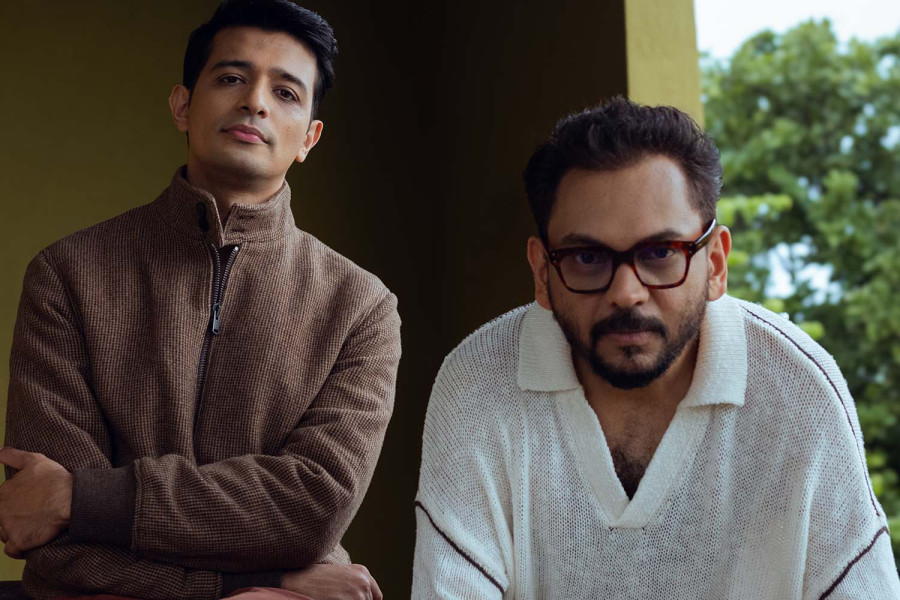
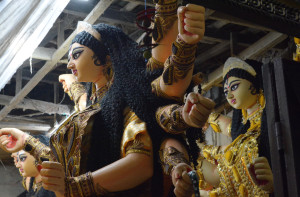
In ‘MAYA’, familiar South Asian beings are reimagined through evolutionary science as Gandhi and Memon explore how new mythologies can help us make sense of an uncertain future. Photos: Provided to the Post
What if there was a planet where tree networks were the internet?
A planet where Manushyaswere not the only species capable of forging culture—where Vaanarspatrolled the cities, the two-headed Gandharvasquite literally tête-à-têtedwith each other, where Naagsslithered through the dark undertowns, and Garudasheaded ministerial positions.
Such a planet is Neh.
In the Indian transmedia project ‘MAYA’, Neh is an Earth-like planet with its own history, architecture, social structures, languages, and, of course, species that have undergone an almost identical evolutionary arc. Through novels, films, and games, ‘MAYA00’ unfolds the tales of these species, the whole of which, in its creators’ words, will form the mythology for the 21st century.
ThePost’s Bibidh Chalise sat down with Anand Gandhi and Zain Memon, the creators of ‘MAYA’, to discuss its need, accessibility, and creative choices. Gandhi is the directorial force behind the National Film Award-winning film ‘Ship of Theseus’, and ‘Tumbbad’.
Memon is an acclaimed game designer whose board games, ‘SHASN’and ‘AZADI’,are played in over 70 countries.
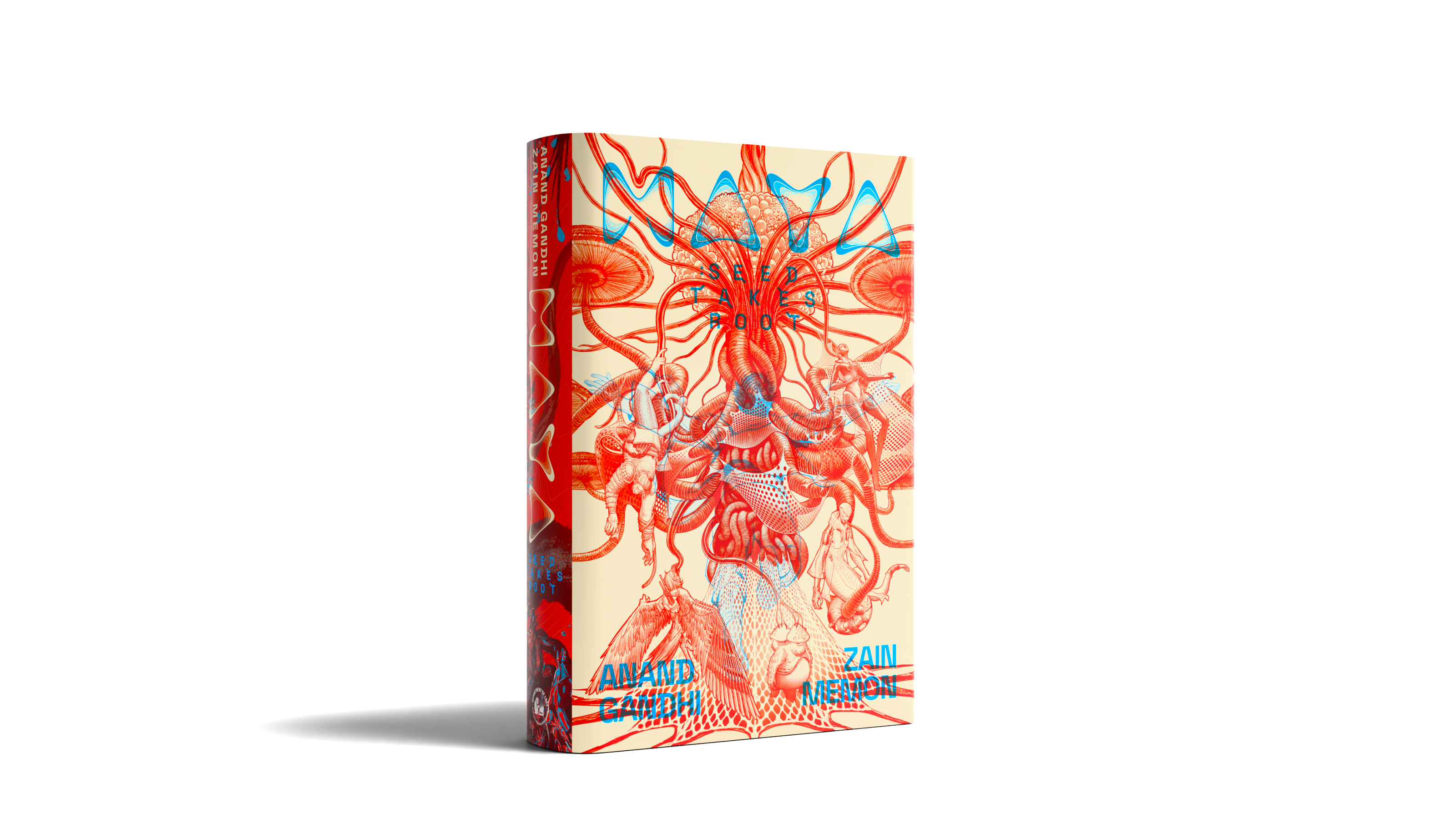
‘MAYA: Seed Takes Root’, the first novel in the universe, came out on August 26.
For those encountering it for the first time, I think it’s essential to establish this first: What is ‘MAYA’?
ANAND: MAYA is an expansive story universe with hundreds of stories already written into it, and more to come. It’s a fictional world on a planet called Neh, an Earth-like world that has undergone Earth-like evolution.
And Neh has millions of species that are very Earth-like. Yet they are different because they have followed slightly different evolutionary trajectories. On this planet, they are called Svaanka. Svaankas are thinking species with advanced thought and the ability to develop culture.
We have 14 languages being made in this world. But not a single one can be read or understood in isolation from the evolutionary pressures that led to the species’ emergence.
A Naag experiences everything in its surroundings through its heat bits. How would such a species think? What kind of logical systems would they use? So the Naags have a logical system that’s completely unique and alien to how a human mind thinks, and hence that language is completely alien from anything we have experienced or thought.
Neh uses a biological information infrastructure. Everyone tethers to trees every day by their own volition, and when they tether to a tree, the trees immerse them in fables, in play, and in the company of their dead. MAYA, is this tree network capable of producing vivid, lifelike dreams.
You describe ‘MAYA’ as a mythology for the 21st century. But we generally understand them as something that evolves over generations, right? Can mythology also be consciously created?
ZAIN: So mythology is fundamentally a distillation of anxieties, hopes, aspirations, and fears of a civilisation that an author or a group of authors or a school of authors, in most cases, sits down and undertakes.
In many cases, it does arrive slowly through word of mouth, through parables and tales, but very often do we see that it’s also a civilisational effort.
Currently, we are seeing a huge upheaval around us right now. 10 years from now, nothing will be the way it was 10 years ago. And this requires us to reconfigure our stories, our priorities, and even decipher where we are headed. ‘MAYA’ is that exploration of how mythology could look in the 21st century. The problem that many mythologies have is that they are canonical—they are set in stone and hence don’t evolve with time.
ANAND: Mythology also allows and equips us with the ability to produce contradictions or the ability to embrace contradictions. A single story may not have the facility for this.
Why does ‘MAYA’ need to exist? And why now?
ZAIN: The shape of ‘MAYA’ is familiar, but at the same time reimagined on a planet far away from now, that’s not in any way connected to Earth, with problems that seem surprisingly familiar—and that is what a good mythology does. It makes things immediate enough for you to know what the problem is and what it feels like and allows you enough distance so that you don’t feel attacked or defensive when an argument is being made. So, it’s simultaneously familiar and alien. The internet has been replaced by a sentient tree network.
Why now? Because there is a certain level of opacity all of us feel as to where we are headed. We’re living in extraordinary times of extraordinary opportunity, extraordinary fears, and extraordinary uncertainty. Times like this call for a dialogue where all the ideologies that are present in the world are allowed to collide with each other.
The very title, ‘MAYA’, invokes one of the most enduring concepts in Eastern philosophy. Beyond the name, how deeply do South Asian philosophical traditions shape the moral and metaphysical architecture of this universe?
ANAND: At the level of epistemological inquiry, ontological inquiry, and inquiry into consciousness, the toolkit that we deploy is made up of Indic philosophy and modern science. At the level of terminology, we have changed everything. ‘MAYA’, for example, does not mean illusion in our world; it’s not even necessarily a simulation.
MAYA in our world is an emergent phenomenon. What baffled the ancients was phenomena in which the whole emerges from the interactions of the parts yet displays properties not found in the parts at all. You can’t find wetness in hydrogen or in oxygen, but you find wetness in water. The ancients looked at wetness and called it ‘MAYA’. We gave it the meaning our ancestors were reaching for.
‘MAYA Seed Takes Root’
Why were these particular seven major species necessary? How do they help create a complete ecosystem?
ZAIN: The characters specifically were the last to come in. Honestly, it started with the stories we want to tell, the ideas we want to put out there. One condition we put on our biologists and evolutionary biologists was that the species need to be anthropomorphic in some sense. They need to have limbs and faces and be able to express themselves as humans do.
At the same time, we were drawing heavily on South Asian folklore from across South Asia, but we also wanted to update the species or beings we had inherited. So what you will see is names and species that sound familiar but are rendered entirely differently.
We wanted to render these species from the inside out: What does the cognition look like? What does their behaviour look like? What will the Garud’s voice sound like? What will the Naag’s movement look like? All of it was built from the ground up. So, it’s familiar, but it’s an entirely new rendering.
Many of your creations, including SHASN, AZADI, and even MAYA now, have often been more readily available in North America and Europe than across much of South Asia. Given your emphasis on creating stories from this region, shouldn’t the people of this region be able to get their hands on your creations first—or at least more easily?
ANAND: We agree with you completely. But the community has to also participate. The reason it's available in North America is not because we tried harder there, but because the community is more open. The community makes an equal effort to access the world, to go beyond Amazons of the world.
So I will definitely encourage everyone who wants more such work to happen in our region to also participate. And by participating, I don't need you to do much; I need you to do just what you do.
As a journalist, you have already participated, and you've done more than asked of you by talking to us today and by becoming the conduit between the community that you speak to and us. We need the participation to now come from the community because the products are here. We have built the infrastructure. We have created the studio.
A lot of this work has been done from scratch and ground up. There was no modern South Asian board game before Shasn was made. We have done it now over and over again with all the films. So now, the only thing that remains is we need to reach the community. You find 100 people in Nepal who are willing to buy Shasn, we'll make it available tomorrow.
ZAIN: You find me just one store in Kathmandu, and I'll send copies across.
I came across one of the MAYA clips where Zain was speaking about how the world-building process has been a deliberate, controlled and intentional one. So why did you choose ‘Seed Takes Root’, a novel, to introduce MAYA? And why not, say, a feature film? A film would’ve, perhaps, attracted more engagement with your work. And what informed the decision to unfold the larger universe in this particular sequence of books, games, films, and so on?
ZAIN: There are multiple reasons, both looking at narrative and how long it takes to build something. The first novel shares the same story as the first film. While we complete the novel, we also complete the screenplay for the film. The film does take three to four years after the screenplay is ready to be realised, so the novel had to precede the film by that amount.
Also, when you are making a mythology, it’s always the novel first. It always starts with the written word, where people start imagining or building this world in their own imagination. The written text is the cornerstone around which big mythologies are written.
The same logic applies to the tabletop game and the video game. The video game will take much longer to build than the tabletop game. So it's a mix of what sets the tone and story perfectly and also what just takes that long to build.
Language is a repository of a civilization’s memories, in that it is a condensed form of what that particular society idealises, reveres, remembers, fears, condemns, and aspires to. Given how deeply your work values South Asian knowledge systems and cultural traditions, why has English remained the primary language for most of your projects, including ‘MAYA’, instead of a regional language that could later be translated?
ZAIN: ‘MAYA’ is currently being translated into multiple languages worldwide. The idea is that eventually the story will be available in more languages than we can imagine. We are going to make sure that the film finds its language in whatever region you are in, in the comfortable language of that region. So, in India, it will be in the regional language of the state you are in; in Europe, in the regional European languages; and in the US, it will be in English. It's starting off as English, but it's not an English-language project.
ANAND: Right from the beginning, we said that we wanted it to be a project that makes dialogue possible. It is as much inward-facing as it is facing outward to the world. It's a project that hopes to become a two-way bridge, a way to participate in a global cultural dialogue. We haven’t had anything from India in a very long time that can occupy an equal place in the global cultural ecosystem.
How do you name the elements of ‘MAYA’? What’s the process?
ANAND: We have drawn from South Asian mythology for the naming convention and very often looked at names as titles, as more often than not job titles. Indra, for example, is a job title in South Asian mythology. We have also delved into the etymological roots of some words and borrowed those intentions, reinventing their meanings in the context of our fictional world and modern science.
Annapurna, for example, is the equivalent of a CEO of the world's food systems, borrowing from the goddess of nutrition. But we have borrowed heavily from all kinds of surprising sources: South American history, the modern tech world, modern policy thinkers.
Yachay comes from Quechua and means visible, knowledge and something to know; in this world, he is the unknown. One Divya is called Waaz-nayak, which comes from Steve Wozniak. We've had a lot of fun leaving these clues and hints as Easter eggs.
What were some of the biggest creative problems you faced in building ‘MAYA’?
ANAND: Frankly, we have not faced major challenges in creating MAYA. Creation is not a challenge. The challenge is finding the community in South Asia. Carpenters make furniture, and they don't complain about the tools they have; there’s just good carpentry and bad carpentry. At the end of it, it's really the culture that you are producing that's valuable or the culture that you are producing that's not valuable.
The larger challenge is that we are an emerging economy with urgent needs that pull us in different directions. There is an urgent need to feed everyone and improve nutrition and cognitive health. But it's also urgent to raise our epistemic health. Hence, science and journalism are extremely important. You cannot have physical health without epistemic health.
Similarly, there is an equally urgent value in ontological health, in worldview building, which is what narratives do. Traditionally, we think of these needs as a pyramid: once food is sorted, we talk about medicine and bridges, then science and policy, and finally philosophy and worldview. I argue that it’s a network, a feedback loop. You cannot have one without the other. Even the production of such agencies is the job of a storyteller, and hence it's as urgent as science and journalism, medicine and food. We need the community to say, “Hey, we do need this.”




 22.06°C Kathmandu