What happens when a bloodthirsty Cold War ends? Does it result in complete harmony at once, or do its effects continue to branch over time?
Mandala Theatre is screening ‘The Age of Darkness’, based on ‘Andha Yug’, a 1953 verse play by Dharamvir Bharati. Originally written at a time when the India-Pakistan partition was marked by violence, it was intended to serve as a reminder, a wake-up call to awaken humanity through the familiar backdrop of the legendary epic ‘Mahabharata’.
We know of Krishna providing moral support to Arjuna to restore what’s right, Bhishma dying in a bed of arrows, and many scenes that have always portrayed what violence looks like. But this play intentionally questions those heated judgments and actions, and whether their consequences are really worth the bloodshed.
It starts with the storytelling of the Mahabharata’s last day of war. The battle has already neared its end, but Dhritarashtra and Gandhari, the blind parents of the Kauravas, have no news of their sons returning. Distressed parents of war, in a conversation with Vidhur, reveal their regret at letting the war escalate so far, when there could have been a peaceful resolution.
Throughout the plot, the play’s live music brings the scenes to life. With Salina BK’s vocals and the melodious tuning of the flute and tabla, the music matches the plot’s intensity.
The story, for the most part, returns to Ashvatthama, Dronacharya’s son, who is presented as a morally ambiguous character. One of the Pandava brothers, Yudhisthira, lies to Drona that his son has died, putting the grieving father into a state of despair, ultimately contributing to his death.
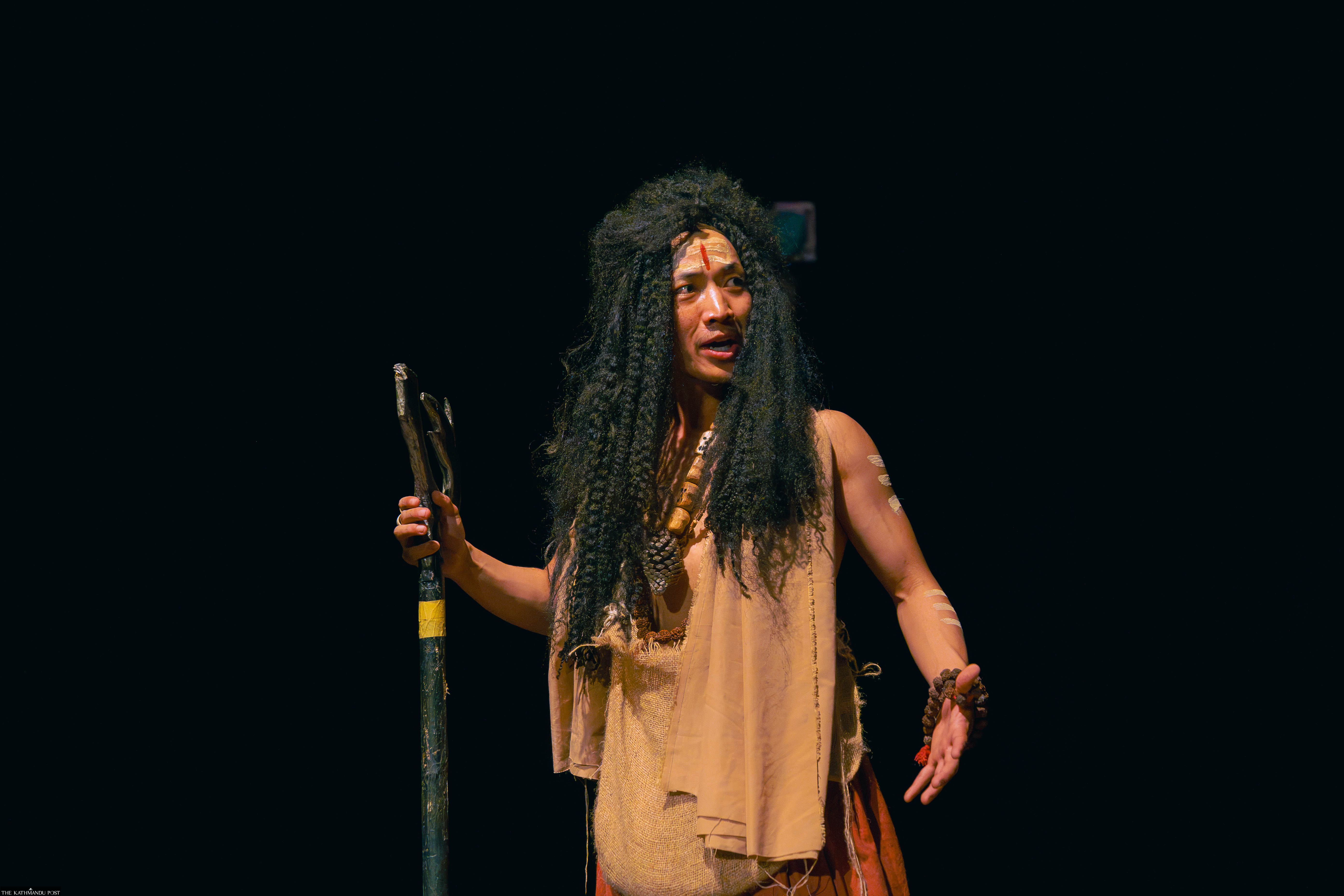
Ashvatthama is enraged, almost as if taking up the form of a ‘savage beast’, hungry for revenge. The actor playing this central figure, Sabina Chaudhary, has understood the portrayal of a character troubled by the echoes of war, one that costs his own sanity and morality.
Wild movements, heavy speech, and an anger that lingers in the actor’s facial expressions make Ashvatthama’s descent into madness feel almost physical, as though the violence of the battlefield has followed him beyond the war itself.
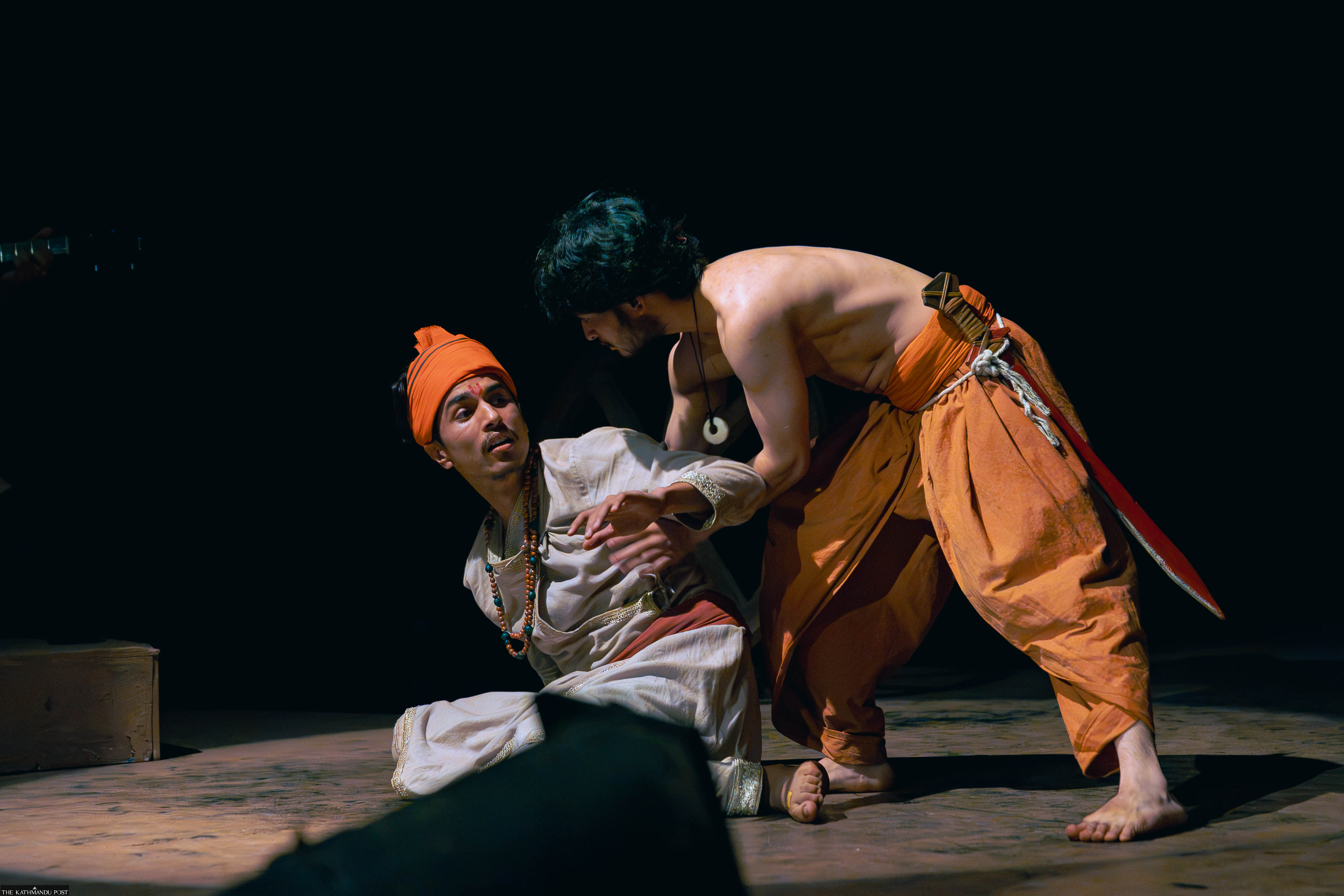
Following his madness, he, along with his peers, Kritacharya and Kritavarma, resorts to killing the Pandava’s sons and sleeping soldiers entirely in a nocturnal massacre. That serves as the play’s main anti-war allegory. Just to look at it from another perspective, Gandhari calls Ashvatthama ‘brave’, but the others around her see it differently. It is not a fair battle, where weaponless soldiers are hunted to death and burnt inside the tents they are sleeping in.
But he does not stop there; the reckless son of Drona, filled with anguish, does the unimaginable and unleashes the Brahmastra. He does not possess the knowledge or discipline to use it, yet he directs the weapon toward the womb of the pregnant Uttara to destroy the Pandava lineage.
Brahmastra is a celestial weapon in Hindu mythology, said to be the most destructive force ever to exist. Its casting, categorised by large fireballs, along with thunder and catastrophic noises, is a symbolic metaphor for the nuclear annihilation of the modern world. The play repeatedly draws such parallels, allowing the themes of an ancient epic to resonate with realities that are now possible.
The original play, ‘Andha Yug’, written in the aftermath of India’s independence, makes this connection particularly significant, as Dharamvir Bharati wrote against a backdrop of Partition, communal violence and the devastation left by war.
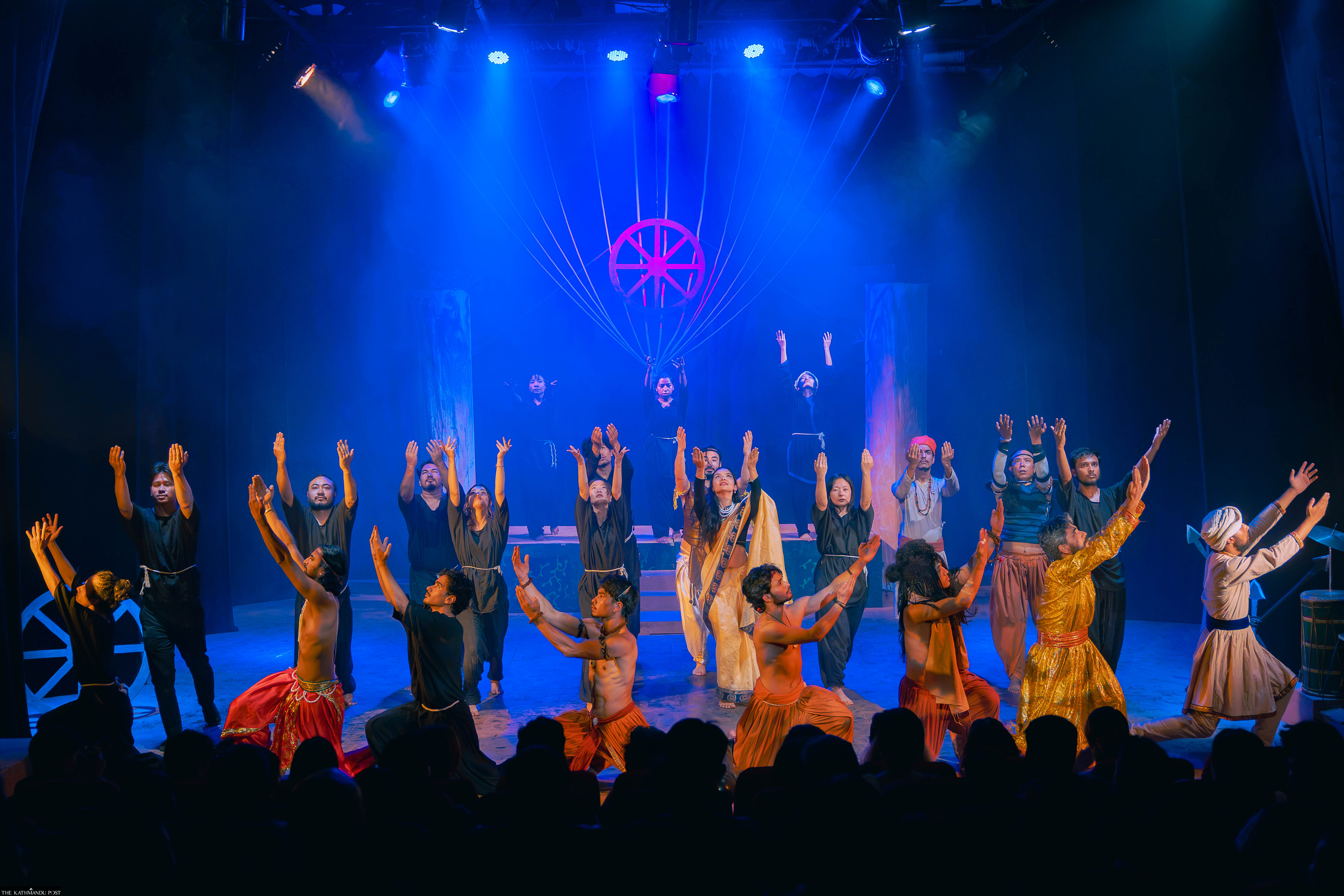
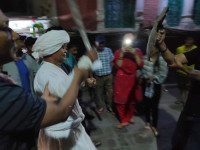
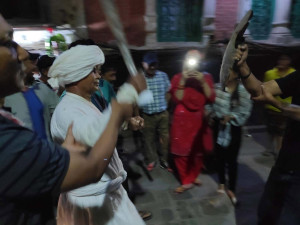
When narrating the events of this conflict, which resulted in numerous deaths and damage to nature, the play chooses to vocalise this through a large group of characters acting as guards or police. They come together, stomping their feet, spinning their spears in the air, and collectively narrating the events that have unfolded. It almost resembles a martial choreography embedded within the storytelling, its forceful movements and commanding voices echoing through the theatre as a deliberate reminder of the violence and destruction that have taken place. This particular narrative becomes a memorable part of the play.
Along with parallels to the modern world, the story hints at emotional dynamics. After all, a life loss is a relationship lost too. Gandhari’s devastation at Kaurava’s death is filled with anger. She is always anxious, anticipating her sons’ win, but the opposite happens. Her loss represents that of the relatives of people who perished in wars. After the battle comes to an end, Yuyutsu, one of the Kauravas, survives but only because he fought against his own brothers.
He returns home to his mother, yet her affection for him is lost, as his survival comes at the cost of the family he fought against. His isolation captures another consequence of war: even those who survive may find themselves unable to return to the lives and relationships they once knew.
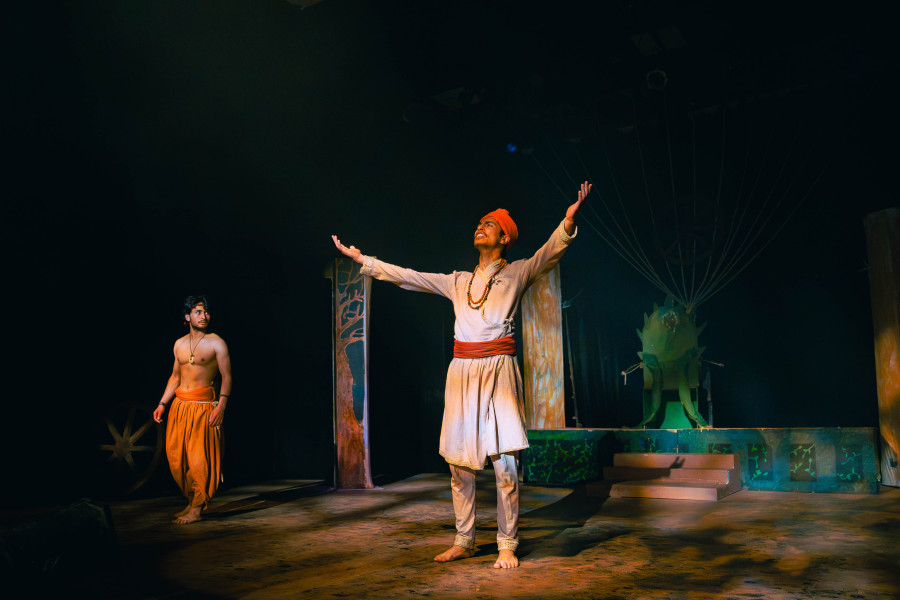
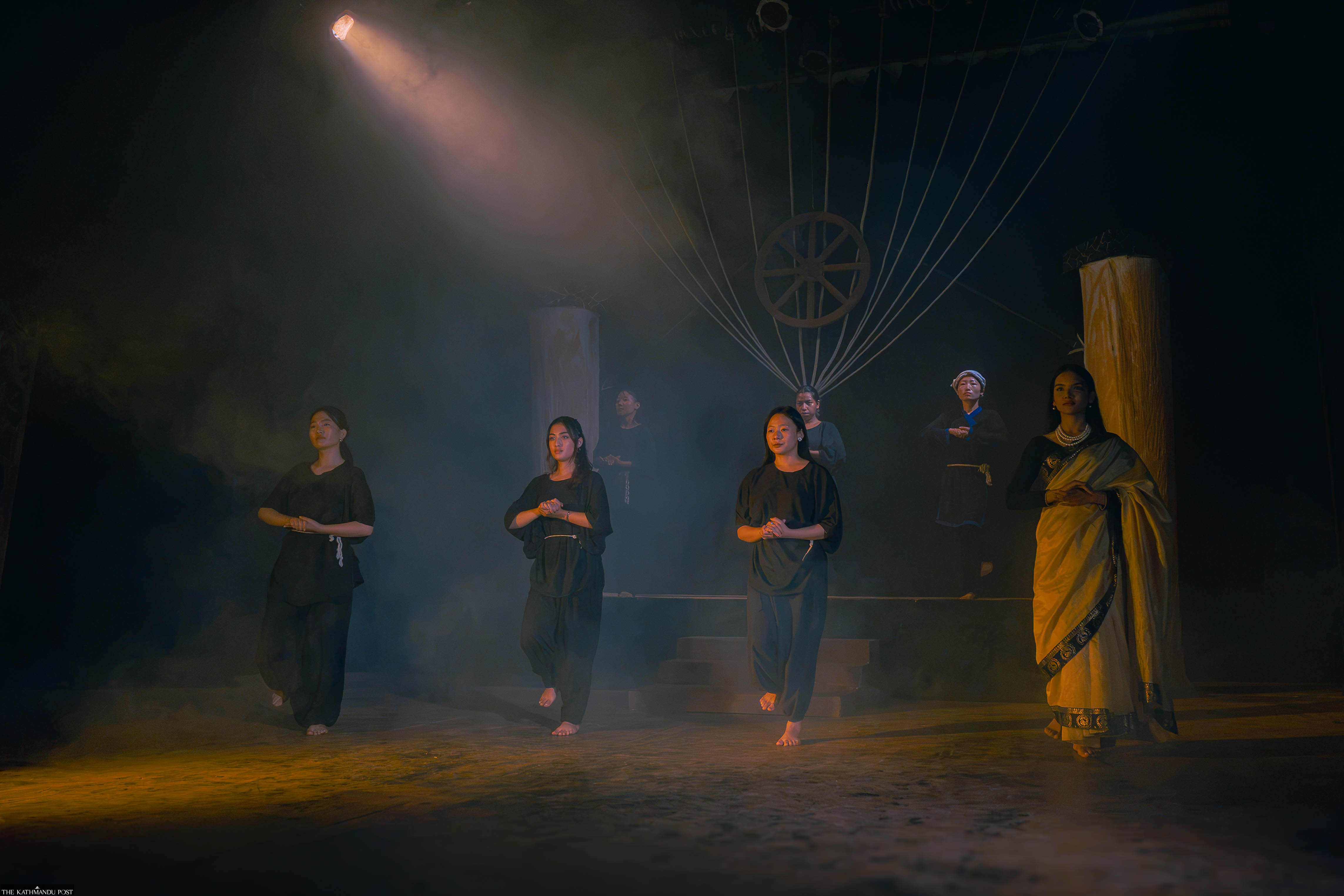
Adding to the dynamic plotline, the lighting manipulation intensifies the play’s atmosphere. Even when a character is praying to the heavens above or during a divine intervention, the colours are changed to become more neon and bluish. Similarly, when Krishna is being cast into a curse, the lighting on this character, who is a god, becomes noticeably lighter to present a different realm than ours. As an audience, there is an immediate sense that something has been altered, just through light manuevering.
The play’s visual set is more acted out than tangibly shown. When Kritacharya, Kritavarma and Ashvatthama stay in a cave, their helplessness is conveyed through the actors’ movements and positioning rather than an elaborate set. Other times too, the actors have emphasised where they now stand through their interactions within the limited space around them, allowing the audience to visualise the setting without it having to be physically constructed.
One aspect where the play falls short is in the coordination between line delivery and emotional expression. There are numerous scenes where characters are supposed to be infuriated with anger and pain. However, at times, their line delivery, filled with words borrowed from Hindu terminology, falters, ultimately rendering their delivery incoherent and making them sound as though they are spluttering.
Perhaps this sort of performance is a calculated move to convey the intensity of the characters’ emotions, but it comes at the cost of clear dialogue and a complete understanding of what the characters are trying to say.
At a time when news of war crimes, genocides and violence continues to dominate headlines almost every day, director Sudip Khatiwada, alongside Nepali adaptor Rajendra Salav, brings a series of acts to the stage that compel the audience to question whether war can ever justify such immense atrocities.
Almost 73 years after Dharamvir Bharati wrote the story, its continued relevance is perhaps the most disturbing part of all.




 14.59°C Kathmandu