Supreme Court orders government to regulate cannabis cultivation for medicinal and industrial use
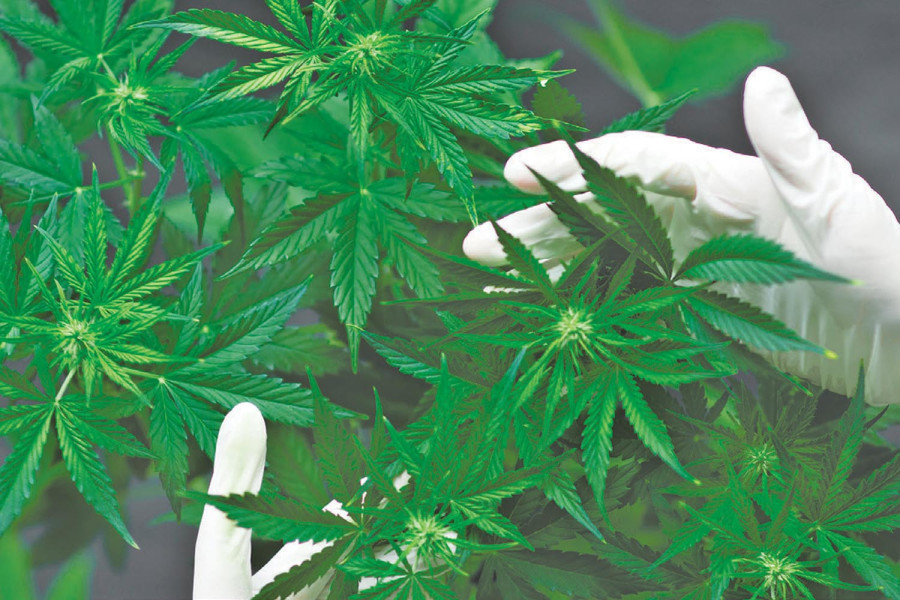
The court has given the government three months to introduce regulations, licensing requirements and monitoring mechanisms for controlled commercial cultivation, while calling for wider consultations on recreational use. Shutterstock
The Supreme Court has ordered the government to establish a regulatory framework for the controlled commercial cultivation and production of cannabis for medicinal, scientific, agricultural, horticultural and industrial purposes.
The court has directed the government to formulate the necessary regulations, standards and procedures within three months to ensure the effective implementation of the Narcotic Drugs (Control) Act, 1976.
A division bench of Justices Nahakul Subedi and Til Prasad Shrestha issued the ruling on May 18, 2025. The full text of the verdict was made public only recently.
The court ordered the government to put in place the necessary legal provisions within three months of receiving the order. These must cover the licensing and regulation of cannabis cultivation, production, processing, storage, use, sale, distribution, import and export for the specified purposes.
The ruling came in response to a writ petition filed by advocate Saroj Adhikari and others.
The court said the government had failed to exercise its delegated authority to frame rules under the Narcotic Drugs (Control) Act for a prolonged period, preventing the effective implementation of provisions intended to regulate cannabis cultivation and use.
It said the government must introduce regulations consistent with the Act and the 1961 Single Convention on Narcotic Drugs, particularly Articles 23 and 28, which provide for the control and supervision of cannabis cultivation.
The court directed the government to establish a strict regulatory and monitoring mechanism to ensure that licensed cultivation and production are permitted while preventing illegal cultivation, production, manufacture, preparation and distribution.
The full text of the verdict states: “The government shall, within three months of receiving this order, make the necessary legal arrangements, including regulations, standards and procedures, and establish a system for controlled cultivation and production of cannabis under the Narcotic Drugs (Control) Act, 1976. This must include a strict regulatory and monitoring mechanism governing the licensing of commercial cultivation, production, processing, storage, use, sale, distribution, import and export for medicinal, scientific, agricultural, horticultural and industrial purposes, while prohibiting unauthorised activities.”
On recreational cannabis use, however, the court said the existing law did not explicitly provide for such use and that the issue had wider social and economic implications.
It drew the attention of the Office of the Prime Minister and Council of Ministers to the need for broader consultations with subject experts and stakeholders, taking into account Nepal’s social, economic and cultural context, before considering amendments to the law.
The court said the legislation sought to prevent the social problems that could arise from uncontrolled cannabis use while allowing the state to regulate the sector and benefit from its potential.
It added that the government’s failure to frame rules needed to implement the law amounted to a failure to fulfil its legal responsibilities.
“The government has been authorised by the legislature to make rules to implement these provisions. It is therefore the duty of state authorities to formulate such rules without delay,” the verdict states. “The failure to do so amounts to a refusal or neglect by the government to discharge its legal obligations.”
The court said it had consequently found grounds to issue an order under Article 133 (2) and (3) of the Constitution, directing the government to frame the necessary rules for the effective implementation of the Narcotic Drugs (Control) Act, 1976.




 19.77°C Kathmandu