Five-day fire ritual next week for Bhotekoshi flood dead and missing
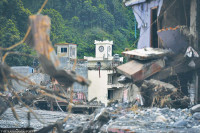
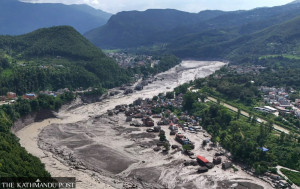
The ‘Pitri Moksha Yagya’ ritual at the Betrawati confluence will honour victims of the August 26 flood across Rasuwa, Nuwakot, Dhading, Gorkha, and Chitwan. The Betrawati town in the aftermath of the August 26 Bhotekoshi-Trishuli catastrophe. Post File Photo
A five-day ‘Pitri Moksha Yagya’, a fire ritual performed for the peace and salvation of the departed, will be performed in Betrawati, at the confluence of Trishuli and Phalanku rivers in Nuwakot district, next week in memory of those killed in the August 26 Bhotekoshi-Trishuli flood.
At least 1,457 people were killed and over 4,700 remain missing, while thousands were rendered homeless after the flood swept through towns and villages along river corridors in Rasuwa, Nuwakot, Dhading, Gorkha and Chitwan districts.
The ritual organised by the Kathmandu-based Guru Gorakhnath Peeth, will run from Monday to Friday at the site, where the late Hindu spiritual leader and scholar Yogi Naraharinath performed a large-scale fire ritual known as Kotihom in 1991.
“The Yagya will be performed by Nath yogis who are followers of Yogi Naraharinath,” said Prahlad Khatiwada, a resident of Bidur, Nuwakot and one of the organisers of the event. “Family members of the deceased can take part in the Yagya and pray for peace and salvation of the departed relatives.”
Betrawati is home to the renowned Uttargaya Dham, a major Hindu pilgrimage site where thousands of devotees gather every year on Paush Amavasya (in December-January) to perform shraddha (prayers and oblations) for their ancestors.
Betrawati also holds historical and cultural significance. It was where Nepal and Tibet signed the Betrawati peace treaty in 1792 following a war between the two. An annual ox-fighting event is held here on Maghe Sankranti (in mid-January) to mark the end of the conflict.
For centuries, Betrawati also served as a major trade route between Nepal and China. Before the flood, scores of container trucks passed through the area daily. The town, which had an old Newar settlement, also hosted traditional festivals, including Ekadashi Mela, Ram Navami Jatra, Krishna Janmashtami and Gai Jatra.
Despite the destruction in August, local youths have begun efforts to revive Betrawati, citing its religious, cultural, and commercial significance. Youths from the area living abroad are voluntarily raising funds to rebuild the local cremation site and temples.
Local residents say they do not want to abandon their ancestral town. “No one remembers a flood of this magnitude hitting this place before. Nor will such a disaster happen every year,” said Shashi Dangol, a Betrawati resident. “If everyone leaves just because of a flood, the significance of this place will cease to exist.”
Dangol criticised the government for failing to come up with a concrete rehabilitation plan more than two months after the disaster.
“We talk about rehabilitation, but the state gives us tents,” he said. “Can people live under tarps forever? We need a concrete rehabilitation plan developed with the participation of local people.”
Arjun Poudel is a health reporter for The Kathmandu Post. Before joining the Post, he worked for Sagarmatha Television, Naya Patrika, Republica and The Himalayan Times.




 15.54°C Kathmandu