Flood cuts off market access for Rasuwa farmers as vegetables pile up
Farmers in Gatlang had expanded cultivation after strong returns last year, but damaged roads and bridges now threaten to leave this year’s harvest rotting in the fields.
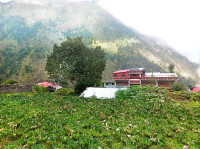
Last year, Chhiring Sangmo Tamang of Gatlang in Aamachhodingmo Rural Municipality-3, Rasuwa, sold vegetables worth Rs1.2 million. Encouraged by the income, she expanded her vegetable farming this year and was preparing to sell produce worth around Rs3 million.
Then came the flood on August 26.
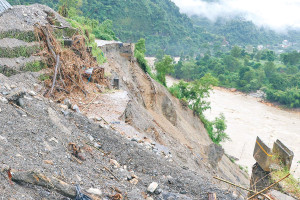
The flood did not directly damage her village, but it destroyed the roadconnecting Gatlang to the markets, leaving vegetables ready for sale stranded in the fields. Residents fear much of the harvest will rot in the fields if it cannot reach the market before Dashain.
“Vegetables worth millions are ready for sale in the fields. I have come to Kathmandu after falling ill from the stress of not being able to sell them,” Tamang told Kantipur. “With no road to take the produce to market, it is now at risk of rotting in the fields.”
More than a month after the Bhotekoshi flood, Aamachhodingmo Rural Municipality remains cut off from the road network. The flood swept away a concrete bridge at Betrawati, severing the municipality’s road connection.
Vegetable farming expanded across four of the municipality’s five wards, except ward 1, after the local government began providing subsidies to farmers. Tamang moved from Kathmandu to Gatlang two years ago to take up vegetable farming. After the farm began generating a good income, she left her children in her mother’s care in Kathmandu and returned to the village.
“I returned to the village to farm, earn a living and educate my children. I had brought my mother to Kathmandu to look after the little ones while I continued farming,” she said. “Now, if I cannot sell the vegetables, they will rot in the fields. I am worried that my investment and hard work will go to waste.”
Tamang said she had borrowed Rs400,000 from a bank to invest in vegetable farming.
She is even willing to contribute labour to rebuild the road and bridge connecting the village to the market.
“I am ready to contribute labour to rebuild the road. I wish the government would listen to us,” she said.
Surendra Tamang, chairman of ward 3, said there was little prospect of rebuilding the road and bridge immediately. He said the local unit had asked the World Food Programme to use the helicopter delivering food to the village to transport the vegetables to market.
“Cabbages are ready in the fields, but if they do not reach the market in time, they will rot,” he said. “We discussed using the World Food Programme’s helicopter to transport the vegetables, but that was not possible.”
Ward 3 alone sold vegetables worth around Rs30 million last year, according to the ward chairman.
“Farmers had expanded cultivation because they were getting good prices in the market. The Bhotekoshi flood has dealt them a huge blow,” he said. “Cabbages, radishes, potatoes and beans are ready across the village, but they have not been able to sell any of them.”
Around 400 households in Gatlang are engaged in commercial vegetable farming. Residents currently have to walk from Gatlang to Syaphrubesi. A tuin (improved cable crossing) has been installed in Syaphrubesi, while foundation work for a Bailey bridge is underway, according to the National Disaster Risk Reduction and Management Authority.
Chandika Tamang, vice-chair of Aamachhodingmo Rural Municipality, said the local unit had purchased and distributed vegetable seeds worth around Rs1 million during the last fiscal year.
“There is little the rural municipality can do until the road is rebuilt. Farmers are in a difficult situation because the road link has been cut off just as the vegetable harvest is ready for market,” she said.
The rural municipality estimates that around 5,000 people are affected, as vegetable farming is the main source of livelihood in the area.
The local unit had planned to send vegetables worth Rs70 million to Rs80 million to market this year. Cabbages, potatoes, radishes and beans grown in the colder climate had been fetching good prices, Chandika said.
Surenrad said the government should provide compensation or subsidies if farmers’ produce goes to waste.
“Instead of focusing only on food relief, the government now needs to prioritise rebuilding the roads and bridges needed to sell the vegetables,” he said. “If farmers cannot sell their produce, the government should provide subsidies to help them cope with the losses.”
Vegetable farming is the main occupation in the area, and he warned that farmers could face food shortages and struggle to pay for their children’s education.
The government says work is underway to reopen the road network up to Betrawati.
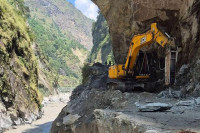
According to a situation report from the National Disaster Risk Reduction and Management Authority, authorities have cleared all of the blocked sections along the 9.8-kilometre stretch between Bidur and Betrawati. Foundation work for a Bailey bridge at Betrawati is also underway.
The authority has recommended that restoring roads and bridges be treated as a priority.
Restoring the road and bridge network linking Aamachhodingmo, Gosaikunda and Uttargaya rural municipalities, as well as Dhunche bazar, Dhunche Hospital and the Dhading district headquarters, is ‘extremely urgent and essential’ under the current circumstances, the authority said. Work to reopen the Dhunche-Betrawati road is in its final stage, while construction of a Bailey bridge over the Betrawati river has also begun.
The authority said tuins had already been installed at three locations: Devighat, Indreni Chaur and Syaphrubesi. Work is underway to install two more at Hakubasi and Pairebasi.
The government has set a target of repairing a total of 20 suspension bridges by mid-October.
“Repairs are underway on five bridges, while the contracting process for repairs to the remaining 15 is being advanced,” the authority said in its report. “Work is also underway to expedite the design and tendering process for the construction of new suspension bridges deemed essential.”




 20.83°C Kathmandu