Can new rules bring order to senior advocate selection?
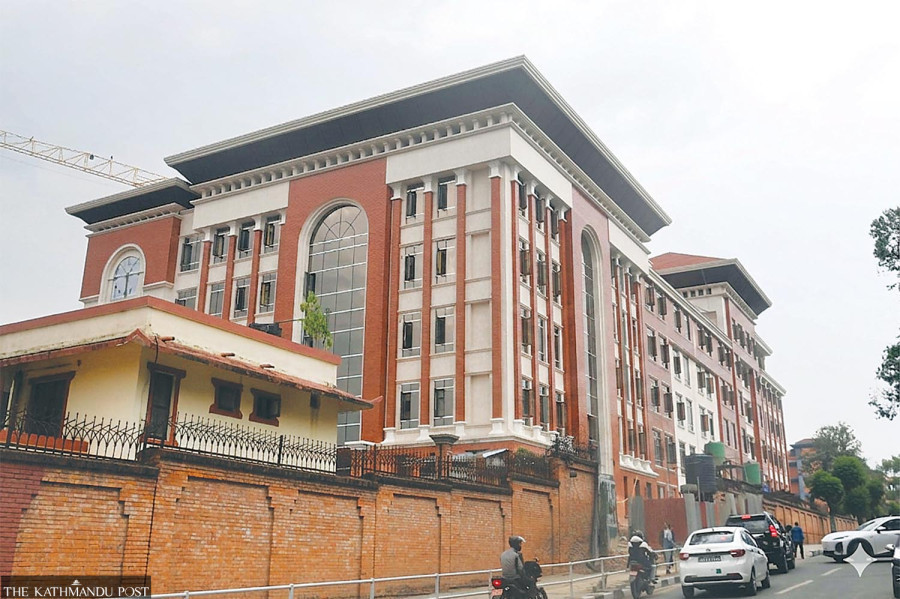
A special committee will review past appointments and develop clearer criteria based on lawyers’ professional performance and contribution.The Supreme Court building. Post Photo
The Supreme Court is preparing to overhaul the way it awards the title of senior advocate, with a new special committee tasked with developing clearer criteria based on lawyers’ professional performance and contribution.
The move follows years of criticism over the way the prestigious title has been awarded. The full court has formed a three-justice committee to review the existing criteria, study past appointments and prepare a new roster of lawyers eligible for the title.
The committee is led by Justice Saranga Subedi, with Justices Nripadhwaj Niraula and Meghraj Pokharel as members. Chief Registrar Bimal Poudel is the member-secretary.
Subedi said the title is meant to be an honour bestowed by the country’s highest court and should reflect that status.
“We reviewed past appointments and found the selection process to be quite disorderly. There have been many questions about it,” Subedi told Kantipur. “As this is an honour conferred by the full court of the Supreme Court, it should be held to the highest standard and treated accordingly.”
The committee plans to study the issue before travelling to locations with high courts to gather suggestions and develop new criteria. Subedi said the committee would retain positive aspects of the existing system while introducing a new approach.
She said the new framework would also include provisions to suspend or revoke the title if a senior advocate engages in misconduct or violates professional rules or the law. No such provision was available under the previous system.
740 senior advocates among 23,752 lawyers
According to Nepal Bar Council data, 23,752 people currently hold advocates’ licences, including 18,135 men and 5,617 women. Of them, 740 have been awarded the senior advocate title. Nearly one-third of all licensed advocates have not renewed their certificates, according to the council.
The first recipients included Krishna Prasad Bhandari and Mahadev Yadav. Later rounds included prominent lawyers such as Sarbagya Ratna Tuladhar, Radheshyam Adhikari, Bishwa Kanta Mainali and Sindhu Nath Pyakurel. Other recipients have included Prem Bahadur Khadka, Harihar Dahal, Shambhu Thapa, Sushil Kumar Pant, Chandra Kanta Gyawali, Raman Shrestha and Satish Krishna Kharel.
The title has its legal basis in the Nepal Bar Council Act, which gives the Supreme Court’s full court the authority to confer it. Under Section 21, advocates who have practised for at least 15 years in the Supreme Court or appellate-level courts and have maintained the profession’s high standards while contributing to the court and society may be honoured as senior advocates.
The provision has been in use since the Nepal Bar Council Act was introduced in 1993, but the process has repeatedly attracted criticism. The Supreme Court issued formal criteria for awarding the title in 2020, seeking to make the process more systematic.
Lawyers say the title of senior advocate is more than a formal designation. The honour it carries should be demonstrated through conduct, not merely through a certificate.
What does the title mean?
The title carries considerable weight within Nepal’s legal profession. Senior advocate Chandra Kanta Gyawali said courts and clients view senior advocates differently, and the designation can affect professional fees for advocacy and legal advice.
“Once someone becomes a senior advocate, the way the court and society view them changes,” Gyawali said. “They can charge fees for advocacy and counselling accordingly. Senior advocates are treated on a par with Supreme Court judges, and the Constitution recognises their status.”
Senior advocates are also subject to additional professional obligations. Bar Council rules require them to maintain professional dignity and have a junior advocate assist them. Under the Rules of Professional Code of Conduct for Legal Practitioners, 2023, the junior advocate is generally required to argue a case first, with the senior advocate concluding the submissions.
Senior advocates are also barred from appearing before quasi-judicial bodies. Those who breach the rule can face warnings and, for repeated violations, suspension. They are also expected to take the junior advocate assigned to them through the case process and cannot refuse to accept interns sent by the Bar Council.
A proposed new law would also require applicants for the senior title to have paid their taxes, renewed their licences and submitted proof of professional tax payments, with tax clearance required every five years. The bill is still in draft form, however, so the existing law and Supreme Court criteria remain in force.
Why has the title been controversial?
The title has long faced criticism, particularly over appointments involving lawyers who were no longer actively practising and concerns about the consistency of the selection process.
The largest single batch was awarded during the tenure of then-Chief Justice Gopal Prasad Parajuli, when 272 lawyers received the title on August 11, 2017, based on their licence numbers. Bar officials say the move contributed to a decline in the title’s prestige.
The Supreme Court later awarded the title to 133 lawyers in 2022. Among them were then Minister for Law, Justice and Parliamentary Affairs Govinda Sharma Koirala, then-Attorney General Ramesh Badal and advocate Krishna Bhakta Pokharel, who was then chair of the parliamentary Law, Justice and Human Rights Committee. All three had long legal careers, although Pokharel was by then appearing in only a limited number of cases.
In September 2024, the full court conferred the title on another 159 lawyers.
Earlier rounds have also drawn criticism. During the tenure of then-Chief Justice Khil Raj Regmi, the full court decided to confer the title on 72 lawyers, prompting objections over the inclusion of people who were no longer actively practising.
The appointments of several lawyers also drew controversy. They included former Speaker of the House of Representatives Subas Chandra Nembang, who had left legal practice to enter active politics; Amber Pant, who was serving as head of Nepal Law Campus; Bed Prakash Shiwakoti, who had become a commissioner at the Commission for the Investigation of Abuse of Authority; and Jagannath Paudel, who was active in Nepali Congress politics.
Other disputed appointments over the years included lawyers who had moved into senior government, academic or institutional positions. Former government secretary Chudamani Raj Singh Malla, for example, received the title shortly after retiring from the civil service. The appointment was reportedly controversial within the Bar at the time.
Other appointments also drew questions, including that of a lawyer working for the United Nations, as well as retired officials from institutions such as Nepal Rastra Bank and Nepal Bank, former law professors, government lawyers, and former Supreme Court employees and registrars who had spent relatively limited periods in private practice.
Nepal Bar Association president Bijay Prasad Mishra said the process should be transparent and worthy of the honour attached to the title.
“The title of senior advocate should not be awarded based on political considerations, access or personal connections,” Mishra said. “In the past, decisions were sometimes driven by an attempt to accommodate everyone and keep everyone happy, which created controversy and diminished the dignity of the title. That needs to change.”




 18.81°C Kathmandu