Decade-old alternative to a vital Prithvi Highway link remains on paper
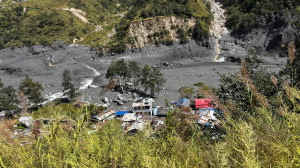
The collapse-prone Krishnabhir section of the Prithvi Highway has exposed the lack of a parallel route on the other side of the Trishuli river, despite plans dating back nearly a decade.A track being opened above the Prithvi Highway section that collapsed in the Trishuli floods, at Krishnabhir, Dhading. Poshnath Adhikari/TKP
The worsening risk of landslides and road collapse at Krishnabhir on the Prithvi Highway has renewed interest in a parallel road proposed nearly a decade ago as a safer alternative.
The route, to be built along the other side of the Trishuli river, was studied alongside the World Bank-backed upgrade of the Naubise-Muglin section of the highway. Detailed studies were completed for two sections in Dhading—Sisne-Dharke and Bishaltar-Fisling—but construction never took off.
Now, after the highway was blocked for nearly two weeks, the need for an alternative route has become immediate. Prithvi Highway is the main road link between Kathmandu and much of central and western Nepal, carrying passengers as well as large volumes of food and other essential goods into the capital.
Detailed studies covered the 94.66-km Naubise-Muglin highway, the 12.4-km Sisne-Dharke section and the 15.3-km Bishaltar-Fisling section. Completed in July 2018 after about 18 months of work, the study report was destroyed in a fire during the Gen Z protests, and the Department of Roads is now searching for a digital copy.
The proposed parallel roads were never taken forward largely because of the cost of acquiring private land and compensating affected households, according to officials at the department.
The study estimated that building the Sisne-Dharke section would cost Rs4.3 billion, including Rs1.75 billion for land acquisition and compensation for houses and other structures. About 500 ropanis of land would have to be acquired. The section would also require a 180-metre tunnel, estimated to cost Rs575 million, as well as four bridges, 29 pipe culverts and 10 box culverts. Some 1,620 trees would have to be removed.
The 15.3-km Bishaltar-Fisling section was estimated to cost Rs6.05 billion. About 350 ropanis of land would have to be acquired at an estimated cost of Rs2.9 billion, with another Rs147 million required for managing houses and other structures. The study also identified the need to remove 5,190 trees and build seven bridges, 23 pipe culverts and eight box culverts.
“The World Bank only carried out the study. At the time, the project did not move forward because land compensation would have cost more than the construction itself,” said Bijaya Jaisi, director general of the Department of Roads.
The approach now is different, Jaisi said. Instead of acquiring large amounts of land for an entirely new road, the government plans to upgrade tracks already opened by provincial and local governments.
“We do not think land acquisition will be necessary now because we will improve roads already built by the provincial and local governments,” Jaisi said. “We will add gravel and improve sections where the road is too narrow or where bends are sharp.”
The immediate focus is on creating a usable alternative to Krishnabhir rather than building the full parallel highway originally envisaged.
Minister for Infrastructure Development Sunil Lamsal said work was underway to upgrade the road between Benighat and Fisling on the opposite side of the Trishuli. The government aims to blacktop the route before Dashain by linking the roads leading to the Benighat and Fisling bridges.
“We are trying to open the road to traffic by widening a temporary track at Krishnabhir, but it does not have much of a future. Krishnabhir could collapse again. It is already close to giving way,” Lamsal told Kantipur. “We are not relying heavily on Krishnabhir, which is why work on the alternative road on the other side is also under way.”
The urgency has grown since the Bhotekoshi floods of August 26 caused the Trishuli to swell. On August 30, the Krishnabhir section of the Prithvi Highway subsided, cutting traffic along roughly 300 metres of the route and forcing vehicles travelling into Kathmandu to use alternative roads.
Lamsal said the government had approved the Benighat-Fisling upgrade through a shortened contracting process and that construction had begun.
“Many bridges were washed away by the Bhotekoshi floods, but the Benighat and Fisling bridges survived,” he said. “We have started upgrading the parallel road to connect the two bridges. We will improve the tracks opened by the province and local governments, and open new tracks where necessary. Our target is to blacktop the road on the other side of the Trishuli before Dashain.”
Officials say an immediate decision on whether traffic can safely resume through Krishnabhir is expected within a week.
“We are working to keep traffic moving through Krishnabhir if possible,” Jaisi said.
Engineers are also studying longer-term solutions at the site. An option is to build two tunnels, each about 500 metres long, to bypass the landslide-prone section. Another is to build a bridge near Krishnabhir to cross the Trishuli and a second bridge farther along to return to the existing highway.
“We are studying whether tunnels or bridges would be cheaper,” Jaisi said. “Only after that will we know what further steps are needed.”
The failure to develop the alternative route earlier has drawn criticism from officials and transport planners.
Arjun Jung Thapa, a member of the National Planning Commission and former director general of the Department of Roads, said the Bishaltar-Fisling road should have been built years ago.
“The DPR was prepared, and an environmental impact assessment was carried out,” he said. “But the Ministry of Finance stopped it, saying it could not provide so much money for compensation. Now we have reached a point where that road has to be built. If we had built it then, the problems at Krishnabhir would have been less severe now.”
An overview of the Trishuli River (left), the collapsed section of Krishnabhir along the Prithvi Highway, and ongoing construction ofa diversion above the damaged section pictured Friday. The blockage since August 30 has disrupted supplies to Kathmandu.
Thapa said the government should locate the earlier study, even if it means getting the report from the consultant, and revive the project.
For now, traffic is being diverted through a patchwork of roads that were never designed to serve as a full alternative to the Prithvi Highway.
Vehicles travelling towards Dhading, Gorkha and Pokhara can cross the Trishuli at the Mastar bridge near a restaurant in Galchhi Rural Municipality-4 along the Naubise-Malekhu section and continue towards Parewatar and Dhadingbesi. That route is about 20 km long, according to Jaisi.
Another option is to cross at the Fisling bridge in Chitwan and travel towards the Benighat bridge in Dhading. That route is about 17.5 km. Around 1.5 km remains problematic, and the department has begun work to open a track there.
Jaisi said tenders had been invited through an accelerated process to plug the missing link. About 10 km of the route was built by the provincial government and another 6 km by local governments and is already in use.
From Mastar, vehicles can travel through Parewatar, Dhadingbesi and Arughat towards Gorkha.
The government is also directing traffic towards Chitwan and other destinations through the Kanti Highway. The BP Highway and other roads remain open, but officials acknowledge that these routes are not ready to absorb all the traffic normally carried by the Prithvi Highway.
The disruption is already affecting supplies to Kathmandu, home to more than 3 million permanent residents, according to the 2021 census, with the number of temporary residents believed to be higher. Thousands more travel into and out of the Valley each day for work, education, trade and other purposes.
With major festivals approaching, the disruption is likely to become more consequential.
Travel times have increased sharply on alternative routes. A journey from Hetauda to Kathmandu that normally takes about three hours can now take more than five hours because of congestion.
The Tribhuvan Highway is narrow and winding, complicating the movement of large trucks and long-distance buses. The Kanti Highway is also unsuitable for all types of vehicles, while some bridges along alternative routes have limited load-bearing capacity.
A Department of Roads source said the problem highlights a broader weakness in Nepal’s road network: alternative routes are often not sufficiently developed to take over when a major highway is blocked.
Krishnabhir has been prone to landslides for decades. The first major landslide there was recorded in 1999, according to local residents. A large landslide on August 11, 2000 blocked the highway for 11 days.
Because the slope was unstable both above and below the road, authorities carried out stabilisation work in 2004 using bioengineering and retaining-wall techniques.
The slope began showing renewed signs of instability in October 2025, when water caused the road to deform and subside. The Department of Roads subsequently worked on micro-piling and horizontal anchors after the Trishuli began eroding the slope below the road. Drainage and concrete works were also undertaken to prevent water from entering the paved surface.
The latest major landslide, 26 years after the first, has occurred while the section itself is being upgraded with a concessional World Bank loan. The Malekhu-Muglin Road Project had already identified the section as particularly difficult to work on because of its geological and landslide risks.




 15.66°C Kathmandu