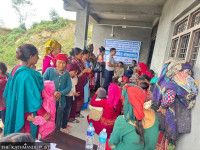
Children who survived the August 26 flood are struggling with sleepless nights, panic, and memories of family members lost, while officials and aid workers race to address a quieter aftermath.
Sixteen-year-old Samiksha Dangol was on her way home from school when she saw her father coming towards her.
It was the morning of August 26 at Tribhuvan Trishuli Secondary School in Nuwakot, a district north-west of Kathmandu. Samikshya, a Grade 11 student, had been sent home after the school received warnings that floodwaters were rising.
Her father had come to take her home.
But the two did not get far. A traffic police officer stopped them and warned that the flood was rising and that they should not cross the bridge.
They waited, assuming the rest of the family had already fled.
They had not.
When Samiksha and her father learnt what had happened, both collapsed.
Her older sister, brother and two aunts (father’s sisters) were missing in the flood.
Days later, after staying at a temporary holding centre, Samiksha moved to her maternal relatives’ home. The water has receded, but August 26 keeps returning to her.
She struggles to sleep. Memories of playing with her siblings surface without warning. She cries and feels restless.
“I tell myself to forget it,” she said. “But I keep thinking about my sister and brothers. The things we did together keep playing in my mind.”
The physical effects have been difficult too. Samiksha, who already suffers from migraines, became so unwell that she and her mother had to be taken to hospital. The family had lost so much that even the medicine she normally took was unavailable.
For children like Samiksha, the disaster did not end when the floodwaters fell. Across Nuwakot, Rasuwa and neighbouring districts, children who survived the floods, witnessed destruction or lost relatives are now confronting a less visible aftermath: fear. Some wake in the middle of night. Some become withdrawn. Others panic at sounds that remind them of the disaster.
In Rasuwa, Karsang Tamang’s 21-month-old son becomes frightened whenever he hears a loud noise.
On August 26, Karsang grabbed her sleeping son and ran as floodwaters swept through the area around Timure, Rasuwa. People were screaming and running in panic.
Since then, even the sound of a helicopter can make the toddler cry.
“He had never been like this before,” Karsang said. “Now he gets startled and frightened from time to time. When he panics, it causes me a lot of pain too.”
Karsang is sheltering at Yellow Gumba (Buddhist monastery) in western Kathmandu. She is more worried about her young son than about what she herself endured.
The scale of the impact on children is difficult to measure.
UNICEF estimates that 17,000 children have been affected by the floods in Nepal. Data from Nepal’s National Disaster Risk Reduction and Management Authority show that 6,901 students at 19 schools in Rasuwa, Nuwakot and Dhading were affected. Local education offices, municipalities and schools estimate that 622 students in Rasuwa and Nuwakot alone remain unaccounted for following the Bhotekoshi flooding.
The numbers capture the scale of the disaster. They do not capture what it feels like for a child to hear a helicopter and be taken back to the moment they ran for safety, or to close their eyes and see a missing sibling.
Some children were found after spending hours or days trapped by the flood.
A six-year-old girl rescued from Timure on August 28 was among them. An Armed Police Force search team heard what sounded like a child crying and followed the sound. They found her injured and brought her to Kathmandu, where she is receiving treatment at Tribhuvan University Teaching Hospital.
Her mother, Geeta Magar, said the girl barely spoke during the first days in hospital.
“She would just keep looking at me,” Magar said. Doctors told the family that the child appeared to have forgotten some things after the flood and had also developed pneumonia.
For aid workers who arrived at temporary shelters, the change in the children was immediately visible.
At the holding centre at Chandrajyoti Secondary School in Devighat, Nuwakot, Nepal Scouts volunteer Hritik Magiya saw children who were initially too frightened or withdrawn to participate in even simple activities.
“When we first came here, the children were in a very different state,” he said. “They were very sad and afraid, wondering what to do if another flood came.”
Some had lost parents or other relatives. Others were waiting for family members who had not yet been found.
In the first days, Magiya said, many children would sit apart from the group. Even when volunteers organised games, some refused to join.
“They were quiet and did not participate in any activities,” he said.
That response is not unusual after a disaster, mental health specialists say.
Psychiatrist Dr Amit Jha said children can be particularly vulnerable because they have fewer resources than adults to understand and regulate fear and stress.
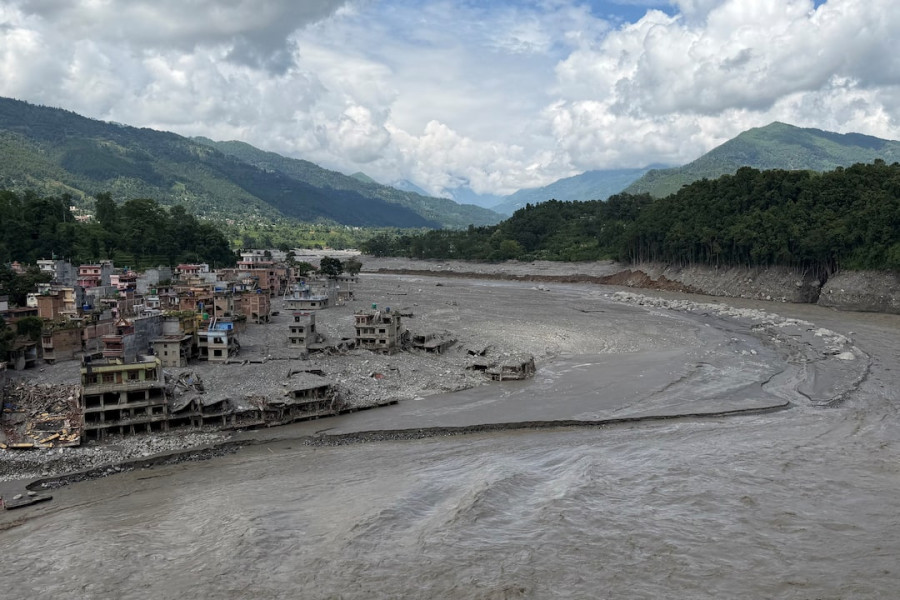
Damaged properties along the Trishuli River where the Tribhuvan Trishuli Secondary School once stood, before it was destroyed by deadly flash floods and mudslides, in Nuwakot, Nepal, August 31, 2026. Reuters
After a disaster, children may have difficulty sleeping, experience a racing heartbeat, sweating or rapid breathing. Such symptoms can form part of an acute stress reaction. If they continue for several weeks, they may develop into anxiety or depressive disorders. In some cases, particularly among children who directly experienced the disaster or lost relatives, prolonged trauma can develop into post-traumatic stress disorder (PTSD).
The psychological impact can extend beyond children who were physically caught in the floods.
Children elsewhere may also be affected after repeatedly watching footage of floods and landslides on television or social media, Jha said. Repeated exposure to distressing images and accounts can leave children frightened, anxious or restless even if they were nowhere near the disaster.
For that reason, adults should be careful about what children see and hear, he said, particularly in the immediate aftermath.
The challenge facing Nepal now is to prevent an emergency response from becoming another source of trauma.
For children who have lost parents or guardians, the stakes are especially high.
“There are many children who have lost their father, mother or guardians,” said Geeta KC Darnal, a child protection officer with Sahayatri Nepal. “We cannot fully understand the pain of losing a parent at such a young age. The immediate priority is to help them come out of the trauma.”
Government agencies and aid organisations have begun providing psychological and psychosocial support.
The National Child Rights Council says it is coordinating with volunteers, counsellors, doctors and local authorities working in affected areas. “The council is also collecting information on the number of children killed and affected in the disaster,” Ram Bahadur Chand, an information officer at the council, said.
Bidur Municipality, meanwhile, says medical teams from all three levels of government are providing mental health and psychosocial counselling. Child-focussed organisations have also established services at holding centres.
The municipality is preparing residential arrangements for children who have been separated from their families or otherwise left without adequate care. Two residential schools have been selected to accommodate some of them.
At the holding centre, officials and aid workers have also tried to give children space to play and return, as much as possible, to familiar routines.
That can be more important than it sounds.
Magiya said the children at the Devighat centre gradually became more engaged after volunteers spent time with them, played games, and told stories.
“We gradually involved them in different activities while also feeding them,” he said. “We played games with them on the school grounds, spent time with them and told them stories. We also asked them to sketch and draw with coloured pencils.”
The children who had initially avoided the volunteers eventually began approaching them on their own.
Some now remember the volunteers’ names, play with them and talk to them.
Yet children who lost relatives still become visibly sad from time to time.
The recovery, experts say, will not be measured simply by whether children return to school or leave temporary shelters. Trauma can emerge slowly.
Milan Dharel, a former executive director of the National Child Rights Council, said the effects of disasters can be physical, psychological and socio-economic.
There is another danger: children who lose the protection of their families can become vulnerable to trafficking, child labour, violence and abuse. Dharel warned that even efforts presented as protection can become mechanisms for exploitation.
The risk has become particularly visible on social media, where images and videos of children affected by the floods have circulated.
Offers to take children in or raise them may appear sympathetic, but child protection officials urge caution. Children can also be exploited through fundraising, online content, or institutions claiming to provide shelter, Dharel said.
The government, he said, has two immediate responsibilities: ensuring that search-and-rescue operations remain child-sensitive, and monitoring anyone who assumes responsibility for a child separated from their family.
Authorities have also warned against another form of harm: turning children’s suffering into public content.
The National Child Rights Council and Nepal Police have urged the public and media not to publish photographs, videos, or personal information that could identify children affected by the floods. Such exposure can violate their privacy and dignity and cause lasting harm to their mental health.
For children already carrying memories of homes swept away, relatives disappearing and adults screaming in fear, the recovery may depend on more than rebuilding roads or bridges.
Psychiatrist Jha calls the first response “psychological first aid”.
Children need to feel safe, he said, adding, adults should reassure them that they are protected, rather than repeatedly asking them to recount what happened.
Parents can help where they are present. Where parents have died or remain missing, relatives, communities and the state must take their place.
The most useful response can be remarkably simple: stay with the child, listen and allow them to speak when they are ready, Jha said.
Children should also be helped back into ordinary life as soon as circumstances permit, including a return to school.
The floods have left the country with damaged infrastructure, disrupted communities and families still searching for those who have not returned. But for children such as Samiksha, the disaster continues to affect daily life. She still struggles to sleep and is often reminded of her siblings and the things they did together.




 12.71°C Kathmandu