In Nuwakot’s flooded villages, grief comes before rescue
As the search for bodies drags on, survivors in the river settlements are searching for loved ones trapped beneath collapsed homes, and waiting for the government to arrive. Pasang Tamang lost her five-year-old son after the flood swept away the school in Angitar. Photo: Angad Dhakal/TKP
Three days after the Bhotekoshi flood, relief has yet to reach many affected areas in Nuwakot, one of the two hardest-hit districts, while the search for bodies believed to be buried beneath homes and settlements has barely begun.
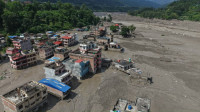
Locals who survived the mayhem said the stench of decomposing bodies had begun to spread through the flood-hit settlements. In Gerku, Betrawati and Aaitar on Friday, houses remained submerged in thick mud and floodwaters. With the surviving houses deserted, Betrawati — once a thriving little town — has changed beyond recognition.
Betrawati has long held religious, historical, economic and strategic significance. It is home to the Uttargaya pilgrimage site, which draws thousands of devotees every year during Poush Aunsi to perform rituals for their ancestors.
It is also where Nepal and Tibet signed a peace treaty following a war between the two sides, an agreement known as the Betrawati Treaty. For centuries, Betrawati has served as a key gateway for trade between Nepal and Tibet and remains an important route to the border with China.
The area was also home to a centuries-old Newar settlement. The market town’s iconic bridge is now gone, along with much of what made Betrawati a habitat. Farmland that once provided families with food for an entire year has turned into barren riverbeds.
For those who survived, the flood had left little behind.
A house stands covered in floodwater in Betrawati market. Photo: Angad Dhakal/TKP
Fifty-four-year-old Ishwari Pyakurel of Bhainse in ward 10 of Bidur Municipality was weeding his paddy when the flood struck. She survived but lost her mother-in-law. Her house and farmland were swept away, leaving her with nowhere to return to. She is now sheltering with her son, daughter-in-law, husband and younger father-in-law, Hariprasad Pyakurel, at a relative’s place in Gerku.
“I keep seeing the flood and water splashing even in my dreams,” Pyakurel said. “I cannot return home. I have no clothes to wear. I am wearing clothes borrowed from my relatives.”
The flood has also torn apart her extended family. Her sister, brother-in-law and seven-year-old granddaughter were swept away, while her daughter-in-law’s brother is also missing.
“We had seen floods before, but never anything like this,” she said.
Across the river in Tupche, the losses have been just as devastating. Pyakurel’s elder brother Basu, sister-in-law Goma, brother Himal, sister-in-law Uma and niece Himani are among those still missing.
For some families, the search has become a desperate wait for news from beneath the debris.
The seven-year-old daughter of Pramod Rijal and Pragati Adhikari, both employees of the Nuwakot District Court, has been missing since Wednesday. Pramod’s 72-year-old father, Shiva Prasad, and 69-year-old mother, Bhakta Kumari, are also unaccounted for. All three were at their home in Angitar, Betrawati, when the flood swept through the settlement.
On Friday, Pramod stood before his destroyed house, unable to enter it.
“We still have no information about my family. We suspect they are buried inside, but it is impossible to get in,” he said.
The smell of decomposing bodies had already begun to spread through the settlement. Five or six neighbours were also caught in the flood, while several students from the nearby Uttargaya school were reportedly missing.
“This is a disaster of enormous proportions. This is precisely when the government needs to show its presence,” Pramod said. “People have problems with food and shelter. There is no electricity, and mobile phones are not working. Most of the bodies are believed to be buried inside houses. They need to be recovered as soon as possible.”
He is now staying with relatives in Gerku, along with many other displaced families.
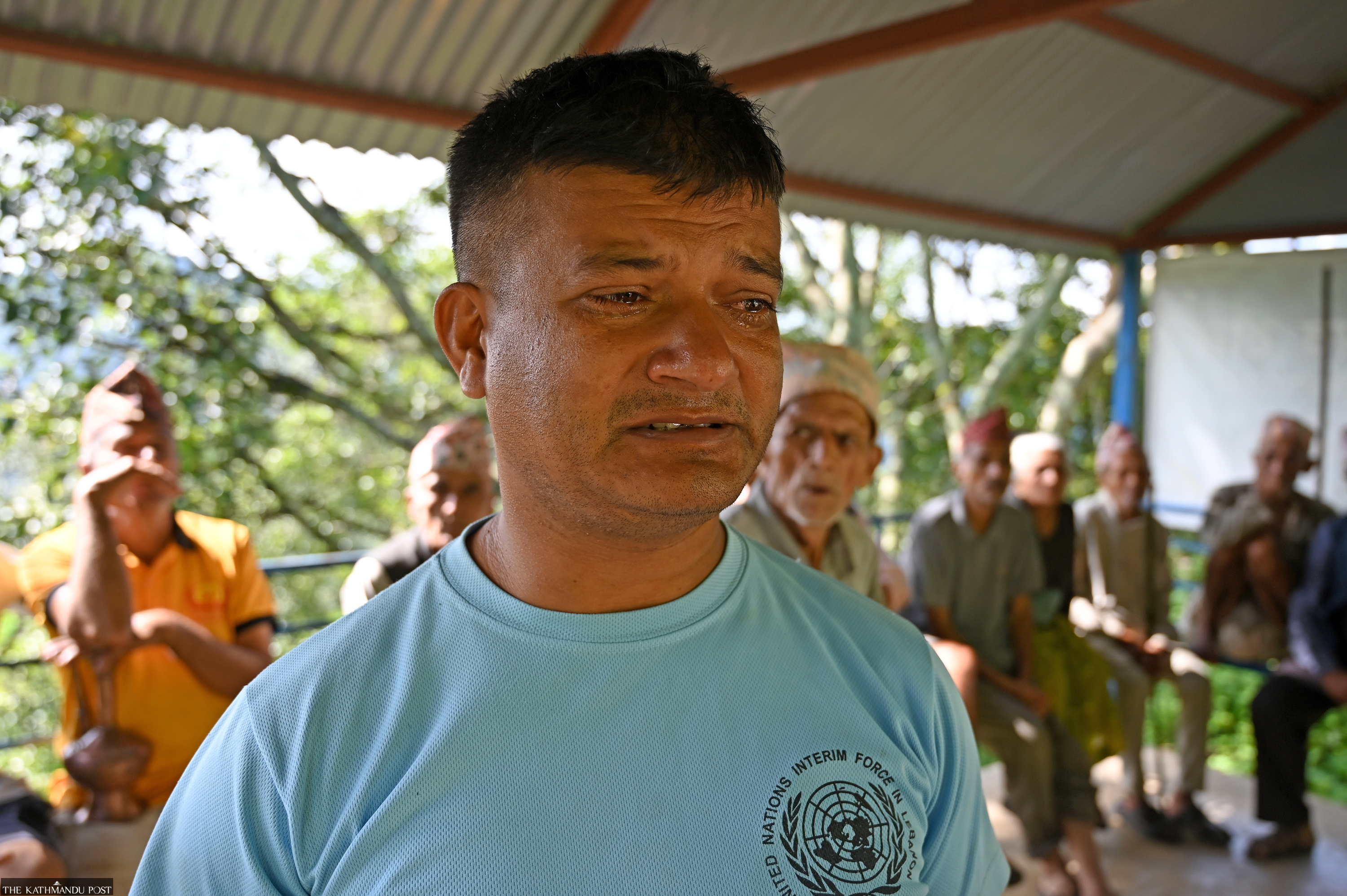
Bhim Prasad Pyakurel lost his mother in Gerku. Photo: Angad Dhakal/TKP
At Bhainse, the destruction has left families grappling with both grief and the loss of their livelihoods.
Bhim Prasad Pyakurel lost his mother. He had been at the Bhainse bridge when word came that a flood was approaching. Because his house stood above the river, he had never imagined the water could reach it. He went around warning villagers to move to safety, and saved many. But by the time he returned home, his mother and the house were gone.
“I never imagined the flood could reach our house because it was above the river,” he said.
He later returned to rescue his wife, who was half-buried in sludge.
“Fifteen to 20 people are missing in Bhainse. Our homes are uninhabitable. There is no food, no shelter, and no information about those missing,” he said.
“I worked in the Gulf for 12 years and built whatever little property I had. Nothing is left. We are homeless now.”
But amid the ruins, the loss of children has left the deepest scars.
Early Wednesday morning, Pasang Tamang of Angitar had returned home after dropping her five-year-old son at the school above her house. When she went to the roof to shut the door, she saw an enormous mass of mud and water rushing down the Trishuli River from above her house.
Realising that the flood could reach the school, she ran towards it through the fields. Before she could get there, the torrent had swept through the neighbourhood and reached the school.
Many students had already fled. Others trying to escape, as well as those still inside the school compound, were swept away.
“My son was among them,” Tamang said. “There was wire fencing around the school for security. A teacher threw three children over the fence to save them. I heard they survived, but my son was not among them.”
Several teachers were also caught in the flood, she said.
Tamang has taken shelter with villagers on higher ground. Everything she owned was in Angitar, she said, and there is now no home to return to. Her husband survived because he had already left for work early that morning.
The Trishuli now flows through the place where Tamang’s house once stood, nearly 200 metres from its previous course.
Across the river, a school bus lies buried beneath flood debris. It was carrying more than 40 students when the flood swept it away. Another school bus belonging to the same school is also buried farther upstream in what is now a riverbed.
The devastation extends beyond Angitar and Bhainse. People in Betrawati and Tapche Phant have also lost homes, farmland and livelihoods.
Hari Bahadur Rai, who moved to Nuwakot from Khotang after being displaced by floods and landslides there, lost his wife, mother-in-law, father-in-law and granddaughter on Wednesday.
“All I had was that house. And that is gone now,” he said. “I had been cultivating someone else’s land next to the house. That is gone too. I have no idea where to go or what to do.”
Rai had already experienced displacement once before. His previous house was destroyed in the 2015 earthquake. “People say the government is there for those who have nothing and that it will look after them,” he said. “Our house was also destroyed in the earthquake. The government told us not to worry and promised to help us, but it never did. But this time, I hope the government will do something.”
For now, he has neither a place to stay nor enough to eat.
“The government should provide relief immediately,” he said.
Arjun Poudel is a health reporter for The Kathmandu Post. Before joining the Post, he worked for Sagarmatha Television, Naya Patrika, Republica and The Himalayan Times.




 20.84°C Kathmandu


.jpg)