Women face higher risk of death in Nepal’s tiger attacks
Tigers killed 141 people between 2010 and 2024, while nearly 70 percent of attacks occurred in buffer zones of national parks. A tiger placed in a cage at Chitwan National Park after it began attacking people. Ramesh Kumar Paudel/TKP
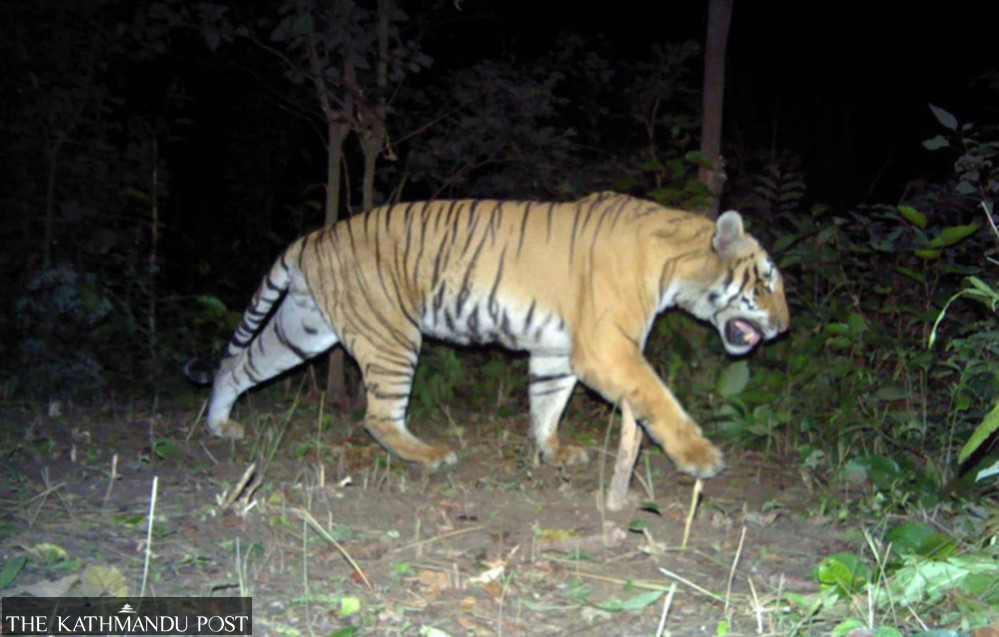
Tigers attacked 245 people in Nepal between 2010 and 2024, killing 141 of them, with women facing a far higher risk of death than men, according to a new study published in the journal Ecology and Evolution.
Women accounted for just 85 of the attacks but 62 of the fatalities, giving them a fatality rate of more than 72 percent. Men, meanwhile, were attacked 160 times and suffered 79 deaths, putting their fatality rate at less than 50 percent.
The study also found that most attacks occurred not inside national parks but in the buffer zones and forests surrounding them, where local people regularly enter to collect firewood and fodder, graze livestock, gather other forest products and fish.
The findings come as recent attacks in Chitwan again highlight the risks faced by communities living alongside Nepal’s growing tiger population.
On August 16, 60-year-old Thakur Adhikari was injured in a tiger attack in Piple Deurali village of Rapti Municipality in eastern Chitwan. The tiger had strayed into the settlement and mauled Adhikari, leaving him with deep wounds to his leg. He is undergoing treatment at Bharatpur Hospital.
The same tiger had earlier attacked a cow in a nearby shed belonging to Dila Kumari Tamang.
Five days earlier, on August 12, Mangal Bote was killed by a tiger while inside a buffer zone forest in Meghauli, west of Chitwan National Park. Park authorities have since captured both tigers involved in the two incidents.
The latest attacks underscore a central finding of the study: people are far more likely to encounter tigers outside the core areas of national parks than inside them.
The paper was co-authored by researchers including Bed Kumar Dhakal, deputy director general and spokesperson at the Department of National Parks and Wildlife Conservation, and wildlife experts Baburam Lamichhane, Naresh Subedi, Thakur Silwal, and Sanjay Kandel.
“Our goal was to analyse the underlying factors driving the total number of attacks,” said Lamichhane, whose PhD research focuses on human-tiger conflict.
Women face greater risk of dying
The study found a striking difference in the outcomes of attacks involving men and women.
Of the 245 people attacked during the 15-year period, 160 were men and 85 were women. Yet the gap narrowed sharply when researchers looked at fatalities. Tigers killed 79 men and 62 women.
That means women, although accounting for only about a third of all attacks, represented nearly 44 percent of the deaths.
Researchers say the disparity needs further investigation, but body posture at the time of an attack may be an important factor.
Men entering forests are more commonly involved in activities such as livestock grazing, which require them to stand or walk. Women frequently crouch or bend down while cutting grass, collecting fodder or gathering firewood.
The study found that 44 of 59 people attacked while crouching or sitting died. Among 71 people attacked while standing or walking, 29 died.
Researchers believe that being upright may give people a better chance of spotting an approaching tiger, escaping or defending themselves.
“Body posture at the time of the encounter seems to play a major role,” Lamichhane said. “We plan to investigate the higher mortality rate among women in greater detail.”
The study did not establish posture as the sole cause of the difference, and researchers say further work is needed to understand the social, occupational and behavioural factors behind the higher female fatality rate.
Most attacks occur outside parks
Although national parks and protected areas are the primary habitats for wild tigers, only a small proportion of attacks occurred deep inside forests.
Just 16 of the 245 attacks recorded in the study, or about 6.5 percent, occurred inside national parks. Buffer zones accounted for 69.4 percent of all attacks. File Photo
Just 16 of the 245 attacks recorded in the study, or about 6.5 percent, occurred inside national parks. Buffer zones accounted for 69.4 percent of all attacks.
The buffer zones are designed as transition areas between protected wildlife habitats and human settlements. But they are also important sources of forest resources for surrounding communities.
The study found that 78 people died while collecting fodder or firewood. Another 19 died while gathering non-timber forest products, 17 while grazing livestock, 11 while fishing and six during agricultural work.
The pattern points to the close link between human dependence on forests and the risk of encounters with tigers.
“Villagers should enter the woods in groups rather than alone, and avoid visits during early morning or evening hours when tigers are most active,” Lamichhane said.
He also recommended clearing dense vegetation along routes commonly used for collecting fodder and firewood. Better visibility could reduce the likelihood of sudden encounters and give people more time to respond when a tiger is nearby.
Dhakal recommended that community forests adopt block-based management, with people collecting forest resources in designated areas rather than moving randomly through dense vegetation.
“Managing designated blocks for resource collection ensures clear lines of sight, reducing the chances of accidental confrontations with tigers or rhinos,” Dhakal said.
Chitwan accounts for nearly half of attacks
Chitwan, which has Nepal’s largest tiger population, remains the country’s main hotspot for human-tiger conflict.
The district accounted for 47 percent of all recorded attacks during the 15-year study period. But the average annual death toll has declined compared with earlier years.
According to Lamichhane, an average of seven people died each year from tiger attacks between 1998 and 2006. That fell to about five deaths annually between 2010 and 2024.
The decline has come despite a substantial increase in Nepal’s tiger population.
The country’s latest tiger census put the wild population at 429, with 145 tigers living in Chitwan National Park alone.
No tiger-related fatalities were recorded in Chitwan’s buffer zone in the previous fiscal year, a significant improvement from a peak of 16 deaths in a single year. But recent incidents show that the risk remains acute, particularly in settlements and forests bordering the park.
The study also found geographical gaps in recorded attacks. No attacks were reported during the 15-year period in the lowland Tarai east of Rautahat or in Rupandehi and Kapilvastu, between Rautahat and Kanchanpur. Incidents were, however, recorded farther north in districts including Surkhet and Salyan.
Researchers say authorities must also monitor individual tigers that pose a higher risk to people.
Older, injured or otherwise weakened tigers can struggle to hunt wild prey and may move closer to settlements in search of easier food.
Lamichhane said regular monitoring and the timely rescue of such animals are critical to preventing attacks. Chitwan National Park has maintained an active tiger rescue programme for the past six years.
But researchers say removing individual problem tigers (that repeatedly attack people) alone cannot address the broader causes of conflict.
Much of the risk arises because people continue to enter forests for basic needs, particularly in buffer zones and community forests.
Reducing that dependence will require alternative sources of energy and income, as well as safer ways of accessing forest resources, Lamichhane said.
Communities seek a bigger conservation share
People living around national parks bear much of the cost of wildlife conservation, local officials say, and need greater economic benefits from the presence of protected wildlife.
Dhakal, who is pursuing a doctorate on human-tiger conflict, said buffer zone communities should receive more support for alternative income-generating activities.
Local committees in Chitwan already run programmes aimed at reducing dependence on forests and improving coexistence with wildlife.
Shivaji Gayak, chairman of the Chitwan National Park Buffer Zone Management Committee, said user committees conduct awareness campaigns, distribute gas stoves to reduce the need to collect firewood, provide grass seed for livestock and promote homestays and other forms of ecotourism.
But funding remains a major constraint.
Under park regulations, 30 to 50 percent of national park revenue is supposed to be allocated to buffer zone user committees. Chitwan has 21 such committees and one sub-committee.
Gayak said the amount actually reaching the committees is significantly lower than the statutory share.
“Although park revenues exceed Rs300 million, buffer zone committees receive only Rs60 million to Rs80 million, well below the statutory percentage,” he said.
The shortfall limits their ability to improve forest management, expand awareness campaigns and support communities facing wildlife attacks, Gayak said.




 16.49°C Kathmandu
1.jpg)