Nepal protests as Saudi Arabia imposes skill test on migrant workers
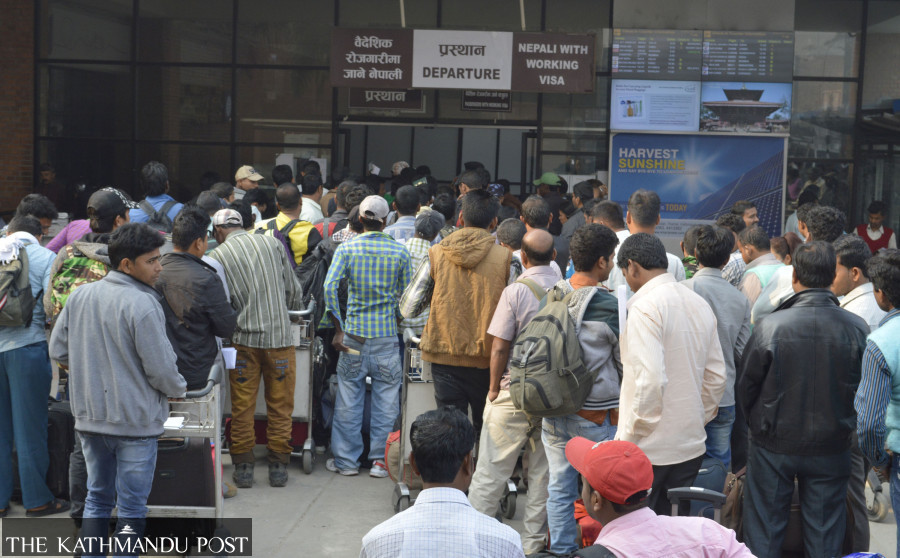
New visa requirement adds thousands of rupees to migration costs as Nepal says the programme was introduced without bilateral agreement. Under the imposed system, Nepali workers would have been required to pay $50 for a skills test and $50 for the Recognition of Prior Learning (RPL) assessment. Post file photo
Saudi Arabia has unilaterally introduced a skill certification programme in Nepal, adding a new financial burden on migrant workers seeking employment in the Gulf country. Workers without a skill verification certificate will no longer be eligible to obtain Saudi work visas.
The Saudi Embassy in Kathmandu has made it mandatory for workers to submit a skill verification certificate before applying for visas. Saudi Arabia had planned to enforce the requirement from June 17, but the rollout was halted after manpower agencies vandalised a training centre assigned to conduct the skill certification test.
Meanwhile, the Ministry of Youth, Labour and Employment has sent a diplomatic note to Saudi Arabia through the Ministry of Foreign Affairs, asking it to reconsider implementing the programme in Nepal.
“This issue should be resolved through bilateral discussions. We have sent a diplomatic note requesting a review of the decision,” said Pitambar Ghimire, spokesperson for the labour ministry.
Saudi Arabia has introduced the skill certification requirement for workers in five occupations: loaders and unloaders, porters, cart operators and construction workers. However, it has not specified which categories of construction workers will be required to undergo the test.
The Saudi Ministry of Human Resources and Social Development said the skill certification aims to verify workers’ professional skills and provide them with occupational recognition.
According to a notice issued by the Saudi Embassy, workers must first register online through Saudi Arabia’s “Professional Verification Portal” before taking the skill test. After registration, they must pay the required fee in US dollars through Visa or Mastercard.
Applicants must select their occupation from the list of available professions under the programme before choosing an approved examination centre and an available test date. The test lasts three hours, and results are expected within 24 hours to one week.
Saudi Arabia’s notice states that workers will be given up to three attempts to pass the skill test. Those who fail will not be allowed to travel to Saudi Arabia for employment. Saudi Arabia said the programme has been introduced in all labour-sending countries.
The Nepal Association of Foreign Employment Agencies (NAFEA) said Saudi Arabia has effectively introduced a “digital control” system to enforce the skill certification requirement. Workers must pay a 50 USD examination fee, equivalent to around Rs7,000, to take the test. However, there is no legal provision allowing workers or manpower agencies to directly make the payment.
Instead, a private company, Sai Vision Pvt Ltd, has been charging workers Rs10,000, including service charges. A fee of 50 USD has also been set for Recognition of Prior Learning (RPL), although details about the RPL process remain unclear.
“The visa application system itself has a mandatory skill verification certificate option. Unless the certificate is submitted, the visa application cannot move forward,” NAFEA president Dik Bahadur Khatri told Kantipur. “This has created digital control. There is no alternative route for obtaining a visa.”
Manpower agencies said they have started sending around 1,700 workers for the skill certification test as their medical examination certificates are nearing expiry.
Saudi Arabia has assigned Industrial Training Institute Nepal Pvt Ltd, based in Basundhara, Kathmandu, to conduct the skill certification test.
“Since employers have already selected these workers, delaying visa applications would mean their medical examination certificates will expire. Once the medical validity period ends, workers have to undergo another medical examination,” Khatri said. “Workers have been trapped in this process.”
Khatri said manpower agencies were discussing whether to halt certification of new labour demand approvals.
“The government failed to pursue effective diplomacy. This issue should have been resolved through diplomatic channels in time,” he said.
On June 26, Minister for Youth, Labour and Employment Ramjee Yadav met Saudi Ambassador to Nepal Fahd Mohammed bin Mnikhr and urged Saudi Arabia to immediately suspend the skill certification process for Nepali workers.
Nepal has maintained that all issues related to skill certification should be resolved through established bilateral mechanisms based on consultation and agreement between the two countries. Nepal has requested Saudi Arabia to continue processing visas as before until such discussions are concluded.
The labour agreement signed between Nepal and Saudi Arabia in January 2026 states that issues related to the recruitment process of Nepali workers will be determined by a joint technical committee. However, Nepal and Saudi Arabia have not reached a bilateral agreement on implementing the skill certification programme. The technical committee includes senior officials from both countries.
“Nepal wants to ensure that the skill certification process does not disrupt visa procedures for Nepali workers and that visa processing continues as usual,” the labour minister’s secretariat said. “The ministry wants to ensure that there are no obstacles to workers’ employment opportunities.”
Saudi Ambassador Mnikhr had said further information would be provided after consultations with the Saudi government. However, Saudi Arabia implemented the skill certification programme without holding further consultations with Nepal.
This is not the first time Saudi Arabia has introduced a requirement affecting Nepali workers without Nepal’s agreement. On December 28, 2024, Saudi Arabia began collecting biometric data, including fingerprints, from Nepali workers without Nepal’s consent. It established a biometric collection facility in Thapathali, Kathmandu. Workers must pay Rs730 for the biometric service, and the embassy does not accept passports of workers who have not completed biometric registration.
During a meeting with foreign employment agencies, Mnikhr said employers would bear the skill certification costs.
“If employers had been required to pay the skill certification fee while obtaining quota approval, workers would not have had to pay it. But since the fee was not collected at that stage, workers in Nepal are now being forced to bear the cost,” Khatri said. “This is nothing more than an attempt to collect money from workers by selling certificates in the name of skill testing.”
Around 80,000 Nepali workers travel to Saudi Arabia for employment every year. Of them, around 67 percent go under general labour visas, 8 percent work in the service sector, and 12 percent are employed as drivers and operators.
Hom Karki is a reporter with two decades experience covering migrant workers issues and the Nepali diaspora. He was previously based in the Gulf for Kantipur Daily.




 17.79°C Kathmandu