Annapurna Circuit sees trekking arrivals rebound after floods
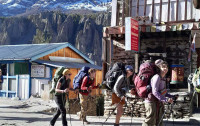
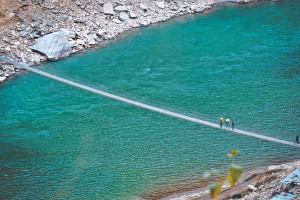
More than 5,300 foreign tourists trekked the route during Dashain, 769 more than in the same period last year, as improving weather and repairs restored access. Foreign trekkers head towards Thorong La from Manang village in Upper Manang along the Annapurna Circuit. Courtesy of ACAP
Foreign trekkers are returning to the Annapurna Circuit as favourable weather and repairs to damaged trails and roads restore access to one of Nepal’s most popular trekking routes.
Visitor numbers had fallen sharply after heavy rain, floods, landslides and snowfall in late September disrupted travel for nearly three weeks. With conditions improving, arrivals have picked up.
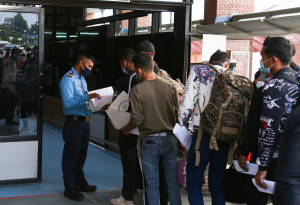
On October 13, a record 552 foreign tourists for the year checked in at the Tourist Checkpost and Information Centre in Dharapani, Manang, operated by the Annapurna Conservation Area Project (ACAP). The centre recorded 473 arrivals on October 14 and 443 on October 15.
During the Dashain holiday alone, 5,384 foreign tourists trekked the circuit between Ghatasthapana and Kojagrat Purnima, from October 11 to 25. That was 769 more than during the same period last year, when 4,615 visitors travelled the route.
Bhupendra Gurung, chief of the ACAP tourist checkpost and information centre in Dharapani, said arrivals had risen encouragingly in recent days.
“Tourist arrivals stopped after the floods and landslides. Even those who had already arrived turned back,” he said. “As the weather improved and the trekking route reopened, travel gradually became easier.”
Dhak Bahadur Bhujel, chief of ACAP Manang, said the disasters struck just as the trekking season was getting underway. Some trekkers who would otherwise have taken the Manaslu route switched to the Annapurna Circuit after floods and landslides blocked the former, he said. Growing interest in trekking has also contributed to the increase in visitors.
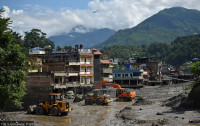
Continuous rainfall from September 24 to 27, followed by snowfall at higher elevations, damaged several sections of the route. Roads and trails were washed away in lower Manang and around Bhratang, above Chame. No tourists checked in at ACAP’s office in Upper Manang on September 25, 26 and 27.
The influx of visitors has gradually recovered, Bhujel said.
The timing of the disaster forced some trekkers to cut their journeys short and return home, he added. Within a week of the onset of the floods, landslides and snowfall, 379 foreign tourists had left Manang. On October 1 alone, 149 trekkers departed the district.
Access improved after a temporary structure was built at Chame’s suspension bridge, allowing people and vehicles to cross and making it possible for tourists to reach Upper Manang by road. Security personnel, ACAP staff and hotel operators also cleared snow and repaired trails from Upper Manang towards the Thorong La area and Tilicho Lake.
Improving weather and easier passage along the route have helped bring trekkers back, Bhujel said.
According to ACAP, 30,135 foreign tourists had checked in at Dharapani for the Annapurna Circuit between January and October 27. The total comprised 18,820 men, 11,306 women and nine visitors whose gender was not recorded.
The Annapurna Circuit begins in Besisahar, the district headquarters of Lamjung, and passes through Manang before crossing the 5,416-metre Thorong La Pass. It then descends towards Muktinath in Mustang and continues through Myagdi to Pokhara.
Some trekkers make a detour to Tilicho Lake before returning to the main route. Others continue across Thorong La towards Mustang. The circuit draws visitors with its Himalayan landscapes, natural scenery, local cultures and high mountain passes.
The trek once typically took about 21 days to complete. But with roads now reaching Upper Manang and Muktinath in Mustang, the journey has shortened to around seven to 10 days.
Although expanding road access has reduced the time needed to complete the circuit, it remains a popular choice among foreign trekkers.




 20.82°C Kathmandu