



 24.79°C Kathmandu
Sun, Oct 11, 2026
Columns
Answer the mountain’s call
Nepal’s government must respond to the disasters with greater accountability and leadership.
bookmark
Bishal Thapa
Published at : September 18, 2026
Updated at : September 18, 2026 06:36
Nepal’s mountains have spoken. Prime Minister Balendra Shah and his governing Rastriya Swatantra Party (RSP) must now respond with greater accountability and offer a clear vision for how Nepal will confront increasingly intense natural disasters.
Shah addressed the Parliament on September 2, a week after flash floods tore through Rasuwa. By the time he spoke, 3,916 people were already missing. The good news from the Prime Minister’s speech was that, at least, he spoke, addressing the Parliament and the people. The bad news is that he said little, offering a dismal repetition of the same tired approach to climate risk management that was out of step with Nepal’s deepening vulnerabilities.
Accountability must begin by acknowledging that climate change will result in more frequent natural disasters, but that we can prevent loss of life and destruction, as it did in Rasuwa.
In his speech, the Prime Minister gave the impression that these flash floods were an unprecedented event beyond what could have been reasonably forecast. This perception is widely shared in Nepal. Nepal’s hydropower, for instance, continues to be built as if such disasters are once-in-a-century occurrences.
Nepal has long known the risks posed by climate change.
In December 2009, then Prime Minister Madhav Kumar Nepal held a symbolic cabinet meeting in Kala Patthar near Everest Base Camp to draw international attention to melting glaciers and the risks it posed to the region. Things have not improved since then—global carbon dioxide emissions have increased by approximately 25 percent, and the planet has become 0.8 to 0.9 degrees Celsius hotter.
Scientists have continually warned Nepal of the growing risks from melting glaciers. In 2023, for instance, the International Centre for Integrated Mountain Development (ICIMOD), a global research institute in Kathmandu, found that glaciers in the Hindu Kush disappeared 65 percent faster in the 2010s than in the previous decade. Its report, ‘Water, Ice, Society, and Ecosystems in the Hindu Kush Himalaya’, concluded with a simple and clear call urging Nepali policymakers ‘to prepare for the cascading impacts of climate change in this critical mountain biome’.
Just in case no one was listening, the mountains themselves raised the alarm several times. In July 2025, for instance, a sudden discharge from a lake in Purepa Glacier, China, led to a flood in Rasuwa that killed 11 people and left 18 missing, a study by the Stimson Center found. Stimson’s assessment of last month’s Rasuwa floods documents several similar disasters in recent years—clear signs of growing risks for Nepal.
These examples are part of a large body of research that points conclusively to growing threats for Nepal. In recognition of these risks, at the UN Climate Change Conference in 2023, Prime Minister Pushpa Kamal Dahal chaired a high-level event with UN Secretary-General António Guterres, Prime Minister of Andorra Xavier Espot Zamora, and representatives from several other countries titled ‘Call of the Mountains: Who saves us from the climate crisis?’
Only Nepal can save Nepalis from the destruction caused by climate events.
On its own, Nepal does not have the ability to stop global warming and climate change. But Nepal does have the ability to prevent or minimise deaths and destruction that result from climate disasters.
For that, the government must first abandon the idea that the Rasuwa floods were a once-in-a-century, unprecedented disaster. Such events are no longer unthinkable and are likely to occur more frequently. We must adapt accordingly and transform how we plan economic activities, build roads, highways, industries and communities. We need better, more sophisticated monitoring systems that can handle the complex environments of our glaciers, rivers and ecosystems.
Nepal continues to develop, build and operate hundreds of megawatts of hydropower largely with the same approach to safety, risk and contingency as before. Continuing to overlook the growing risks amounts to negligence—hydropower developers and investors must also be held accountable for deaths that occur at their facilities.
Seventy-six people died in Gen Z’s revolution last year, more than 2,000 were injured, and some 2,000 buildings were destroyed. In response, the interim government and the Gen Z leaders systematically investigated the events and related corruption cases—and very rightly so.
Deaths and destruction from climate disasters in Nepal also need the same level of accountability. More than 1,300 people have died, and thousands more are missing in the Rasuwa floods. Communities, towns, villages and infrastructure have been destroyed. Will there be an investigation into whether adequate safety and precautionary standards were in place and followed? Will anyone be held accountable?
A second example of the lack of accountability is reflected in the Prime Minister’s strategic choices in responding to the disaster.
In his speech to Parliament, the prime minister spent considerable time blaming global climate change for the disaster. There is no doubt that a warming planet is to blame. The prime minister is correct to demand greater action and financial resources from the international community, particularly rich countries.
A few days after his speech in Parliament, the Government announced that Shah would travel to the UN General Assembly in New York later this month to draw attention to global climate change. As the face of the new Gen Z leadership, he will no doubt be feted, celebrated and widely applauded on the global stage.
For a prime minister who has chosen to remain cloistered in Kathmandu in his year in office thus far, refusing to meet global leaders, particularly those of India and China, his sudden decision to go to the UN General Assembly represents an odd strategic choice. His account of Nepal’s tragedy will add to the growing evidence of climate change and its impacts, but is unlikely to meaningfully galvanise international negotiations at this time.
This is precisely where the government must demonstrate stronger, more accountable leadership. Nepal’s ability to adapt and build resilience against climate impacts is intertwined with India and China.
We need new cross-border approaches, partnerships and agreements with India and China on how we share climate information, access disaster-response resources, train people, invest in resilience, and build adaptive capacity. These agreements require intervention at the highest levels of government—essentially, from the prime minister himself.
Shah must engage more directly with his counterparts in India and China to evolve a new framework for addressing climate impacts in our shared region.
Shah has adopted a highly unorthodox public style for a politician, let alone a prime minister. He rarely speaks in public or in Parliament, and is largely inaccessible, except to his inner circle and confidants. Because he is not publicly transparent, it is hard to understand his vision or find reassurance in moments of such a national crisis.
The government has indicated that the prime minister’s work will do all the talking. His work will not directly stop the glaciers from melting, but it can directly prevent the loss of life and destruction resulting from melting glaciers.
Shah must demonstrate accountability and respond more boldly with a clear vision of how we deal with these challenges. He must show up and lead.
Bishal Thapa
Thapa is an energy sector professional.



Most Read from Columns

Before you take credit for Khula Manch, read its history
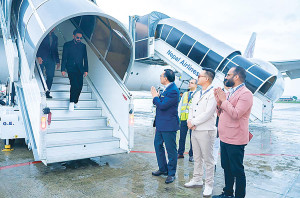
Shah went to the UN to speak for Nepal, then left before he could make the most of it
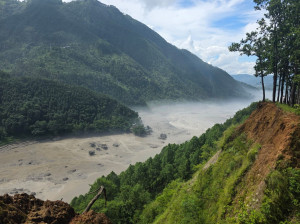
Why Nepal’s latest disaster needs a local name—not just a scientific label

Balendra Shah should prepare for the worst

Lesson learned after the death of Ronaldo
Editor's Picks

Constitutional Bench caught in seniority, ‘pick and choose’ dispute

A Dom boy’s long road to becoming a doctor

From blankets to handmade dolls, two foreign women bring comfort to flood survivors

News Analysis: When institutional defence exposes institutional fault lines

It’s a bird … it’s a plane … it’s the Indian ambassador’s farewell tweets
E-PAPER | October 11, 2026

×