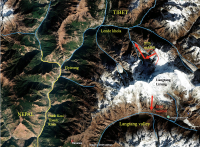
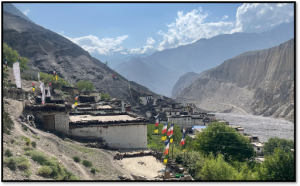
On the morning of August 26, a huge section of glacier sheared away from a mountain near the Nepal-Tibet border. Within minutes, a flash flood heavy with sediment and debris surged into the Bhotekoshi river and onward into the Trishuli river, engulfing humans, animals and houses. Water levels reportedly rose by as much as nine meters in half an hour. Villages in the remote Rasuwa district, including Timure and Syabrubesi, were buried or swept away. Hundreds are now confirmed dead and thousands missing—among them villagers, workers, pilgrims and tourists. The Gyirong border crossing, bridges, roads, and at least 13 hydropower sites were reportedly damaged, causing major infrastructure losses and drastic landscape changes we have never seen before.
Amid this crisis, there has been a crisis of communication with hundreds of thousands of people in Nepal, China and elsewhere in the world awaiting news of their loved ones.
Crisis communication failure
Varieties of information spreading within Nepal and across the world on varied platforms—newspapers, television, Instagram, Twitter and Facebook, among others—showcase the devastation of the land with thousands of videos, name lists and survivor accounts. However, those who have their family members missing for over four days are still struggling to find reliable information, causing severe distress.
Although Nepal’s communication infrastructure has improved significantly since the 2015 earthquake, the lack of reliable information on a single official platform, through a single authority, makes it hard to access basic facts and information about missing families. Families are navigating a confusing web of platforms: photos of handwritten lists circulated on Facebook by the army or our prime minister and other ministers who choose to use the social networking site rather than an official government website, and a torrent of unverified content.
On top of that, Nepal Police and the Nepal government have two different accounts of information about the missing, the rescued and the dead. The National Disaster Risk Reduction and Management Authority (NDRRMA) has tried its best, but their information came up in a pop-up form for many days until recently. They finally created a tab that reads ‘Rasuwa Flood’ on the third day.
AI-fabricated videos and science
The disaster has been an opportune moment for various influencers chasing engagement by circulating Artificial Intelligence (AI) generated videos as real flood scenes. Social media is filled with old footage from disasters in other countries being recycled as fresh, and fraudulent QR codes soliciting donations spread beside genuine appeals. In a disaster’s wake, this flood of unverified content can distort rescue priorities and waste scarce resources. It also inflicts quiet cruelty on families scanning every clip for a missing face, every list of names, and every website that could potentially give them an answer.
Even experts added to the noise. Scientists worldwide have rushed to share AI-generated satellite images of the destruction, wanting to promote their own research without thinking about how to support the communities on the ground. Nepal’s hazard should not be taken as a fascinating, adrenaline-rushing event where scientists could use it to make their profiles better. We need science to support and establish safer and disaster-resilient communities by understanding their suffering and prioritising their needs. There are images and analyses out there, which are routine for scientists (such as us) to investigate and find what happened, but it is also true that this does not show rescue and recovery routes and does little for emergency workers.
Warning without preparedness
The infrastructure and communication failures began before the flood arrived. While there have been various monitoring systems, including anticipatory actions being developed in Nepal, a lot of times, warnings have been designed for isolated hazards, such as rainfall, annual exceedance probability for floods and probability of rainfall-induced landslides. These warnings don’t include unexpected cascading hazards such as glacier collapse-triggered floods, landslides and mudslides all at the same time. We have also seen the families of missing engineers in hydropower plants where a warning was not sufficiently given, as well as where evacuation was not prompt due to the nature of the disaster and lack of resources. The warning system could have been better.
We cannot build warning systems around single hazards in a landscape where ice, bedrock and water have dynamic actions that amplify the disaster. Even a perfect warning cannot support people without preparedness. Rescuers need to know which slope to climb, a safe assembly space, and who to call. A warning without a rehearsed response is only a countdown. Reports suggest that many lost their lives not knowing the magnitude of this disaster.
Representation of marginalised
Another question is how the suffering of the marginalised has been represented in the media. We have seen an old woman’s photo circulating without dignity. We have seen the Western media focusing on tourists who have survived and are narrating their survival stories, while many are under the mudslide and have been swept away from Rasuwa to Chitwan. The question is: whose suffering gets seen, how it’s represented, and for whose benefit? Far less attention has gone to those who live and work in these valleys year-round: engineers, geologists and locals.
Rasuwa is home largely to the Tamangs, an Indigenous community long pushed to the margins of Nepal’s economy and politics, alongside migrant labourers, porters and hydropower workers. Many lack smartphones, insurance or the connections that bring helicopters, and many could be trapped in other remote locations out of reach. They are the least likely to receive warnings they can act on, the least visible in coverage, and the slowest to be accounted for. A crisis of communication is never felt equally. Those who are less represented before a disaster have the least chance to access information during one.
Climate injustice
This is a climate story. The Himalaya is warming faster than the global average, thinning glaciers, destabilising slopes and swelling glacial lakes; the world is responsible for this. The exact trigger is still being established, but the direction is clear. A warming climate is loading the dice, and the people paying the price contributed least to the emissions driving it. The world should take accountability for its actions and be obligated to listen to the mountains and end climate injustice.
The mountains will not stop; they will produce more disasters like this one. Rivers do not stop at borders, and neither should warning systems, data sharing or emergency communication. Nepal and China must treat this corridor as one transboundary system. Nepal must also invest in information infrastructure with the same seriousness it invests in dams and highways. A single verified emergency portal, multilingual warnings and community drills would cost a fraction of one hydropower plant. The glacier could not have been stopped, but the confusion could have been avoided, and information streamlined into one official platform rather than many. When the next flood comes, survival will depend not only on the sirens, but on whether an ordinary family knows exactly where to look and what to do.




 15.38°C Kathmandu

.PNG&w=200&height=120)