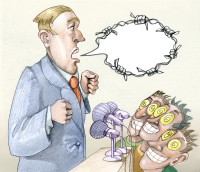
If our politics continues to remain so abysmally unequal, our society will continue to dig itself a deeper hole of patriarchy, and we will continue to police women’s cleavages. Shutterstock
Patriarchy has had quite the moment in India this past week. It has been a buzzword, triggering many heated debates, living room conversations, and social media slugfests. On one hand, the opposition leader in the Lok Sabha and the face of Congress, Rahul Gandhi, called out the patriarchy inherent in India, urging it to be smashed. On the other, a harmless Raksha Bandhan ad campaign starring actor Kriti Sanon by jewellery brand GIVA ruffled many a feather, causing inexplicable outrage and prompting the brand to pull down the advertisement, all because the actor was apparently showing too much cleavage for a traditional occasion.
One cannot even begin to explain how ludicrous the entire GIVA controversy is. But it does tell us one thing—patriarchy is far, far from being on its way out of our society. We continue to remain deeply gendered in our thoughts, actions and everyday life. The jewellery brand furore shows how we continue to police women, monitoring their lives and choices, and refusing to leave them with any agency. Raksha Bandhan as a tradition is anyway rooted in a flawed concept of the superiority of men, and in the idea of women being largely helpless when it comes to protecting themselves.
To object to a woman showing more cleavage than what some might find comfortable in a campaign for this already patriarchal tradition is as ironic as irony gets. Essentially, not only do we continue to tell women that they need ‘protection’ from their brothers, but we also tell them what exactly to wear while seeking that ‘protection’. The male gaze, after all, will not shy away from objectifying women,
Meanwhile, Gandhi had already kicked off a patriarchy debate with his speech last Saturday, when he questioned why relationships with men should define a woman’s identity. The Congress leader struck the perfect chord, and he was proven right with the GIVA ad controversy barely days later. However, what is also true is that this gendered idea of society in India will continue unrestrained till our politics leads by example and displays equality in the true sense. To that extent, Gandhi is as answerable for the perpetuation of patriarchy as anybody else in India.
Patriarchy in the news
On August 22, speaking at the Chhatron Ki Goonj (echoes of students) programme, Gandhi called out the gender inequality in our society and said that a woman’s identity should not be restricted to that of being a beti, patni or ma.
“Whenever I speak to a man, women are put in three boxes—you are either seen as a daughter, as a wife or as a mother,” he said. The Congress leader went on to slam the Manusmriti—an ancient text that seeks to lay down rules for Hindu society—and said its dictums were “shameful”.
One cannot deny the significance of a mainstream male politician publicly slamming patriarchy and calling out a regressive scripture in a very one-dimensional, gendered polity.
“The mindset is that a girl has a place, that she should be closed in a cage, she should be controlled, she should not work, and boys should have full freedom. We don’t want this kind of India,” he said.
Unfortunately, that is precisely the kind of India we have, for barely days later, a woman’s cleavage on a ‘traditional festival’ ad caused much offence, and Sanon’s spirited stand notwithstanding, the brand showed little spine in standing up for its own creative product and, more importantly, for its brand ambassador. Caged and controlled, she definitely is.
Why politics should lead the way
While Rahul Gandhi’s intent and emotion are both laudable, the question to be asked is—what has the political class done to lead on this front and to send a message out to society? Has our politics, in any way, reflected the idea of gender equality or empowerment?
Consider some figures. Of the 29 states in the country, only one state has a woman chief minister. Of the 30 ministers at the Centre with cabinet rank, only two are women. Of the 543 Lok Sabha MPs, only 75 are women, which is less than 14 percent. Of the around 8,3oo candidates in the 2024 Lok Sabha elections, only 800 (9.6 percent) were women.
The two biggest political parties had a dismal record in giving tickets to women as an overall percentage of their candidates in 2024, with the BJP at 16 percent and the Congress at 13 percent, respectively.
These are staggering statistics. Astonishing for a country where the prime minister claims to stand for nari shakti and the Leader of Opposition gives a ‘smash patriarchy’ war cry.
The political class has a greater responsibility than anyone else in setting an example for the right causes because of its sheer impact in shaping social thought and action, for better or for worse. For instance, when the BJP introduced an aggressive majoritarian brand of Hindutva-laden politics, it decidedly nudged India’s society towards a more communal, less tolerant path. Or when Kanshi Ram decided to give a political voice to Scheduled Castes in Uttar Pradesh, the Dalit community became a far more powerful electorate than ever before, which made it impossible for anybody to continue to ignore them in the state. Or when politicians decided to engage more with women voters and cater to their aspirations, the female electorate became the most potent tool in electoral politics.
While these are just a few examples, the point is clear—politics has a way of shaping social thinking and behaviour. If our politics continues to remain so abysmally unequal, our society will continue to dig itself a deeper hole of patriarchy, and we will continue to police women’s cleavages.




 15.26°C Kathmandu