



 14.7°C Kathmandu

Fri, Oct 23, 2026
Columns
What the US FMF grant means for Nepal’s fleet
As Nepal diversifies its aviation fleet with upcoming Bell helicopter deliveries, lessons from grounded Mi-17s underscore the need for domestic technical self-reliance.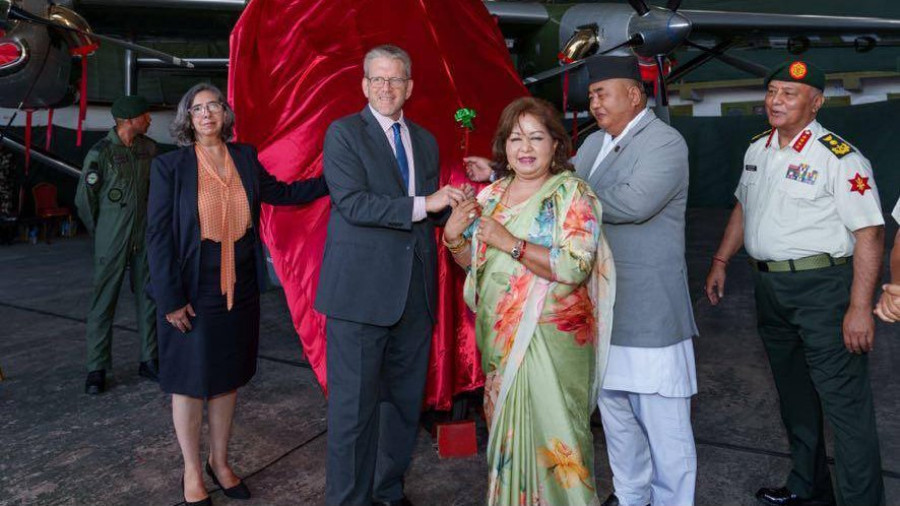
bookmark
Shreya Khakurel
Published at : August 19, 2026
Updated at : August 19, 2026 21:08
In June, Nepal accepted a$100 million (around Rs15 billion) Foreign Military Financing (FMF) grant from the US to boost the country’s disaster response and humanitarian assistance capabilities. Nepal remains highly vulnerable to climate-induced disasters, including flash floods, wildfires, landslides and glacier lake outburst floods, making rapid aerial response a critical national priority. Under the grant, the country will receive six Bell helicopters comprising four Bell 407GXis and two Bell 412EPXs equipped for firefighting and external sling missions with a maximum payload of 2,268 kilograms. The new platforms are, realistically, expected to be delivered only after 2030. The Nepali Army already operates Bell variants, making them a logical addition that builds on existing operational familiarity.
The FMF grant contributes to Nepal’s disaster response posture but highlights a broader structural challenge associated with foreign security assistance for long-term use. The package’s initial spare parts, logistical support and training provisions facilitate early-stage operational readiness. However, long-term aircraft availability relies on Nepal’s ability to finance sustainment, develop local technical expertise, strengthen international supply chains and institutionalise lifecycle planning, while working with limited budgetary and institutional resources.
The Nepali Army already possesses a relatively capable aviation fleet for disaster response and humanitarian assistance, performing a broad range of missions, including search and rescue (SAR), medical evacuation (MEDEVAC), relief-material transport and humanitarian logistics. The fleet includes the Russian Mi-17 heavy-lift helicopter, the Indian HAL Dhruv Mk III light helicopter, the French Eurocopter AS350 Écureuil, the Polish PZL M28 Skytruck short-takeoff-and-landing (STOL) aircraft, among other complementary assets.
The fleet composition reflects decades of acquisition from multiple international partners under various procurement arrangements, consistent with Nepal’s long-standing non-alignment foreign policy posture. The planned addition of Bell helicopters further diversifies the country’s supplier base but simultaneously adds to the complexity of an already fragmented maintenance ecosystem. Each platform relies on its own maintenance procedures, technical documentation, spare parts supply chain, certification standards and original equipment manufacturer (OEM) support arrangements. This fragmented ecosystem exposes Nepal’s aircraft availability to disruptions across multiple supply chains and requires the Nepal Army to bear greater financial burdens and administrative complexity to support fleet readiness.
Nepal’s experience with the Mi-17 fleet illustrates the intricacy of maintaining foreign-origin aircraft throughout operational lifecycles. Two of the Nepali Army’s four Mi-17 helicopters have been stranded in India for more than two years. Due to the Russo-Ukrainian war, Nepal routed Mi-17 overhauls through the Indian state-owned Mazagon Dock Shipbuilders Limited (MDL), which subsequently subcontracted the work to the Vietnamese Helicopter Technical Service Company (HELITECHO). However, as the war lengthened and evolved, Russia revoked HELITECHO’s authorisation. Rosoboronexport, the official exporter of the Mi-17s, subsequently informed Nepal that overhauls carried out at a now-unauthorised facility cannot be certified as flight-safe.
Despite investing approximately $3.5 million in maintenance, the Mi-17s remain grounded. Russia’s stricter export-control posture has made it nearly impossible to obtain the necessary certification to fly the helicopters back to Nepal. If the certification issue remains unresolved, Nepal risks losing platforms worth a combined $19.7 million (approximately Rs3 billion). Another Mi-17 also reportedly remains grounded at Tribhuvan International Airport in Kathmandu, awaiting component overhauls and repairs.
The external shocks surrounding the Mi-17s are not unique to a single aircraft or country of origin. The Bell helicopters being acquired under FMF benefit from having a large, global commercial support network that may reduce some of the supply chain vulnerabilities associated with the Mi-17s. Nevertheless, Nepal will continue to rely on an international maintenance ecosystem, inherently susceptible to external disruptions, throughout the aircraft lifecycle.
A greater fleet commonality with the Bell variants will improve institutional sustainment capacity by reducing the complexity of maintaining multiple, parallel foreign-origin aircraft. However, as the Bell fleet assumes a larger share of Nepal’s disaster-response capability, long-term aircraft availability could become concentrated within a single OEM support ecosystem. Consequently, Nepal’s expanding inventory of foreign aircraft necessitates strengthening the domestic maintenance ecosystem alongside international support agreements to reduce future vulnerability.
As Nepal expands the Bell helicopter fleet across both military and civilian operators, the growing commonality in airframes presents an opportunity to establish a more coordinated national approach to organisational-level maintenance where operational security permits.
Nepal should gradually build shared technical capacity through common training pipelines, standardised maintenance procedures, specialised tooling and spare parts management. A coordinated domestic maintenance ecosystem would improve resource utilisation and reduce duplication of technical investments, maximising the institutional efficiencies of fleet commonality. Over time, Nepal could reduce long-term reliance on a single OEM support ecosystem for routine maintenance activities while maintaining international support agreements for OEM-certified depot-level maintenance and military-specific requirements.
Nepal’s domestic maintenance capacity must be supported by stronger evidence-based lifecycle planning that simultaneously advances both self-reliance and long-term international maintenance partnerships. Nepal should institutionalise a centralised digital asset management system to monitor aircraft utilisation rates, maintenance cycles, component reliability, and spare parts consumption without disclosing operationally sensitive information. The system can provide a common evidence base to identify recurring maintenance bottlenecks and turnaround timelines, while informing decisions on which capabilities to develop domestically and which to retain through international partnerships. A comprehensive fleet performance database will improve forecasting of lifecycle costs, strengthening Nepal’s overall negotiating position in future acquisition and maintenance arrangements.
Shreya Khakurel
Khakurel is an aerospace and defence analyst specialising in the US and Asia-Pacific defence landscapes.





Most Read from Columns




Editor's Picks





E-PAPER | October 23, 2026

×