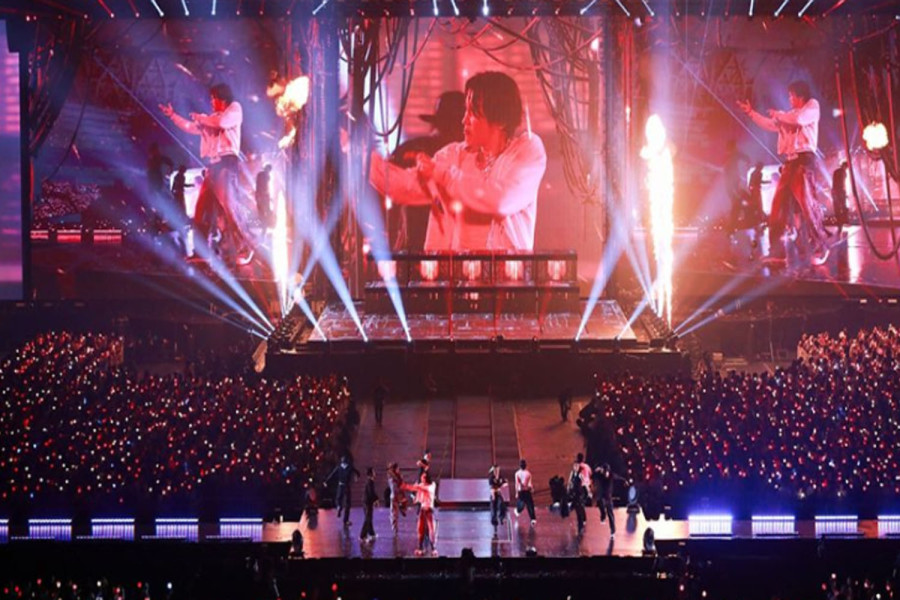
Production scale, stadium tours, and global inflation drive ticket prices higher. J-Hope of BTS performs at Goyang Sports Complex in Gyeonggi Province, June 13, 2025. PHOTO: BIG HIT MUSIC/THE KOREA
Fan club presales for BTS’ upcoming “Arirang” world tour kicked off Thursday, and within moments more than 100,000 fans flooded into the online waiting queue. All seats for three concerts in Goyang, Gyeonggi Province, in April sold out almost instantly, with anticipation high for the group’s first such tour in nearly four years.
With competition fierce, even among official fan club members, many BTS fans found themselves edged out by fractions of a second. While some secured tickets, others were pushed deep into the waiting line, with tens of thousands in front of them, underscoring both BTS’ enduring demand and the increasingly punishing reality of K-pop ticketing.
The difficulty of securing tickets was matched by sticker shock. The highest-priced tickets for the Goyang shows reached 264,000 won ($183), a 20 percent increase from the 220,000 won sound check package sold for BTS’ “Permission to Dance on Stage” concerts in 2022, just before the group went on hiatus. Compared to 2018, when top-tier tickets peaked at around 110,000 won, prices have risen by 240 percent.
BTS is not alone. K-pop concert tickets crossing the 200,000 won threshold are no longer the exception. In 2022, BTS became the first K-pop act to push ticket prices past that mark with the introduction of premium sound check packages granting early venue access to watch artists rehearse ahead of the show. Since then, similar pricing structures have become standard across major agencies.
Illit, a rookie girl group under Hybe music subsidiary Belift Lab, is charging up to 253,000 won for meet and greet tickets on its first tour in March. Senior labelmate Enhypen set comparable prices in October during its “Walk the Line” concerts at Olympic Park in Seoul, with sound check seats priced at 220,000 won and meet and greet packages reaching 253,000 won. Just a year earlier, Enhypen’s top-tier tickets stood at 198,000 won, reflecting a 28 percent increase.
Despite growing complaints, industry insiders say ticket price hikes are largely unavoidable. Globally, live music prices are rising as concerts evolve from straightforward performances into large-scale productions incorporating massive screens, immersive sound systems and complex stage designs, all of which significantly inflate production costs.
Rising global inflation has also driven up operational expenses, including stage equipment rentals, transportation and logistics and wages for specialized technical staff. Stadium and dome tours further amplify costs. Large venues require nearly double the security personnel of standard concert halls.
BTS’ Goyang Sports Complex illustrates the shift. The stadium can accommodate up to 50,000 attendees — roughly three times the capacity of commonly used K-pop venues such as Gocheok Sky Dome or KSPO Dome — which also increases staffing as well as safety and logistical demands accordingly.
Even in absolute terms, K-pop concert tickets in South Korea remain relatively affordable next to those in other markets.
For BTS’ world tour, VIP tickets in Japan are priced from 45,000 yen ($292), while standard S section seats start at 25,000 yen. In North America, top-tier prices climb far higher. In the US, ticket prices vary widely by seating section, with premium seats reaching around $800. In New Jersey, for example, tickets have been listed at prices ranging from about $84 to as high as $787.
“In Korea, BTS concert ticket prices seem really cheap to me,” said Grace Kao, a New Jersey-based BTS fan. “We often have to buy on the secondary market, and things can get very expensive. I got my presale ticket for $644.36 including tax for one of the US tour dates in the West.”
Still, many agree that ticket prices in the 200,000 won range are far from insignificant, especially given the core audience for K-pop concerts largely consists of teenagers and fans in their 20s.
Music critic Lim Hee-yun says concert tickets should, at a fundamental level, be sold at prices young fans can realistically afford on their own.
“While many teenagers rely on their parents to buy tickets, a mid-200,000 won price point is relatively high when viewed from a student’s perspective.”




 14.75°C Kathmandu