



 12.65°C Kathmandu

Sat, Oct 24, 2026
Koshi Province
In Panchthar, a century-old community labour tradition lives on
Amid repeated floods and landslides, residents of the far-eastern district are rediscovering the strength of ‘harguhar’ to keep their district connected.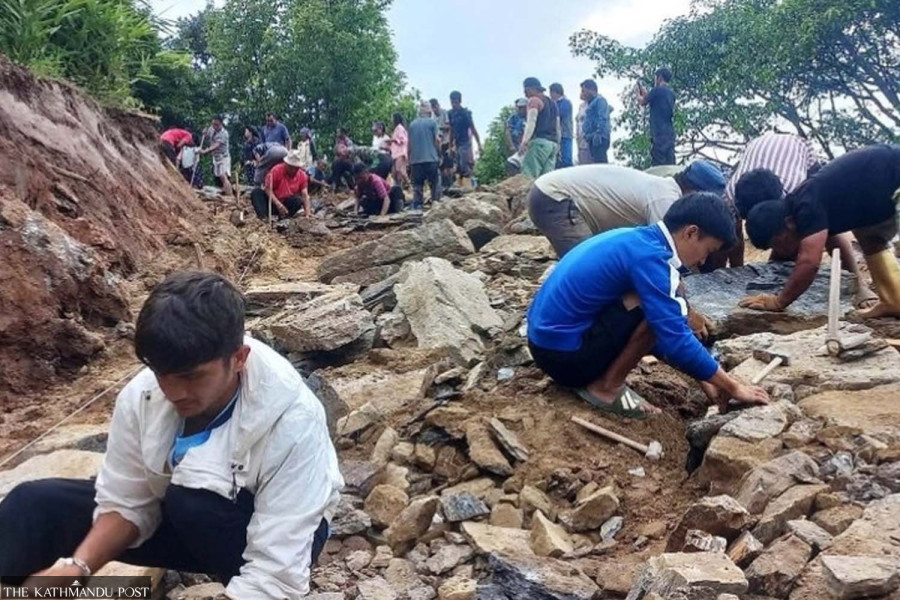
bookmark![]()
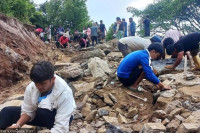
Local residents at work to reopen a blocked road at Phalelung-7 in Panchthar recently. Laxmi Gautam/TKP
Laxmi Gautam
Published at : August 23, 2026
Updated at : August 23, 2026 06:43
Panchthar
Villagers would gather at one place carrying hoes, spades, picks and shovels. Whether they had to build a track or a phadke, a makeshift footbridge, village chieftains would send word from house to house. And villagers would turn up for ‘harguhar’. There were no mobile phones to call people.
Nearly a century later, the practice remains alive in Panchthar, a hill district of Koshi Province. The world has changed, and so have the tools and equipment, but the tradition of joining hands to rebuild public infrastructure mainly during disasters survives.
Gangaram Bhattarai, aged 96, of Phidim Municipality-1 still remembers those days. The Jimmawals, Tharis and Subbas (the village leaders) would send messengers from house to house. And on the given day, villagers would arrive carrying hoes, spades, picks and shovels.
“Timber and bamboo were laid across big rivers and torrents to make phadke,” Bhattarai told the Post recently. “Whether it was to make a path for people or build a public structure, villagers worked together.”
Bhattarai said overseas employment was virtually unknown then. Those who left home for work generally went to India. Most households had young men, and one man from each household would join the harguhar. Women mainly prepared food and distributed it. If someone could not attend, another person was sent to their place.
People also mobilised collective labour to reconstruct school buildings damaged by the major earthquakes of 1934 and 1988. Before the major festivals of Dashain and Tihar, footpaths and horse trails would be cleared, damaged tracks would be repaired, and public resting shelters, stone taps, and water springs would be restored.
Local residents also contributed labour to the construction of the Ilam-Taplejung section of the Mechi Highway, which links Jhapa with Taplejung via Ilam and Panchthar. According to Bhattarai, the then village panchayats were assigned different sections, or ‘blocks’, of the road. Villagers worked in their respective areas to clear the route and lay the road. “At that time, people from each village panchayat were assigned different blocks and asked to build the road,” said Bhattarai.
That system gradually weakened as roads reached villages and machines replaced manual labour. Excavators reduced the need to spend hours digging with hoes and spades. Old footpaths and horse tracks fell into disuse, and some suspension bridges were neglected. Collective labour for development also declined.
But the tradition did not disappear in Panchthar.
Floods, landslides and other disasters have repeatedly brought people back together. Rather than wait for government agencies, residents have increasingly started clearing roads, repairing crossings and restoring access themselves. The old harguhar has returned in a new form.
Panchthar’s difficult geography and repeated water-induced disasters have made such efforts particularly important. The floods and landslides cut the district’s main road links, including the Mechi Highway, Mid-Hill Highway and Tamor Corridor repeatedly.
In June 2023, floods destroyed the Hewa bridge and a Bailey bridge on the Tamor Corridor, severing road connections to Hilihang, Yangwarak and Phalelung. Temporary crossings built afterwards have themselves repeatedly been washed away. In 2024, landslide risks forced 60 households in Yangwarak Rural Municipality-3 to move to safer places. In 2025, repeated flooding again damaged diversions and roads in various sections.
On May 22 this year, a flood washed away the diversion at Dobhane Khola along the Mid-Hill Highway in Yangwarak Rural Municipality-2, halting traffic. Residents formed a construction committee and built a motorable wooden bridge. The work was led by Narbahadur Gurung, ward member of Yangwarak-1, with Tejendra Rai coordinating the construction. Local residents supplied labour and materials, and the crossing was completed.
About 250 people from Yangwarak wards 1 and 2 took part. They collected timber themselves and raised money to buy gabion wire and fuel for an excavator. Traffic resumed on August 18 after the bridge was completed.
Local residents are also working to restore the road at Phalam Khola on the Mid-Hill Highway by installing a hume pipe. Another road from Mewa Khola to settlements including Chamlingdanda, Biruwa and Perunge has been blocked for about three months, and residents have agreed to reopen it through voluntary labour.
A similar scene unfolded this month at Shivakhola along the Phidim-Samdin-Mayalumod road connecting Shiva, Lumphabung and Nawamidanda. A flood on August 10 washed away a culvert, bringing traffic to a halt.
Hundreds of locals from Phidim Municipality-6 and Phalgunanda Rural Municipality-1 joined the effort. Ward chief of Phidim-6 Bipan Tumrok and Phalgundnada-1 ward chairman Hom Prasad Angdembe took initiatives for voluntary labour to resume transportation there. Some cleared mud, others carried stones and built gabion walls. There was little distinction between elected representatives and ordinary residents: everyone worked towards the same goal of reopening the road.
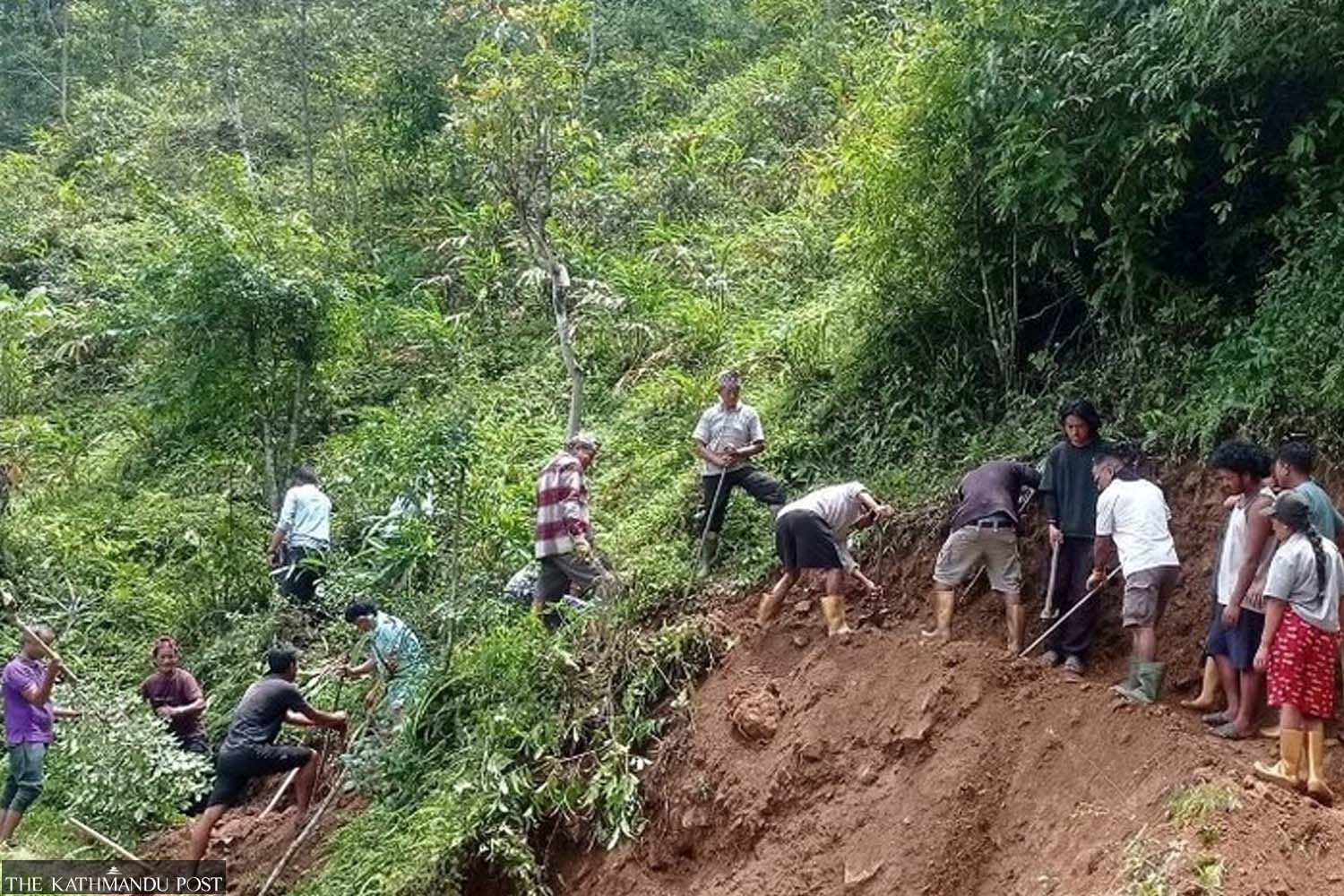
The people’s representatives used Facebook to call for volunteers, and residents arrived the following morning with household tools. About 100 people worked continuously for 12 hours and reopened the road. Transport operators, drivers and senior community members arranged snacks. Teenagers, adults and people up to 70 years old joined, with women making up about one-quarter of the participants.
According to Tumrok, hundreds of vehicles and goods carriers were stranded on either side of the stream after the flood washed away the culvert. Drivers were forced to remain on the road, while the supply of food and other essential goods was disrupted. He said a prolonged closure could have fuelled public anger and prevented patients from being taken to the district headquarters for treatment. Fearing that a delay would make the problem harder to resolve, he appealed for volunteers through his Facebook account. By the following morning, local residents had gathered at Shivakhola with their own tools to help reopen the road.
Phalelung has its own long record of collective labour donation. A flood in 2023 washed away the motorable bridge at Ghumaunetar. Residents worked for two months to restore the road, joined by people from neighbouring Phidim and Hilihang. They raised money as well as providing labour, and deposited the funds in the rural municipality’s disaster fund. Bir Bikram Thamsuhang, chairman of Phalelung Rural Municipality, said a strong culvert built through that effort has carried traffic and freight for three years.
Last week, a landslide blocked the road from Khewatham stream in Phalelung-4 towards Memeng-Bardanda. The ward office called residents to clear it, and more than 100 people gathered each day. According to ward chair Santa Kumar Rai, information was spread through social media, local media, neighbourhood organisations and people visiting the ward office.
Residents worked for four days to reopen the road. Women accounted for around 20 percent of the volunteers. A month earlier, residents had similarly reopened the road to Thokpan Basic School after a landslide blocked it. “Voluntary labour should be spontaneous, selfless and free of party politics,” said Jebi Chamling, who has taken part in such work.
Suryakumar Tumrok, a local of Phidim-7 who worked at Shivakhola, said residents should see roads and other public infrastructure near their homes as a shared responsibility. “We could ask the government to build the road in front of our own homes, but the habit of waiting for the government and watching from the sidelines is growing,” he said. “That is wrong.”
He argued that waiting for the state can take time and costs public money. Wherever possible, residents should use their own labour to reopen roads and repair public structures while seeking government help for work beyond their capacity.
Jaharman Tumrok, former ward chief of Phidim-6, agrees. He said voluntary labour was not a substitute for government efforts but a way of adding citizens’ responsibility to public work.
Under the district’s wage rates, a skilled worker earns Rs1,200 a day, a semi-skilled worker Rs800 and an unskilled worker Rs1,000. Yet people who join such campaigns do not demand wages. They bring tools, work without pay and often arrange their own food and snacks.
Mitra Prasad Kaphle, mayor of Phidim Municipality, said the community’s willingness to act during disasters gives local governments valuable support. When residents repair public structures and reopen blocked roads themselves, it also strengthens the relationship between local government and citizens, he said.
For nonagenarian Bhattarai, the revival of harguhar is more than a practical response to disasters. It is a link with a social tradition that predates modern roads, machines and digital communication.
“Some villagers worked more and some less,” Bhattarai said, wistfully. “But everyone worked and sweated at public sites.”
Bhattarai went on, “I worked hard when I had strength and youth, but now old age makes it difficult for me to walk. These days, when I hear on the radio, television or mobile phone that people in Panchthar are gathering because floods have washed away roads, landslides have blocked them or bridges have collapsed, I feel happy.”

Most Read from Koshi Province

Editor's Picks





E-PAPER | October 24, 2026

×