Nepali Congress falls short of one-third women’s quota in central committee
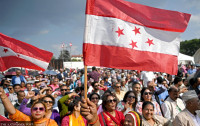
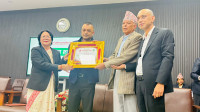
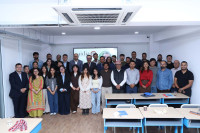
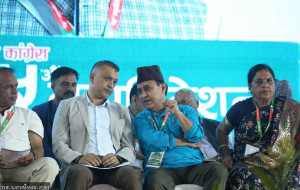
All 69 women elected to the central committee won reserved or inclusion-category seats, leaving party president Gagan Thapa to nominate at least 30 more to meet the requirement.Participants at the Nepali Congress’s 15th general convention, held in Kathmandu from October 4 to 9. Angad Dhakal/TKP
Women have secured 69 of the 231 elected positions on the Nepali Congress central committee, accounting for 29.87 percent of elected members. All won seats reserved for women or allocated under the party’s inclusion categories.
The party’s statute requires women to make up at least one-third of executive committees at every level. The 297-member central committee comprises 231 elected members and 66 nominees appointed by the party president. Three women were elected to office-bearing posts, while 66 won central committee seats.
With 69 women elected, party president Gagan Thapa must nominate at least 30 women to the 66 appointed seats to bring female representation to 99, or one-third of the committee.
Although the new committee includes representatives from a wider range of ethnic, social and professional groups, no woman won an unreserved seat.
The party reserved one seat each for women in the posts of vice-president, general secretary and joint general secretary. Pushpa Bhusal, Dila Sangroula (Pant) and Pratima Gautam were elected to those positions, respectively. Sangroula is the first woman to be elected general secretary in the party’s history.
The central committee elected at the Nepali Congress’s 15th general convention, held in Kathmandu from October 4 to 9, reflects broader representation across ethnic communities and professional groups. However, women remain below the one-third threshold among elected members, leaving the party president to meet the quota through his nominations.
For the central committee election, the party allocated a set number of seats for women across open and inclusion-based categories. Beyond the seats designated specifically for women, female members were elected through quotas for Khas Arya, Indigenous nationalities, Madhesi, Dalit, Tharu and Muslim communities. Women also secured places representing all seven provinces, Kathmandu Valley, under-35 youth, disadvantaged regions, overseas Nepali party committees, professional groups and workers.
The breakdown includes 15 women elected through the women’s open category, eight each from Indigenous nationalities and Khas Arya groups, and five each from Madhesi and Dalit communities. Tharu and Muslim groups elected two women each.
Two women were elected from professional groups and two through overseas Nepali party committees. Workers, the disadvantaged region category and Kathmandu Valley each accounted for one woman member. Seven women under 35 were elected through provincial youth representation, while another seven won seats in the province-based women’s open category.
Twelve women contested positions outside the reserved categories, but none was elected, underscoring the limits of women’s representation in seats not set aside for them.
Sangroula said women had secured a more substantial presence in the party leadership than in the past.
“The presence of women at the highest levels of office and across different communities is positive in itself,” she said. “There is a binding provision requiring at least 33 percent women’s participation in the party’s central committee. If the elections do not produce that number, the party president still has the option of nominating women to meet the requirement.”




 23.72°C Kathmandu