Experts urge urgent stabilisation of Krishnabhir. Tunnel or bridge advised for long term fix
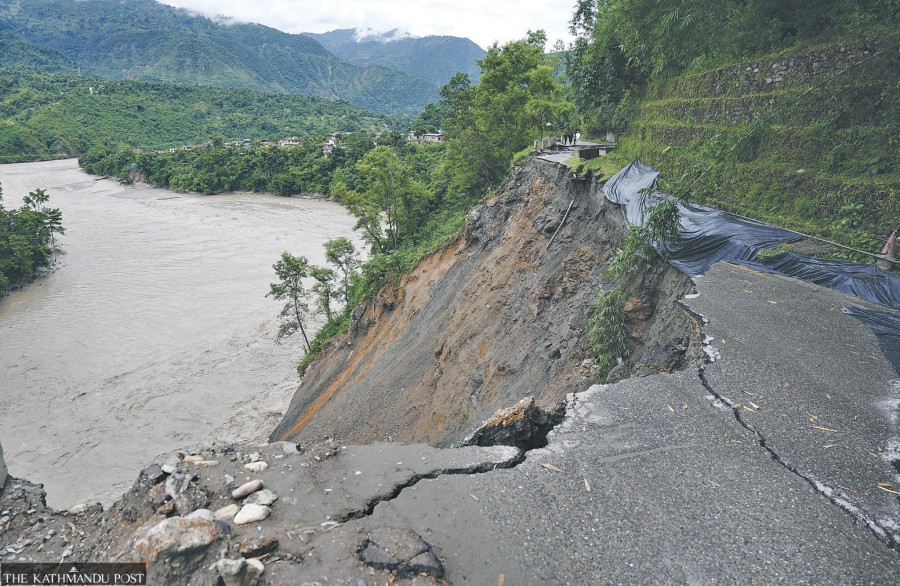
Engineers and geologists warn that the temporary route built above the collapsed stretch remains vulnerable and needs immediate slope stabilisation treatment. The damaged section of Prithvi Highway at Krishnabhir in Dhading pictured last week. The Trishuli river flows below. Post Photo
The new track constructed above the collapsed Krishnabhir section of the Prithvi Highway in Dhading should be strengthened immediately if it is to serve as more than a short-term escape route, say engineers and geologists. They warn that the unstable hillside in Krishnabhir remains a serious risk.
Experts have urged the government to combine immediate slope treatment with studies for a tunnel or bridge that could eventually take the highway away from the landslide-prone section.
The Department of Roads is widening an existing small track above the road that fell into the Trishuli river on August 30, four days after the catastrophic Bhotekoshi flooding. The existing track was wide enough only for excavators.
“Krishnabhir is unstable. There were even suggestions that it should not be operated,” said Keshav Sharma, a former secretary at the Ministry of Infrastructure Development. “But Kathmandu’s lifeline was cut and the supply chain disrupted. The track had to be extended over the landslide out of necessity. Now piling must be done immediately.”
Sharma said steel bars could be driven into the slope from above and below to help stabilise the landslide-prone hill section. He said the authorities should not treat opening the track as the end of the problem.
“Technology must be used immediately to make the newly opened section reliable,” said Sharma. “The second option is to consider building a tunnel from inside. The third and long-term option is to build a bridge across the Trishuli and connect the Prithvi Highway from the Gorkha side.”
Arjun Jung Thapa, a former secretary and member of the National Planning Commission who inspected Krishnabhir, said the immediate priority had to be restoring traffic because the situation had left the government with few practical choices during the monsoon.
“Because of the circumstances, constructing a temporary road at Krishnabhir and operating traffic has taken priority. But there should be no delay in looking for alternatives such as a tunnel or bridge,” said Thapa. He said Chinese experts had also been involved in observing the site and that constructing a bridge during the monsoon would be difficult because the Trishuli was flowing at a high level.
“A strong pier with a solid foundation would have to be built in the middle of the Trishuli before a bridge could be constructed, which is not possible during the rainy season,” he wrote on social media. “Concept and reality are different things.”
Thapa, however, said the government should begin planning immediately. “If no other options are explored at Krishnabhir, it would be a failure,” he wrote. “The government and Nepali contractors are technically and financially capable of building a short tunnel or two 150-metre bridges.”
The Ministry of Infrastructure Development has already approved immediate and longer-term measures. It plans to build structures above the existing gabion breast wall so vehicles can use the hillside track. Officials also plan to install sacrificial gabion boxes and drop boulders from the hillside as part of efforts to stabilise the route.
For a permanent solution, the Department of Roads is studying a tunnel, soil nailing, sheet piling and other measures. The Nepal Geotechnical Society is also providing expert support.
But concern over the safety of the new track has grown after cracks were found on the hillside above the construction area.
Department of Roads Director General Bijaya Jaishi said cracks had appeared about 50 metres above where excavators were working. “More cracks than we had expected have appeared,” said Jaishi. “They will be sealed immediately, and experts will analyse what effect they could have on overall safety. But we will not stop the work. We will accelerate it and open the route to traffic as soon as possible.”
According to Jaishi, the department would first try to reopen traffic through the temporary track and then choose between a tunnel and a bridge after assessing which option would be cheaper and more reliable.
Ranjan Kumar Dahal, a professor at Tribhuvan University’s Central Department of Geology who has studied the Krishnabhir landslide, said the new alignment should be accompanied by immediate slope stabilisation.
“The track should not be opened without simultaneously using technology to strengthen the soil and rock at Krishnabhir,” said Dahal. “Soil nailing and anchoring can be used to strengthen the slope from below and within. These works need to start immediately.”
“For the long term, a 400 to 500 metres long tunnel could be considered,” said Dahal. “A bridge over the Trishuli is another option. For now, however, there appears to be no practical alternative to opening a track above the landslide.”
The Krishnabhir disaster is the latest in a long history of instability at the site. A major landslide first occurred there in 2000, and a large slide in August that year blocked the highway for 11 days, according to local residents. Authorities later carried out bioengineering and retaining-wall works to control the slope.
The Department of Roads reported last year that the road at Krishnabhir had begun sagging and sinking because of water. River erosion was also weakening the road’s base, prompting engineers to work on micro-piling, horizontal anchors and drainage improvements.
The latest failure followed the massive flood that entered the Bhotekoshi from the Tibetan side on August 26 and travelled downstream through the Bhotekoshi and Trishuli rivers. The flood and subsequent erosion caused about 70 metres of the highway at Krishnabhir to collapse into the Trishuli, while another 120 metres developed severe cracks.
The Krishnabhir road collapse completely cut the Mugling-Kathmandu section, forcing traffic onto alternative routes. The Prithvi Highway normally carries about 12,000 vehicles a day, making the disruption a major blow to passenger movement and the supply of goods to the national capital.
The closure has also forced vehicles to use the Hetauda-Kathmandu routes, while goods have been diverted through alternative roads. The disruption has raised concerns because the Prithvi Highway is the main road linking Kathmandu with the country.
Authorities began cutting the new alignment, aiming to restore the key road link within about two weeks. “Once traffic starts, special attention must be given to treating Krishnabhir,” Sharma said.




 12.64°C Kathmandu