Eleven days without a call: Three Kanchanpur families wait for news of men missing in the flood
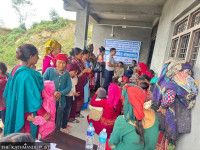
In Kanchanpur, wives, children and elderly parents are still waiting for relatives swept away or out of contact after the Bhotekoshi floods. Relatives of Kaluram Rana gathered at his Kanchanpur-based house. Post Photo
For years, Sittu Rana knew what to expect from her husband’s phone.
Rikesh Rana would call her about three times a day from the hydropower project where he worked in northern Nepal. The calls were part of the rhythm of family life: a few minutes to ask about home, their two-year-old daughter and the ordinary business of getting through the day.
Then, on August 26, the calls stopped.
Eleven days later, Sittu still keeps her phone close.
She waits for the screen to light up and for the familiar ring to break the silence. At first, every ring brought a rush of hope. Now, after more than a week without any word, even that hope has begun to fade.
Sometimes she cries. Sometimes she holds her daughter and tries to comfort her.
“I keep waiting for him to get in touch,” she said.
Rikesh was working as a labourer at the 216-megawatt Upper Trishuli 1 hydropower project in Rasuwa, a mountainous district north of Kathmandu, when devastating floods swept through the area on August 26.
He had spoken to Sittu that morning.
He had been on duty the previous night and had returned from work in the morning. After breakfast, he told her, he would sleep for a while and call again in the afternoon.
That call never came.
“As soon as we heard about the flood, we started calling him,” Sittu said. “But we could not get through. We still have no idea where he is.”
Rikesh had spent years working as a wage labourer in India before moving to Rasuwa about two years ago with help from a neighbour. He returned home in June to take part in the rice planting season, as he did most years, and went back to the hydropower project after the work was finished.
He had resumed regular work on July 17.
At the project, he worked under China Power Construction Corporation, doing welding and other jobs as required.
For Sittu, the work had offered something she had not expected: a job for her husband close enough to home to make a life in Nepal possible.
“Everything was going well,” she said. “He had found a good job in his own country. Then, in an instant, everything fell apart.”
The uncertainty has brought another fear with it. Rikesh was the main source of income for the family.
“I am worried about how we will run the household,” she said.
Still, she has not given up hope.
Reports that security personnel have rescued some people on the 10th and 11th days after the disaster have kept that possibility alive. But as the days pass without a call or confirmed information, fear is growing alongside hope.
Rikesh is not the only member of the Rana family missing.
Two other men from the same family, who worked at the same project and shared the same room, have also disappeared.
They are 30-year-old Kaluram Rana and 23-year-old Kresan Rana. Kaluram is Rikesh and Kresan’s uncle.
Three homes stand next to one another near Pipal Chautara in Dekhatbhuli, a settlement in Krishnapur Municipality-3 of Kanchanpur district in Nepal’s far west.
Since the flood, silence has settled over all three.
Relatives and neighbours regularly come by to ask whether there has been any news. There has not.
At Kaluram’s home, his wife Rekha waits with their four-year-old daughter and 10-year-old son.
Her son keeps asking when his father will call and when he will come home.
“What am I supposed to tell him?” Rekha said. “It has been 12 days. We keep waiting for some news from relatives, but nothing comes.”
Kaluram also called home on the morning of August 26, at about 9am.
Rekha was preparing their children for school.
They spoke for about two minutes.
“The school bus had arrived, so I told him I would call after sending the children,” she said. “He said he would talk for a little while and then go to sleep. After that, we could not contact him.”
The last conversation has become a memory that Rekha returns to repeatedly.
The practical consequences of his disappearance are becoming harder to manage.
Rekha has a respiratory illness, while her 65-year-old mother-in-law, Chhunkidevi, is also unwell. Kaluram had been responsible for the children’s education and the household expenses.
To keep the family running, Rekha borrowed money from a local savings group. She is expected to make an instalment payment in the final week of every month. Kaluram normally sent the money before the payment was due.
This time, he cannot.
The instalment remains unpaid.
Every visitor brings a mixture of hope and grief.
As their house is close to Pipal Chautara, neighbours and relatives frequently stop by to ask about the three missing men. During the day, Rekha said, the visits help pass the time.
Night is different.
“During the day, relatives come and other people come to ask about them, so somehow we get through it,” she said. “But the nights are very difficult. I keep looking at my phone, hoping some news will come.”
Kaluram and Rikesh had returned home together in June for the rice planting season. After completing the work, the uncle and nephew travelled back to Rasuwa together.
Their shifts at the hydropower project changed between day and night, depending on the schedule. They often called home in the morning, evening or during the day.
For the families in Kanchanpur, those calls had been small but dependable connections across hundreds of kilometres of mountainous terrain.
Now there is nothing.
Kresan, the third missing man, had not called home for two days before the flood. He usually spoke to his family every day or two, and because the three men lived and worked together, the family expected that they would remain in contact.
Kresan had told his wife, Bipasha, that he would return home after receiving his monthly salary.
They have a one-and-a-half-year-old daughter.
“Please find my husband, however you can,” Bipasha said. “My appeal to the army and police is the same: please find him.”
The family has not simply waited for the authorities to search.
Kresan’s father, Nandakishor Rana, travelled to Nuwakot with a neighbour, Birendra Singh Dhanuk, to search for the missing men. After visiting flood-affected areas, they were preparing to return to Kathmandu.
Kaluram’s elder brother Kuber Rana also travelled to the area. He is a member of the Armed Police Force and had come home on leave after learning that his brother and nephews were missing.
He spent three days searching around Nuwakot before travelling to Kathmandu.
Kuber says he still believes they could return.
That hope has been sustained partly by the fact that people have continued to be rescued after many days.
But he has also seen reports of families making effigies from Kush, the sacred grass, and performing funerals for relatives who remain missing because their bodies have not been recovered.
He is not ready to think about doing the same for his brother and nephews.
“For now, I cannot even think about that,” he said.
The families have nevertheless begun to confront the possibility that the search may end without the men being found alive.
On Friday, Kanchanpur District Police Office collected DNA samples from the children of all three missing men at Mahakali Provincial Hospital. Such samples could help identify remains if they are recovered.
For Kuber, however, the collection of DNA is not a sign that the family has abandoned hope.
Search and rescue operations are still under way, he said.
As long as they continue, there is still a chance that the three men will come home.
That uncertainty is particularly difficult for families because the flood has taken away something more basic than information: the ability to know whether to mourn or wait.
For Sittu, each day brings the same question.
Her husband left home to work. He was supposed to sleep after breakfast and call her later in the day.
Instead, his phone has remained silent for 11 days.
She has a young daughter who cannot understand why her father has not called. Rekha has children asking when their father will return. Bipasha has a toddler who may grow up with only fragments of memories of the father who was expected home after payday.
The three families live far from the flood zone, but the disaster has entered their homes through the absence of a phone call.
The distance between Kanchanpur and Rasuwa is now measured not in kilometres, but in unanswered calls and rumours.
Every report of a survivor rescued after days brings a fresh moment of hope.
Every night without news makes that hope harder to hold.
And so the phones remain close.
For now, the families are still waiting for the ring.




 14.7°C Kathmandu