From hospital to hospital, families search for the ones the flood took
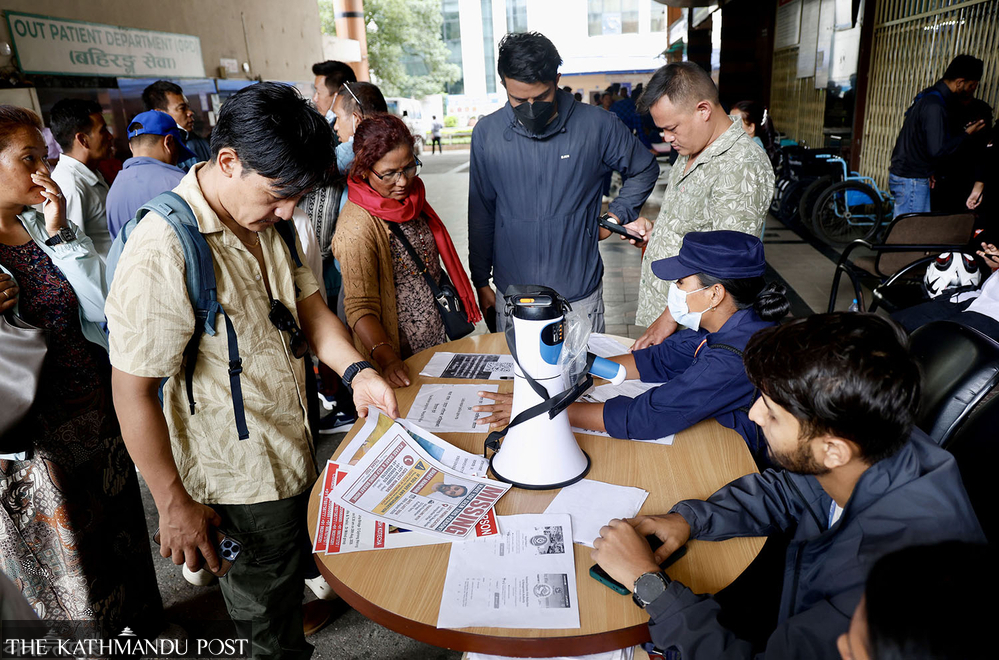
Relatives travel hundreds of kilometres across Nepal, moving between morgues, rescue camps and social media in search of any sign of those swept away or trapped by the Bhotekoshi flood. Relatives of people missing after the Bhotekoshi flood gather at Kathmandu’s Tribhuvan University Teaching Hospital, hoping for news of their loved ones and searching for clues that could help identify them. RSS
When Ram Budha left his younger brother Praveen at their workplace in Rasuwa on Tuesday and returned to Kathmandu, neither imagined it would be their last meeting. The following day, a devastating flood swept through the Bhotekoshi river system. Twenty-year-old Praveen, who worked at the Upper Trishuli-1 hydropower project in Hakubesi, disappeared. Since then, Ram has been searching.
He travelled from Kathmandu to Hakubesi and tried to enter the hydropower project’s tunnel, hoping his brother might be trapped inside. But mud had piled up to his chest, forcing him to turn back. “I stood there and shouted my brother’s name, hoping he would answer,” Ram said. “I waited for a while, but there was no response. We have no idea what the situation is inside the tunnel.”
The brothers are from Patarasi Rural Municipality in Jumla. Their parents remain at home, waiting for news. “I have been telling them that the search is continuing,” Ram said. “But what answer will I give my parents now?”
Praveen had recently completed Grade 12 and was preparing to go abroad for work. Ram had brought him to Rasuwa so he could earn some money while waiting for his departure. “He was hardworking and listened to me,” Ram said. “I never imagined a day like this would come. I keep thinking that perhaps I should have left him in Kathmandu.”
Ram is one of thousands of relatives now scattered across Nepal, searching for family members who disappeared after last Wednesday’s Bhotekoshi flood.
They have travelled from remote villages in Karnali, Sudurpashchim, Madhesh and other provinces to Rasuwa, Nuwakot, Chitwan, Nawalpur, Tanahun and Pokhara. Some move from one hospital morgue to another. Others visit rescue centres, police stations and military camps. Many carry photographs of the missing in their pockets. They do not know whether their relatives were swept downstream, buried under debris or remain trapped somewhere in the disaster zone.
By Sunday evening, authorities had recovered 788 bodies, while 2,502 people remained unaccounted for, according to the National Disaster Risk Reduction and Management Authority. Among those missing are 933 workers, engineers and employees at hydropower projects. Authorities also say 592 foreign nationals and 127 Nepalis travelling with foreign tourists remain out of contact.
For families, the uncertainty has become its own form of torment. Some have divided themselves among different districts to search simultaneously. Others have posted appeals on social media or sought help from local representatives. Those without money, mobility or access to the internet often have little choice but to wait at home.
Sarita Chaudhary of Tulsipur in Dang travelled to Pokhara searching for her husband Sunil, a mason working at a hydropower project in Timure, Rasuwa.
She had spoken to him on the phone until 5pm the day before the flood. “He told me the work was difficult and that he was afraid of the rivers and streams,” she said, wiping away tears. “I told him I could send money for the fare and asked him to come home.”
Sunil refused. “He told me to focus on my treatment, buy clothes for the children and said he would come home for Dashain,” she said. “The next afternoon, we heard that the flood had swept everything away.”
Their 16-year-old son and 10-year-old daughter now repeatedly ask where their father is. “If he is not found, the government must at least provide compensation and help protect and educate our children,” Sarita said.
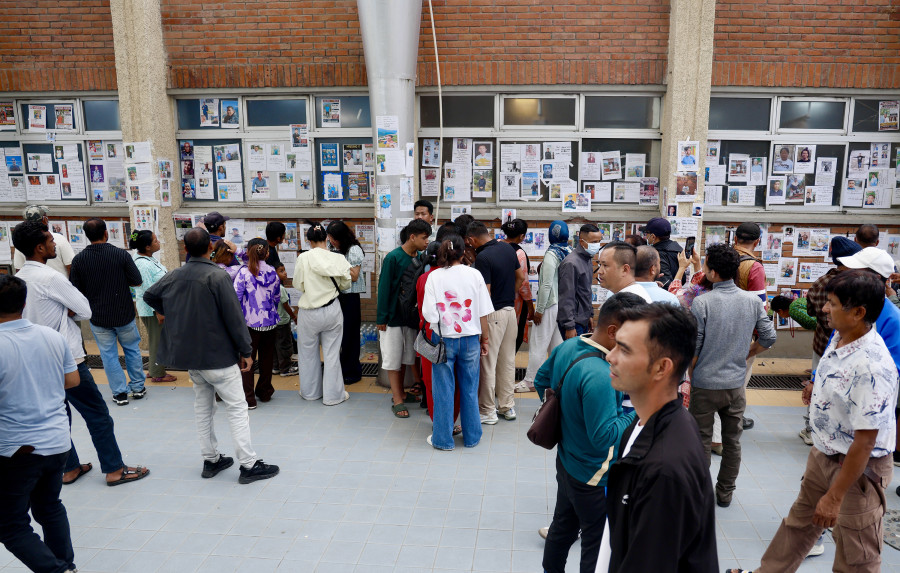
Over 1,000 relatives arrived in Pokhara on Saturday to scour a display of photographs of 102 bodies recovered downstream from the recent floods. Deepak KC/TKP
In Pokhara, families from Tulsipur formed a 40-member team led by local ward chair Mohan Paudel to search for 18 residents believed to have disappeared when a hydropower project in Timure was swept away. After failing to identify anyone in Chitwan, the group travelled to Pokhara.
At Pokhara Academy of Health Sciences, they examined photographs of unidentified bodies one by one. A display showed details including clothing, height and physical features.
For relatives, each image brought another moment of dread. After examining photographs of all 102 bodies, they found none of the missing residents from Tulsipur. “None of them was from Tulsipur,” Paudel said. Kaski Police say around 1,000 people a day have been arriving in Pokhara searching for missing relatives.
A mother searches for her son
Sixty-year-old Birsimaya travelled from Rautahat to Bharatpur on Sunday in search of her son Sher Bahadur Majhi, who had been working near the Rasuwa customs office before the flood. The family learned of his disappearance late. “We heard that bodies had been brought here, so I came,” she said. Her husband is elderly. Sher Bahadur’s brothers and wife are abroad, leaving Birsimaya and other relatives to search.
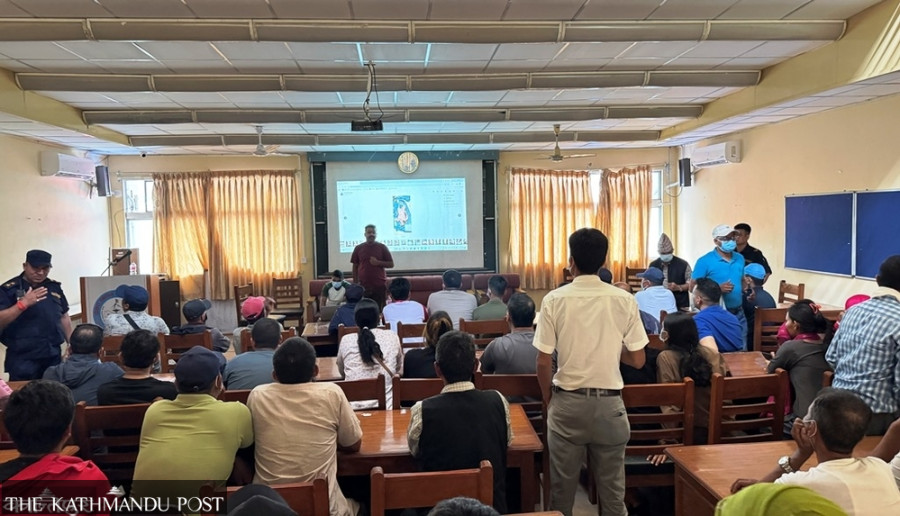
At a local chamber of commerce building in Chitwan, photographs of unidentified bodies are displayed on a large screen. Birsimaya sat with her daughter-in-law and a neighbour, studying the images.
Her son’s face was not among them. She has heard that bodies have also been taken to hospitals in Gaindakot and Pokhara. She says she will continue searching. “I still believe my son is alive,” she said. Her hope persists despite previous tragedy. One of her other sons, who had gone abroad for employment, has already died. “As I grow older, I seem to receive more and more bad news,” she said.
For some families, the search has exhausted both their money and strength.
Karinga Tharu of Kohalpur in Banke has spent days in Bharatpur searching for his brother Asharam and Asharam’s son Prithvi Narayan, who were working at a hydropower project in Nuwakot.
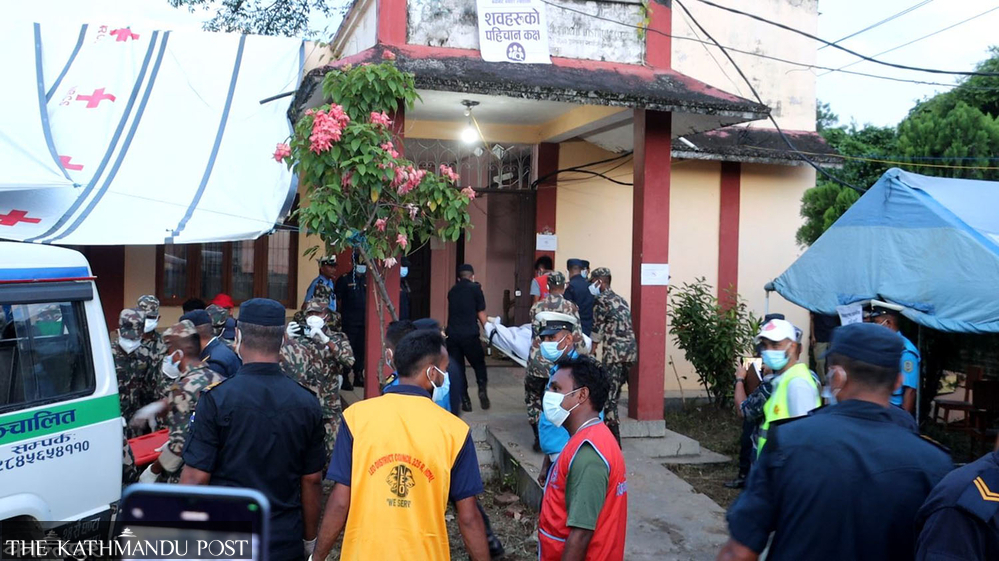
Families still have no clue whether their loved ones are alive, trapped or swept downstream. Post Photo
Three men from their village who worked at the same site were found dead in Bharatpur. Karinga hoped his relatives might also be found there. After two days without any information, he decided to return home. “I don't know where else to search,” he said.
Searching for a brother, searching for a son
Navaraj Lama travelled from Nuwakot to Chitwan, Gaindakot and Pokhara looking for his 42-year-old younger brother Rameshwar. He arrived in Nuwakot on Thursday night. There was no sign of his brother.
In Chitwan, he examined photographs of bodies. In Gaindakot, he visited the municipal hospital. Then he travelled overnight to Pokhara. By Sunday, exhausted, he returned home. “What do I tell my sister-in-law?” he asked. “How many places are we supposed to visit to search for one missing person? It would be easier for families like ours if bodies were kept in one place.”
The day before the flood, Navaraj and his brother had spoken on a video call. “He told me he had eaten and was about to sleep,” Navaraj said, breaking down. “It has been five days. There is neither a breath of life nor a body.”
Rameshwar, a driver, had travelled towards the Rasuwagadhi border with a vehicle to collect goods the day before the flood. Om Bahadur Karki of Thaha Municipality is living through the same uncertainty. His son Prashant, also a driver transporting goods towards Rasuwagadhi, disappeared after the flood.
Karki rushed to Nuwakot and then travelled from hospital to hospital. “I went not only to Bharatpur but also to Madhyabindu Provincial Hospital in Nawalpur to look at the bodies,” he said. “When I couldn't find him anywhere, I returned home in despair.”
According to the Makwanpur District Administration Office, 65 people from the district remain missing after the flood.
From Karnali to Rasuwa
For many families, the disaster has drawn people hundreds of kilometres from Nepal’s poorest and most remote districts.
Menwalal Budhathoki left his home in Salyan after receiving a desperate call from his younger brother Girilal, who ran a business with his family in Timure. “My brother called and said, ‘Brother, I have lost everything. The flood seriously injured me and swept away my wife and children,’” Menwalal recalled.
He immediately left home.
Girilal was taken to Kathmandu for treatment, and Menwalal found him in hospital. But his search for Girilal’s wife Sunita and children Nirmala, Keshav and Nirajan has continued. “I saw security personnel rescuing people alive and taking them to hospitals, so I went from one hospital to another,” he said. “I couldn’t find them anywhere.”
He later received information that Sunita’s body may have been found in Rasuwa, but the family has yet to confirm it.
Arjun Rana, also from Salyan, has travelled through Chitwan, Damauli and Pokhara searching for his 60-year-old father Durga Bahadur Rana, who had gone to Timure only last month to work as a labourer. “I have no idea where my father is or what condition he is in,” Arjun said. “We have not received any reliable information. It has been five days, and I haven't been able to sleep properly.”
Local representatives have also joined the searches. Durga Bahadur Pun, chair of Kapurkot Rural Municipality in Salyan, travelled towards Kathmandu with relatives of missing residents. “People from our municipality went there for work and have disappeared,” he said. “We will continue searching until we know whether they are alive or dead. Searching for our citizens is also the responsibility of the local government.”
‘The phone went dead while we were talking’
For Priyanka Gadariya, the disaster began with a phone call that suddenly ended. Her husband Ashish, 23, was stationed at a police post in Mailung, Rasuwa. “We were talking on the phone at around 8:30 in the morning when the call suddenly disconnected,” she said. “He never called back, and when I tried, his phone was unreachable.”
Relatives are travelling hundreds of kilometres, checking unidentified bodies one hospital at a time. Post Photo
Half an hour later, she learned of the flood. “I felt as if I had fallen off a cliff,” she said. “It has been five days, and we have received no information.”
Ashish had joined the Nepal Police only 17 months earlier. After completing nine months of training, Mailung was his first posting. His family travelled to a hospital in Kapilvastu after hearing that bodies swept downstream had been brought there. Ashish was not among them. His parents are unable to travel widely to search. “He is our only son,” his father Khedu said. “We raised him by raising sheep. Now all we can do is pray that he returns safely.”
Authorities say 45 members of the Nepali Army, 25 Nepal Police personnel and 12 Armed Police Force personnel remain missing. Employees of customs, immigration, Langtang National Park and other government offices are also among the unaccounted for.
Carrying photographs from hospital to hospital
Humnath Neupane has spent three days at the body identification room of Lumbini Provincial Hospital. In his shirt pocket is a photograph of his relative Prakash Devkota, about 28, who worked as a customs agent in Rasuwa and has been missing since the flood. Neupane printed the photograph from Facebook and carries it wherever he goes. At the hospital, he repeatedly shows it to police officers. “Please look carefully. Does this face match anyone?” he asks.
Prakash was in contact with his family until the morning of the flood. Nothing has been heard since. “We still hope he may have been rescued and is somewhere alive,” Neupane said. “But rumours that unidentified bodies may soon be disposed of have made us even more anxious.”
Elsewhere, the search itself has pushed families into debt.
Tilak Gharti Magar of Banke borrowed Rs30,000 to travel in search of his 28-year-old daughter Janaki, who had been working at a hotel in Rasuwa for about six weeks. “My heart would not allow me to stay home after my daughter disappeared,” he said. Janaki had been preparing to go abroad for work, but according to her father, a broker took the money she had paid for the process. She went to Rasuwa to work and repay the debt.
Now she is missing. Tilak travelled to Chitwan and submitted her name and photograph to authorities. With roads blocked and fears of further flooding, relatives have advised him to return home.
“I may have no choice but to go back,” he said. But for families like his, returning home does not mean giving up.
Across morgues, hospitals and rescue centres, the same hope remains.
As Navaraj Lama put it after days of searching for his younger brother: “Until we find either a breath or a body, hope does not die.”




 12.97°C Kathmandu

.jpg)
1.jpg)