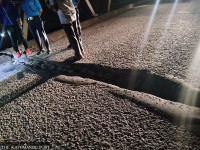
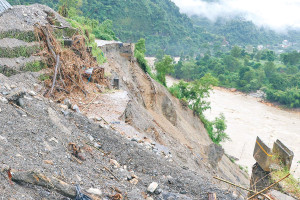
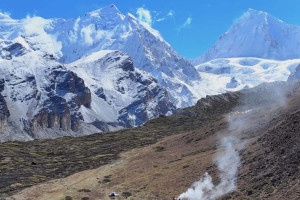
The government, which was initially reluctant to accept various kinds of support offered by friendly nations, has started allowing them to carry out search and rescue operations for people trapped inside hydropower tunnels in the Trishuli basin.
On Saturday, three different teams from India, China and South Korea reached disaster-hit areas and hydropower projects in the search and rescue of stranded individuals.
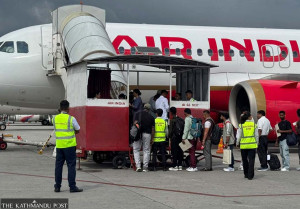
An Indian team from the National Disaster Response Force that arrived in Kathmandu on Friday flew to Chilime and Langtang in coordination with the Nepali Army and the Armed Police Force.
A technical team from India carried out on-site reconnaissance of hydropower tunnels in the area affected by the flash flood, the Indian Embassy in Kathmandu stated. It would help facilitate early search and rescue of stranded individuals.
The 11-member Indian team was flown to the two designated areas but the Nepal government on Saturday turned down another Indian request to send a bigger search and rescue team.
Indian experts conducted a recce of tunnels in Chilime and Langtang power plants area with the Nepali Army, Indian Ambassador Naveen Srivastava wrote on X.
Kathmandu has been selective in accepting external assistance and decided to seek the support of foreign experts on tunnel rescue, DNA and forensic examination. As Nepal is looking for large-size freezers to manage bodies, the government is in close consultation with immediate neighbours and the international community, said Foreign Minister Shisir Khanal.
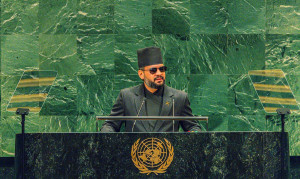
Writing on Facebook on Saturday, Prime Minister Balendra Shah said that the government has received 2,000 airtight bags each from India and China for managing bodies of victims. The government has requested 30 Bailey bridges with China, he stated.
As many foreign nationals are also missing, a dedicated Emergency Control Room has been established at the foreign ministry, Khanal told a news conference on Saturday. “Our diplomatic missions are also constantly sharing and updating verified information, and facilitating communication with families and extending any necessary assistance, identification and repatriation procedures.”
Hinting at why the government earlier did not accept foreign teams, the minister said Nepal’s security agencies and other response teams are currently handling the situation effectively.
“As operations continue, we have requested specific and specialised assistance from our friendly neighbours in areas where their support can further strengthen our search-and-rescue efforts such as opening the tunnels where people have been trapped,” Khanal said. Also useful would be technologies that help us locate people alive in the affected areas, quick forensic and DNA analysis and mortuaries.
On the question of why the government was reluctant to allow the foreign teams for search and rescue operations, Minister Khanal said Nepali security agencies are well familiar with the geography and terrain.
“Since the disaster struck in difficult terrain and narrow passes this time, the foreign teams may face difficulties flying over the affected areas.”
Only helicopters can fly in the narrow gorge, possibly only by Nepali pilots, he stressed. “Since the terrain is risky, we are sensitive to the safety of personnel deployed.”
An eleven-member specialised technical reconnaissance team for tunnel rescue from India has been mobilised and a tunnel rescue team from China has also arrived, he said.
The government has also allowed some South Korean experts to visit and inspect the disaster-hit areas. A team was moved on Saturday itself, said an official. Another team is seeking permission to deploy.
Soon after the disaster, South Korea had offered to conduct aerial surveys using drones to locate victims and rescue survivors but the Nepal government declined.
According to the Chinese Embassy, at the request of the Nepali government, China’s Ministry of Emergency Management urgently dispatched five tunnel experts to Nepal on Saturday.
The experts flew by helicopter from Kerung near the Chinese border to the disaster-hit areas in Nepal. They immediately joined the tunnel rescue operation at a hydropower station, the embassy stated.
In response to the needs of the rescue operation, another four Chinese tunnel experts will be urgently dispatched to Nepal soon, said the embassy.
On the modality of sharing of information between Nepal and China prior to a potential natural disaster, Minister Khanal said that the Tribhuvan University and the Chinese Academy of Science and Technology were working on it.
“After the disaster, we have had excellent coordination, communication and cooperation with China on sharing data and information,” said Khanal.
Prior to Wednesday’s floods, even the Chinese had no proper information about the looming disaster, Khanal said. There are no arrangements between the neighbours for the sharing of prior information. “We are in the process of having it,” said Khanal.
A six-member Chinese team landed in the Trishuli area by a Chinese helicopter. It will begin the rescue operation in close coordination with a Nepali Army team, according to statements.
Although the conditions inside the Trishuli 3 B tunnel in Rasuwa remain extremely challenging, the government of Nepal,the Nepali Army and Chinese expert team are making every possible effort, the PM’s Office stated.
Nepal and China have maintained close communication on transboundary disaster management, the Chinese Embassy in Kathmandu said in a public notice on Saturday.
In May this year, a delegation from the Ministry of Water Resources of China and the Department of Water Resources of Xizang Autonomous Region visited Nepal and made substantial progress with the Ministry of Energy, Water Resources and Irrigation and the National Disaster Risk Reduction and Management Authority of Nepal in promoting the establishment of a transboundary disaster information-sharing mechanism, the embassy said.
In August, a team from the Institute of Mountain Hazards and Environment of the Chinese Academy of Sciences visited Nepal for scientific research exchanges and shared China's practical experience in glacial lake monitoring, said the embassy. On August 26, the day the flood disaster struck, the China Meteorological Administration held an urgent virtual meeting with the Department of Hydrology and Meteorology of Nepal to assess the disaster situation and share data simultaneously.
Anil Giri is a Chief Sub Editor covering diplomacy, international relations and national politics for The Kathmandu Post. Giri has been working as a journalist for more than two decades, contributing to numerous national and international media outlets.




 15.13°C Kathmandu