Washed away bodies lead to problem of identification, morgue crunch
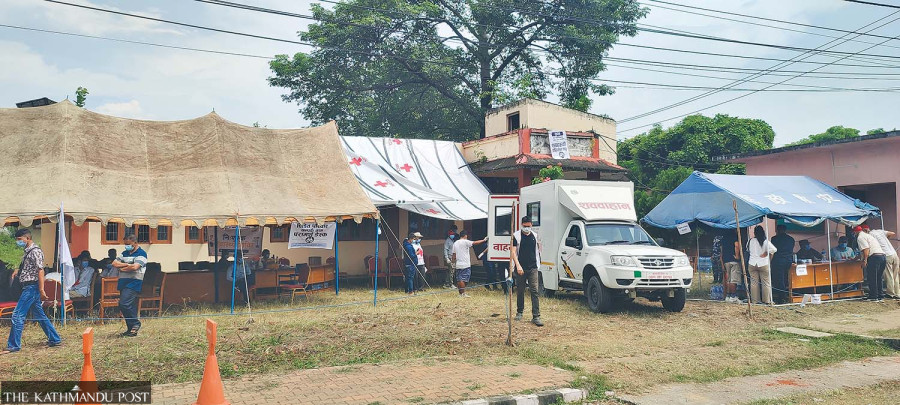
Families search overcrowded mortuaries for missing relatives as authorities struggle with decomposing remains, scarce forensic expertise and limited cold-storage capacity across central Nepal. Relatives of people missing after the Bhotekoshi flood gather at a temporary body handling centre in Bharatpur, Chitwan seeking to locate them. Ramesh Kumar Paudel/TKP
On Friday morning, an anxious crowd gathered outside a temporary body-management centre near the Electricity Office Road in Bharatpur, Chitwan. Some relatives clutched faded photographs. Others held up mobile phones showing pictures of missing family members.
Among them was Damodar Adhikari, who had travelled overnight from Tulsipur in Dang to search for his son, Narayan Adhikari, a technician at a hydropower plant along the Trishuli river. Narayan disappeared with five colleagues after Wednesday’s floods swept through the river basin.
Mohan Paudel, ward chair of Tulsipur-6, had arranged a vehicle for the families. They reached Bharatpur at about 7 am.
Inside the centre, officials displayed photographs of recovered bodies on television screens. Families stared at the images, searching for familiar faces.
By 4 pm on Friday, 233 bodies had been recovered in Chitwan, but photographs and records had been prepared for only 82 of them.
“We feel the process of displaying these photographs should be accelerated significantly,” Damodar said. “People cannot sit here indefinitely while their missing family members remain unaccounted for.”
As search and rescue teams continue working along the river corridors of central Nepal, authorities face a second crisis: how to identify, store and eventually hand over the dead.
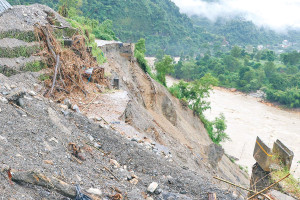
Floodwaters have carried bodies dozens of kilometres downstream, depositing remains along the Trishuli, Marshyangdi and Narayani rivers across Rasuwa, Nuwakot, Dhading, Tanahun, Gorkha, Chitwan, Nawalparasi East and Nawalparasi West.
Hospital mortuaries have been overwhelmed. Authorities have converted community halls, police compounds and other buildings into temporary morgues. But many lack proper refrigeration, allowing decomposition to accelerate in the summer heat.
Some remains recovered from mud and debris are so badly damaged that facial identification is impossible. Search teams have found severed limbs and partial torsos. Authorities are therefore relying on tattoos, jewellery, clothing, fingerprints and DNA.
Yet the destruction of roads and bridges has made it difficult for families to reach district headquarters, inspect recovered remains or provide reference samples.
Ganesh Aryal, chief district officer of Chitwan, initially said the remains would be kept in air-conditioned rooms using dry ice. But shortages have made it difficult to secure sufficient supplies.
“The odour outside the holding facility has become unbearable,” said Subas Sunar, a volunteer at the Bharatpur centre. “It is becoming extremely difficult for volunteers and police personnel to remain nearby. If the current storage conditions persist, we will face a severe public health crisis within forty-eight hours.”
The scale of the crisis is reflected in figures released by the National Disaster Risk Reduction and Management Authority at 7pm on Friday. Chitwan had recovered 233 bodies, Nawalparasi East 154, Gorkha 46, Dhading 40, Nuwakot 37, Tanahun 31, Nawalparasi West 27 and Rasuwa 12.
Too many bodies, too few specialists
In Nawalparasi East, the influx has pushed local medical facilities beyond capacity. The district has six medical personnel trained to perform basic autopsies but no certified forensic pathologist.
Authorities are seeking emergency support from Kathmandu.
“We never anticipated a disaster of this scale,” said Jagadishwor Upadhya, the chief district officer in Nawalparasi East. “Our priority is to hand over identified bodies to families as quickly as possible while expediting autopsies and sample collection for the rest.”
Security personnel searching the Narayani river continue to recover bodies and move them between facilities.
Of the 154 bodies recovered in Nawalparasi East, 48 were being kept at Gaidakot Municipal Hospital, 46 at Madhyabindu Provincial Hospital, eight in Palpa and 41 had been transferred to Pokhara. One body was kept at a community forest hall in Kawasoti-16, where emergency air-conditioning units had been installed.
The recovered remains included 52 adult men, 34 adult women, 11 girls and eight boys. The sex of 49 could not be determined because of decomposition or dismemberment.
Authorities must collect DNA samples from unidentified remains before they can be buried.
For families, even the smallest physical detail can become the key to identification.
Suman Gole, a 25-year-old excavator operator from Hetauda, was working at a hydropower project on the Trishuli river in Nuwakot. After finishing an overnight shift on August 26, he returned to his riverside quarters. Moments later, a surge swept through the site and carried him away.
His uncle, Umesh Syangbo, travelled with friends to Chitwan and Nawalparasi the next day, searching riverbanks and hospital compounds. They circulated Suman’s photographs online while police published photographs and descriptions of unidentified remains.
Residents in Nawalparasi recognised a distinctive chest tattoo in one police bulletin and alerted the family.
Syangbo travelled to Madhyabindu Municipal Hospital in Chormara with local officials and a hearse.
“His face was completely unrecognisable because of damage inflicted by water and blunt trauma,” he said. “We located him solely because he had his wife’s name tattooed across his chest. We spent days wandering between districts, caught between hoping he was alive and searching for his body. It is heartbreaking, but at least we have closure.”
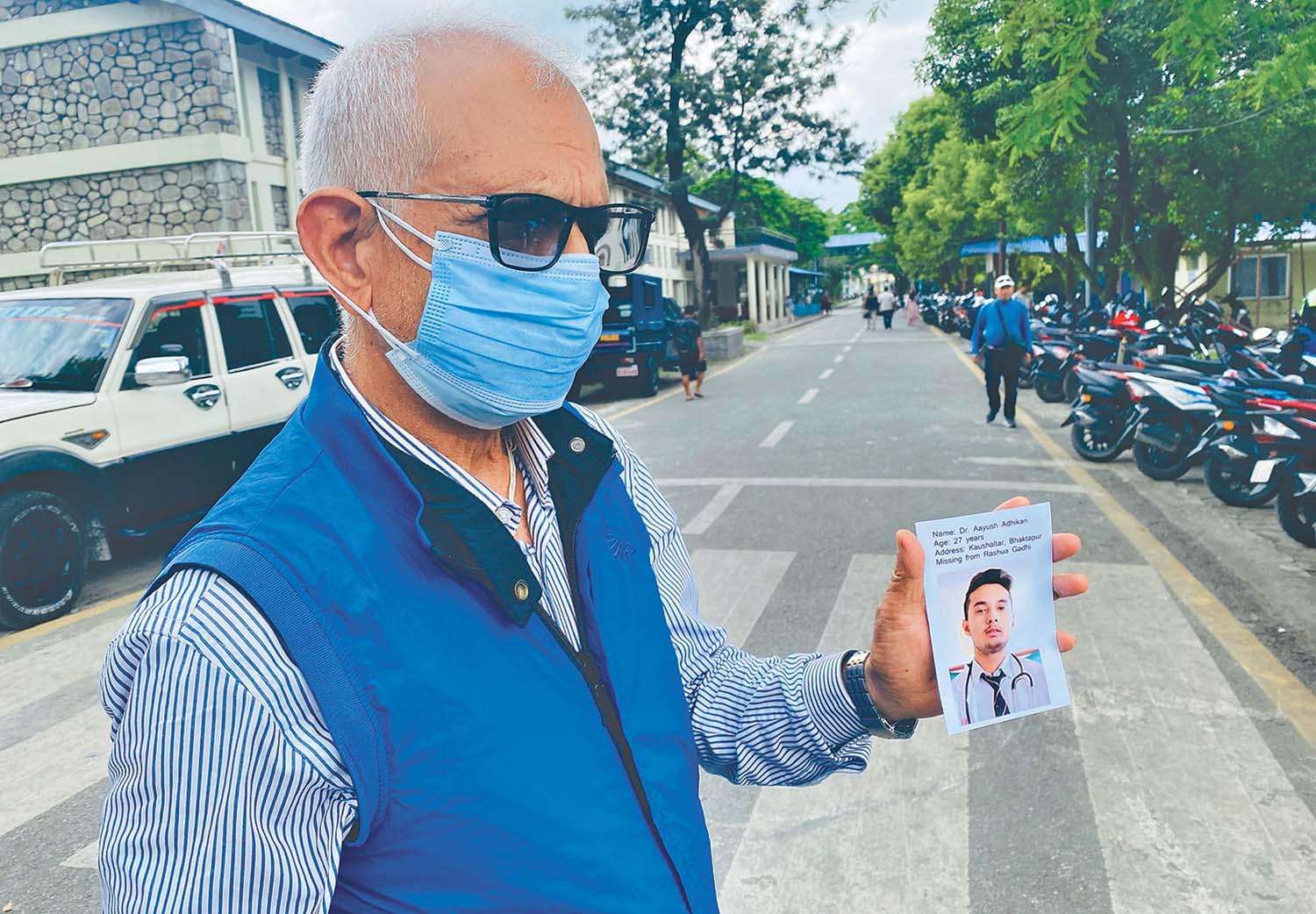
A man holds a picture of his relative missing after the flood, at the Pokhara Institute of Health Sciences, where bodies of some victims are kept for claim by their kins, in Pokhara on Friday. Xinhua/RSS
Mortuaries pushed beyond capacity
Bharatpur Hospital has formed four specialist forensic teams to process the growing number of bodies.
Dr Bishwabandhu Bagale, the hospital’s medical superintendent, said it initially had only two forensic pathologists. Additional specialists were sent from hospitals in Nepalgunj and Butwal as the numbers increased.
Each processing unit has seven to eight personnel.
“We are fully equipped to extract and preserve DNA samples here in Chitwan, but genetic sequencing must be done in specialised laboratories in Kathmandu,” Bagale said. “Our priority is to photograph identifiable features and collect genetic material from each body, regardless of its condition.”
In Pokhara, the situation is equally strained.
Authorities transferred nine bodies from Tanahun on Wednesday night. On Thursday, ambulances brought another 11 from Gorkha, 27 from Dhading, 41 from Nawalparasi East and 14 from Tanahun, taking the total transferred to Pokhara to 102.
Nine bodies were autopsied and moved to Manipal Teaching Hospital, while three were handed over to relatives. The remaining 90 were placed at the Pokhara Academy of Health Sciences, whose mortuary has a stated capacity of 72.
Kuman Singh Gurung, chief district officer of Kaski, said neighbouring districts were still asking Pokhara to accept more bodies.
“Pokhara’s total cold-storage capacity across all hospitals is 88 spaces, and we are currently holding 102,” Gurung said. “We simply cannot accept more until existing bodies are identified, released or buried.”
Police have even had to double up remains inside freezer chambers.
“We are placing two children in a single chamber, or combining partial remains from two individuals where space allows,” said Superintendent Navin Karki, head of the Kaski District Police Office.
Race against decomposition
Kaski police have established an emergency information desk at the Pokhara Academy of Health Sciences to make the identification process easier.
Technicians clean recovered remains, photograph distinguishing features and display the images on digital screens so families do not have to enter the cold-storage rooms.
“Once a tentative match is made, we assist relatives through the legal paperwork,” Karki said.
The District Bar Association has provided volunteers to help families prepare claim petitions. After autopsies and legal procedures are completed, authorities issue burial permits.
Police are also uploading photographs and descriptions to their website and social media channels.
Seven forensic specialists were working at the Pokhara Academy on Friday: three from the academy, two from Manipal Teaching Hospital and two from Gandaki Medical College.
Sushil Aryal, information officer at the academy, said autopsies had initially been delayed by inter-district paperwork but were later accelerated.
But time is running out.
Pokhara’s cold-storage facilities maintain temperatures between 2C and 6C. Aryal said that could preserve bodies for only about 10 days to two weeks.
“Preserving remains beyond that window requires specialised sub-zero freezing infrastructure, which does not exist anywhere in Gandaki Province,” he said. “Bodies brought in from distant districts are already decomposing rapidly.”
When storage runs out
With mortuaries filling across central Nepal, authorities are preparing for the possibility of burying unidentified remains.
Under Nepal’s Unidentified and Unclaimed Body Management Guidelines 2021, district management committees led by chief district police officers can authorise burials.
Before burial, police photograph bodies, record fingerprints, collect tissue for DNA profiling and publish notices seeking relatives.
“If bodies remain unclaimed after storage limits are exceeded, we cannot hold them indefinitely,” Karki said. “The genetic evidence is secured forever.”
Police and municipal authorities will designate burial sites, and each body will receive a permanent identification number. The system is intended to allow families who come forward months or even years later to locate the burial site of a relative.
DNA samples are sent to Kathmandu for analysis at the Nepal Academy of Science and Technology or the Nepal Police Central Forensic Science Laboratory.
But with hundreds of bodies and fragments entering the system, officials expect final DNA matches to take five to six months.
For families still searching, that means the end of the physical search may not bring an immediate end to the uncertainty.




 14.78°C Kathmandu
1.jpg)

.jpg)