Jajarkot landslide-hit families struggle to get by in makeshift shelters
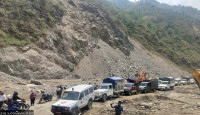
New mothers worry about feeding their babies and children have been cut off from school. Fear of more landslides is keeping families from returning home. A team of eight officials from the National Disaster Risk Reduction and Management Authority, including geologists, travelled to Jajarkot to assess potential sites for the temporary camps. Reuters
When a landslide destroyed her home last Saturday, 45-year-old Nayana Rokaya of Risang in ward 2 of Bheri Municipality in Jajarkot was forced to take shelter in a local school building with her one-month-old son.
Eight days on, life in the makeshift shelter remains difficult, particularly for new and expectant mothers, who have been without adequate food, privacy and comfort.
“We get cooked meals only in the morning and evening, but there is no provision for snacks or other nutritious food,” she said. “My baby keeps breastfeeding, but a mother needs to eat properly to produce enough milk. It breaks my heart to see my son hungry, but there is nothing I can do.”
Her husband, Bhadra Bahadur, spends his days caring for his wife, their one- month-old son and their 15-year-old elder son. Their older son, Santosh, has been suffering from a fever for the past three or four days, while their 22-year-old daughter is married.
“It has become difficult to look after all of them. I haven’t even been able to check on the condition of our damaged house,” he said. “When it rains, water leaks through the tarpaulin and we cannot sleep. When the rain is heavy, water pools on the floor. We have spent two or three nights awake.”
The family had been living in a temporary shelter near their house, which had been partly damaged by an earthquake three years ago. As the rains intensified, they moved into the damaged house, only for a landslide to bury part of it and force them to take shelter at the school.
One side of their house has been buried by the landslide, leaving them unable to retrieve their food grain, clothes, or other belongings.
Rokaya is among 251 people displaced by landslides who are now taking shelter at Tribhuvan Basic School. Six new mothers and five pregnant women are among those living at the school, according to Bhim Bahadur Karki, ward 2 chair of Bheri Municipality.
Women, children and people with disabilities have been given space inside the school building, while young men are sleeping outside under tarpaulins, Karki said.
“Keeping so many people in such a small space is causing health problems among the displaced. Poor sanitation also increases the risk of infectious diseases,” he said. “Most children, women and elderly people are suffering from cold, fever, diarrhoea and headaches. But there is no need to panic because health workers have been deployed at the school round the clock.”
Sujata Khadka, 39, also from Risang, has spent the past eight days at the shelter with her six-year-old daughter and two-year-old son, after leaving home with only the clothes they were wearing.
“We get cooked meals in the morning and evening, and women and children have been given space to sleep inside the school,” she said. “But it is so noisy that we cannot sleep at night. Mosquitoes keep biting us and rainwater leaks through the school’s tin roof. There is no certainty about food, accommodation or even where we will sleep. How long are we expected to live like this?”
Her husband, Shankar Khadka, goes home during the day to tend their livestock and returns to the school at night.
Dr Sunil Pun, chief of the District Health Service Office, said people with minor health problems were being treated at the camp, while those requiring more specialised care were being taken to the district hospital.
The displaced families are trying to keep their daily lives going despite the difficult conditions at the school shelter.
Indra Bahadur Thapa of Sisneri said as their stay at the shelter has stretched on, he goes back to his damaged home during the day to look after his livestock and returns to the school at night.
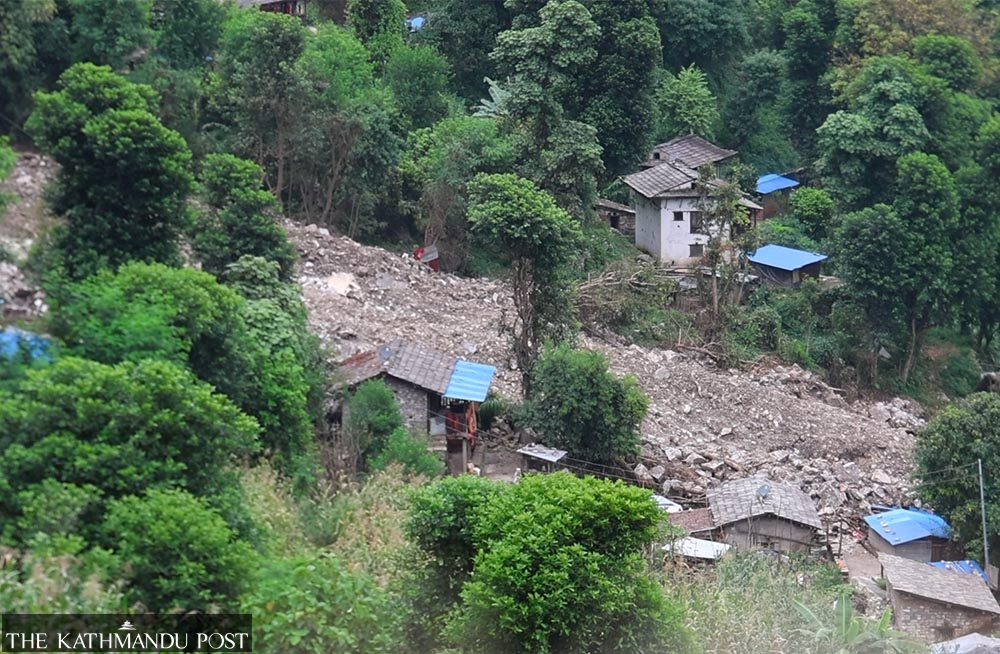
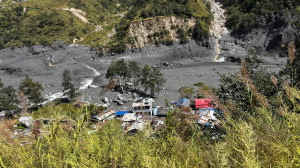
“It keeps raining, and we are constantly afraid that another landslide could come down from above or the ground could collapse beneath us,” he said. “The landslides have torn the village apart. In some places, there is not even a path connecting one house to another. The houses had already been weakened by the earthquake, and after the landslides hit, it is no longer possible to live there. Still, we are trying to keep our daily lives going.”
He said 10 to 15 landslides, large and small, had struck the village and that the danger had not eased because the rain was continuing.
Landslides disrupt children’s schooling
Rabin Thapa, 32, of Darnetaka in Risang, has been living at the temporary shelter for eight days with his wife Shanti and their two sons, 10-year-old Sandesh and eight-year-old Prabin, after their house was buried by a landslide.
Authorities are preparing to shift the landslide-displaced families from the schools to three temporary camp sites to allow classes to resume, and provide the families more suitable living conditions. Post Photo
The boys, who study in grades 5 and 3, respectively, at the same school where they are now sheltering, no longer have their textbooks or notebooks.
“All our belongings were buried,” Thapa said. “We left home with only the clothes we were wearing. There are landslides all around the house, so we could not go back and recover anything.”
He said the family would have to buy new books and notebooks when schools reopen.
Most children displaced by the landslides have similarly been unable to retrieve their school materials, disrupting their education, said Karna Bahadur Shahi, the school headteacher.
“Many children had to leave their books and notebooks behind when their families fled the landslides. Without learning materials, they have been unable to attend school properly,” he said. “Now that the school itself has become a temporary shelter, there has been no decision on when classes can resume.”
The landslides have affected 893 people from 168 households in ward 2 of Bheri Municipality alone, including 198 children. They are taking shelter at Tribhuvan Basic School, Bijay Primary School and Bishnu Primary School.
Rajesh Gharti, a teacher at Bishnu Primary School, said prolonged disruption to schooling could affect children’s learning.
“Living in a temporary shelter is already affecting their mental wellbeing. Being away from school for an extended period could also cause them to forget what they have learned,” he said. “That is why the shelters need to be moved out of the schools as soon as possible.”
Chandra Prakash Gharti, mayor of Bheri Municipality, said 251 displaced people were staying at Tribhuvan Basic School, 28 at the Bheri municipal assembly hall, 27 at Bijay Primary School in Syala and 80 at Bishnu Primary School.
“We plan to move them to alternative sites and resume classes within two or three days,” he said. “Moving the displaced families out of the schools should also make their living conditions somewhat easier.”
Yagyashwar Khatri, head of the Education Development and Coordination Unit, said the disruption could further undermine the learning of displaced children, particularly after schools had already lost substantial teaching time.
“Enrollment campaigns were held from mid-April to mid-May, and classes ran throughout mid-May and mid-July. But there was nearly a 20-day monsoon holiday from mid-July to early August,” he said. “The landslides struck less than two weeks after that holiday ended, and it is still unclear when classes will resume.”
Displaced families to move to three camps
Authorities are preparing to shift the landslide-displaced families from the schools to three temporary camp sites to allow classes to resume, and provide the families more suitable living conditions.
“Because the landslide risk remains, we cannot send the displaced families back to their villages until permanent housing is available,” said Chief District Officer Khadananda Adhikari. “We are therefore preparing to move them to temporary camps until conditions improve.”
The displaced families will be moved to an area below the school in Risang, private land above the school and a site in Kalyanpur, he said. Work has begun to build temporary structures at the sites.
Tents, tarpaulins and other materials will be provided to create temporary accommodation, Adhikari said.
A team of eight officials from the National Disaster Risk Reduction and Management Authority, including geologists, travelled to Jajarkot to assess potential sites for the temporary camps.
The team examined the risk of further landslides, terrain, drainage and road access at the proposed sites before temporary structures were built.
The large number of displaced families means they will have to be divided among three sites, said Suresh Sunar, an undersecretary at the authority.
Bheri Municipality will pay rent for the land, while security personnel are carrying out construction work for the required temporary facilities, he said.




 13.15°C Kathmandu