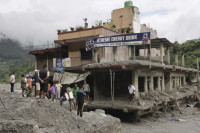
Road users along the Kapurkot–Tulsipur section of the Rapti Highway have been facing disruptions for the past week after debris from ongoing road widening works was left piled on the road, narrowing the route and creating hazardous travel conditions.
A contractor working on the highway upgrade project has been using an excavator and a breaker machine to widen a sharp bend at Ramri. However, rocks and soil excavated while cutting the hillside have been dumped on the road instead of being removed, making it difficult for vehicles to pass.
The unmanaged debris has narrowed the highway, while rainwater has turned the affected sections muddy. Falling rocks have also repeatedly blocked the road, forcing vehicles to stop and causing delays for people travelling between Salyan, Rukum, Rolpa and Dang.
The situation has increased the risk of accidents, with drivers and riders forced to navigate the narrow and slippery road. The disruption has affected local commuters, transport operators, traders and residents who rely on the highway for access to markets, schools, health facilities and other essential services.
The road section is being upgraded to improve mobility, but the work has created additional challenges during the monsoon season. The contractor began cutting the hillside at Ramri on July 22 after large rocks above the road became unstable due to continuous rainfall, raising the risk of landslides and posing a threat to nearby settlements.
Following requests from residents living in vulnerable areas, the contractor deployed an excavator and a breaker machine to remove the unstable rocks and reduce the risk of accidents. However, the debris generated during the work was not cleared, leaving the highway partially obstructed.
"The authorities were right to take action to prevent a possible disaster, but the problem arose because the rocks and soil were not managed immediately," said Dal Bahadur Oli of Bagchaur Municipality-11 in Salyan.
He said the combination of scattered rocks and muddy conditions had made travel difficult, particularly for motorcycles and other two-wheelers. Some riders had slipped and fallen because of the slippery road surface, he added.
Vehicle driver Purna Reul said driving through the section at night had become particularly dangerous because of the debris left on the road.
"A small mistake could lead to an accident," Reul said, criticising the decision to carry out hill-cutting work during the rainy season.
"If the work had been carried out for a few hours in the morning and the debris removed by trucks at the same time, the situation would not have become this difficult," he said. "When rocks pushed by excavators block the road, vehicles have to wait for more than half an hour and long queues form. Passengers may wait, but the situation becomes much more serious if an ambulance carrying a patient gets stuck."
Kiran Rokaya of Siddhakumakha Rural Municipality said travellers were already facing problems on the Rapti Highway because sections such as Aringalepedi had become muddy and vulnerable to landslides during the monsoon. The debris piled up at Ramri had further disrupted vehicle movement, he said.
Ashok Chaudhary, information officer at the Road Division Office in Dang, said the road widening work had been delayed because continuous rainfall caused large and hard rocks above the highway to become unstable, putting nearby settlements at risk.
"The unstable rocks had to be removed carefully, and that took time. Because of this, the debris dumped on the road could not be cleared immediately," Chaudhary said.
He said the hill-cutting work was nearing completion, and the rocks and soil piled on the highway would be removed from Thursday.




 18.94°C Kathmandu