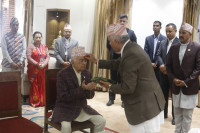
Supreme Court opens direct grievance channel for complaints against courts
The judicial governance centre has received 186 complaints since June, with more than half already resolved. Judicial governance centre was formally launched at the apex court on July 16, fulfilling a commitment made by Chief Justice Manoj Kumar Sharma during his parliamentary confirmation hearing to establish a grievance redressal mechanism. Deepak KC/TKP
Service seekers can now lodge complaints against courts across the country directly with the judicial governance centre at the Supreme Court, a move aimed at improving accountability and addressing delays in judicial service delivery.
The centre was formally launched at the apex court on July 16, fulfilling a commitment made by Chief Justice Manoj Kumar Sharma during his parliamentary confirmation hearing to establish a grievance redressal mechanism similar to the government’s ‘Hello Sarkar’ initiative.
The facility had been operating informally since June 3. Following its formal inauguration, the centre has been providing regular services, according to Bibek Pathak, an officer at the unit.
The centre has received 186 complaints so far, with 57 percent already resolved, Pathak said.
Service delivery-related issues account for the majority of complaints, making up 55 percent of the total submissions. These include delays in serving notices, late delivery of verdicts, prolonged delays in preparing full texts of judgments, repeated postponements of hearings, cases being listed as ‘could not be heard’ or ‘cannot be heard’, delays in scheduling hearings, and prolonged transfer of case files between courts.
Other complaints relate to missing case files, hearings being scheduled on public holidays, court staff refusing or delaying the issuance of appearance dates, and requests for legal advice from litigants dissatisfied with court decisions.
In one case, a complaint was filed regarding a matter at the Kathmandu District Court that had remained pending for an extended period. The centre coordinated with Bench No. 21 of the district court and found that although the notice had been served and returned, the case had not been listed for hearing because court staff had failed to verify it. The necessary process was later completed and the case was placed on the cause list.
Similarly, after a case file went missing at the execution section of the Mahottari District Court, the centre coordinated with the court registrar to help reconstruct the file so that proceedings could resume. The registrar also sought an explanation from the employee responsible for causing difficulties for the service seeker.
In another complaint, a Supreme Court justice was accused of repeatedly assigning a case to the same bench, which eventually ruled against the petitioner. However, as the centre cannot intervene in judicial decisions or orders, the complainant was advised to seek legal remedies through consultation with a lawyer.
Chief Justice Sharma said the complaints received so far highlight the need for continuous reform to make judicial services faster, more accessible and effective.
“There were many complaints within the court system, but people had nowhere to take them. We brought this centre into operation specifically for service seekers,” Sharma told Kantipur. “People can freely raise complaints about courts without hesitation. We will make every effort to address them.”
The identities of complainants are kept confidential. Four staff members have been deployed at the centre to handle grievances, while the secretariats of the Chief Justice and Chief Registrar receive daily updates on its activities.
During the period, the centre received 27 complaints against court employees. The Chief Justice’s secretariat said action had been initiated against officials accused of misbehaviour, demanding money for services, refusing to issue appearance dates and harassing service seekers.
A total of 17 complaints were filed against judges, including allegations of failing to properly assess evidence, collusion with opposing parties and bias.
Fifteen complaints concerned the execution of judgments, including delays in dispatching field deputations (dor), intentional delays in property transfers and repeated issuance of appearance dates.
Ten complaints were unrelated to the judiciary and concerned agencies such as land revenue offices, police and local governments. Another 15 complaints lacked sufficient details, with complainants failing to provide contact numbers or case numbers.
Senior advocate Bijaya Prasad Mishra, president of the Nepal Bar Association, welcomed the establishment of the centre, saying it could strengthen transparency, good governance and service-oriented delivery within the judiciary.
“At a time when discussions on judicial reform often focus only on structural changes and appointments, a mechanism that listens to and resolves the daily problems faced by service seekers is a significant initiative,” Mishra said. “But it should not become a showcase. It must function effectively, and strict action should be taken against those who engage in wrongdoing and harass service seekers.”
Mishra said the Bar supports measures aimed at judicial reform but would not support efforts to protect insiders while placing blame only on others.
Delays in case management, hearing schedules, preparation of judgments, notice delivery and execution of court orders have long affected service seekers. Lawyers and members of the public believe a single-window system to register, analyse and resolve complaints could improve judicial services if backed by effective coordination.
“Setting up the centre alone is not enough. Its success will depend on how quickly and effectively it resolves complaints,” Mishra said. “It will serve its purpose only if it goes beyond collecting grievances by setting clear timelines for resolution, publishing regular reports and recommending policy reforms.”




 18.41°C Kathmandu