Small countries must defend multilateral trade system, says WTO chief
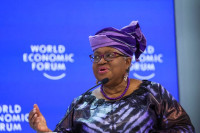
Ngozi Okonjo-Iweala urges developing economies, including Nepal, to push for reforms and use WTO tools to help local businesses access global markets. Director-General of the World Trade Organization Ngozi Okonjo-Iweala speaks during the 54th annual meeting of the World Economic Forum, in Davos, Switzerland, January 19, 2024. Reuters
World Trade Organization (WTO) Director-General Ngozi Okonjo-Iweala has urged smaller and developing countries, including Nepal, to actively defend the multilateral trading system and push for reforms to make global trade rules work better for them.
Interacting with journalists from developing countries during the Konrad Adenauer Stiftung-World Trade Organization Outreach Programme for Journalists, held alongside Aid for Trade Global Review Week 2026 in Geneva on Tuesday, Okonjo-Iweala spoke about the challenges facing smaller economies amid growing reliance on power-based trade relations.
She said countries with limited economic and political influence stood to lose the most if the global trading system became dominated by powerful nations.
“Small countries need a multilateral approach,” Okonjo-Iweala said, stressing that most countries continue to operate within the WTO system despite the absence of a major member.
“For Nepal, maintaining the rules-based trading system is particularly important because its trade is concentrated largely with neighbouring India rather than the United States. India and China, two of Nepal’s major trading partners, continue to operate within the multilateral system,” she said.
“Nepal should therefore encourage its neighbours to decentralise parts of their value chains to the country, creating opportunities for domestic manufacturing and greater participation in regional and global trade.”
Okonjo-Iweala said smaller countries should not remain passive participants in the WTO but actively engage in efforts to reform the organisation and its rules.
“They should be the ones making the most noise about maintaining the multilateral trading system and its rules and supporting it,” she said.
Acknowledging that the existing system was not functioning as effectively as desired, she called on smaller and poorer economies to identify the changes needed to make trade rules more responsive to their interests.
Her remarks underscore the importance of collective rules and institutional mechanisms for countries such as Nepal, which have limited leverage when negotiating trade arrangements with larger economies.
Speaking at a press conference on the Aid for Trade report jointly produced by the WTO and the Organisation for Economic Co-operation and Development, officials said that despite some success stories, the quality and composition of exports from developing economies had not improved sufficiently.
WTO Deputy Director-General Xiangchen Zhang said greater support was needed to help these economies expand their role in international commerce and participate more effectively in the multilateral trading system.
Support for trade policy and regulations accounts for around 3 percent of aid for trade, Zhang said. Such assistance helps developing economies strengthen their institutions, build technical expertise and improve their negotiating capacity within the WTO.
The development community and WTO members have worked together to build these capacities, including in least developed countries. The results are reflected in the growing involvement of developing economies in trade negotiations.
Zhang said the WTO had developed tools to help small businesses, particularly in developing countries, understand regulatory requirements in export markets.
He highlighted the WTO’s ePing platform, which enables businesses and other users to access information on product-related regulations and trade requirements in different markets. The platform can help businesses identify the regulations applicable to their products before entering foreign markets.
A small business seeking to export an agricultural product, for instance, can use the platform to identify relevant requirements in its target market and seek clarification on regulations, Zhang said.
Drawing on his visits to developing countries, including those in Africa, he said some small businesses were already using the platform. The WTO also had other tools designed to help smaller enterprises participate in international trade.
For Nepal, greater awareness and use of such resources could help exporters navigate foreign-market regulations and explore opportunities to expand beyond traditional trading partners.
Krishana Prasain is a business reporter for The Kathmandu Post covering markets. Before joining The Kathmandu Post in 2018, she spent 3 years in New Business Age magazine covering business.




 16.91°C Kathmandu