



 13.8°C Kathmandu

Mon, Oct 19, 2026
Money
Upper Karnali project set to advance after years of funding delays
Investment Board Nepal decides to facilitate construction of the 900MW project after repeated deadline extensions, court challenges, and prolonged uncertainty over financial closure.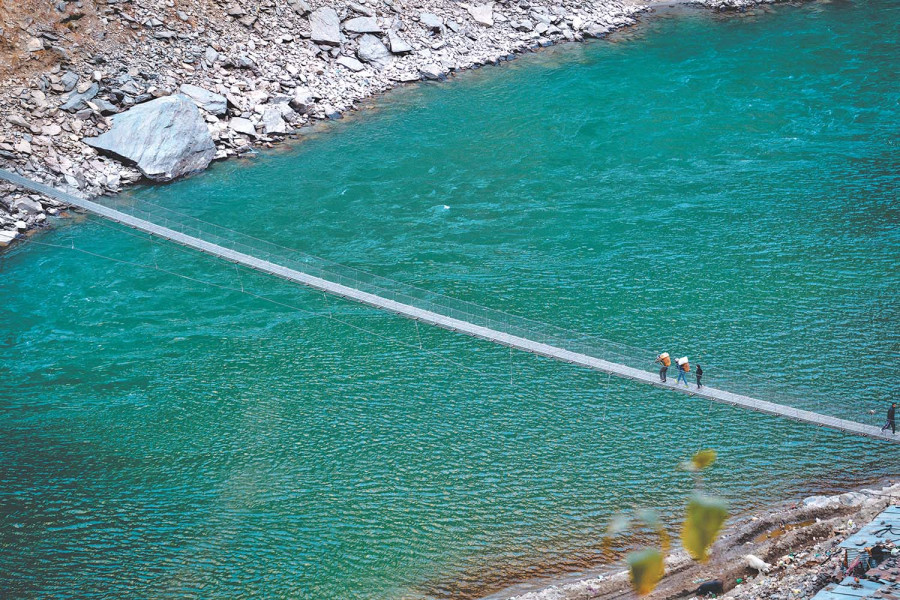
bookmark
Seema Tamang
Published at : October 19, 2026
Updated at : October 19, 2026 07:04
Kathmandu
The much-delayed 900-megawatt Upper Karnali Hydropower Project in western Nepal, which has struggled for years to secure investment, is now set to move towards construction.
The 68th meeting of Investment Board Nepal recently decided to facilitate the immediate commencement of construction in accordance with the provisions of the Project Development Agreement (PDA).
However, the Investment Board Office has yet to send an official letter communicating the decision to the project developer, India’s GMR Group, or Grandhi Mallikarjuna Rao Group.
The company said it would proceed accordingly once it receives the official letter.
GMR had submitted the necessary documents earlier, but financial closure had remained elusive.
On January 15, 2025, GMR submitted documents to the Investment Board seeking financial closure, claiming that funding for the project had been secured. The company said the Indian Renewable Energy Development Agency (IREDA) had responded positively to a proposal to provide a loan of INR65 billion (Rs103.94 billion), while a consortium of Nepali banks had given in-principle approval for a loan of Rs20 billion.
A senior official at the Investment Board Office said the PDA for the project did not explicitly require the board to approve financial closure. Although the agreement does not provide for such approval, it specifies each party’s share of the investment and defines financial closure in terms of the required documentation.
The board’s 60th meeting had already approved a revised shareholding structure for the project, under which GMR holds 34 percent, Indian state-owned Satluj Jal Vidyut Nigam (SJVN) 34 percent, IREDA 5 percent, and the Nepal Electricity Authority 27 percent.
Previously, GMR held a 73 percent stake and the Nepal Electricity Authority held the remaining 27 percent. GMR brought in IREDA and SJVN as shareholders to help mobilise investment.
With the board now deciding to facilitate the immediate commencement of construction, the project can move forward.
“The developer can now submit any outstanding and updated documents and proceed with construction,” the senior official said. “As the board has decided to facilitate the process, the developer must complete construction within the next five years.”
On December 24, 2024, Dan Bahadur Budha, an advocate and proprietor of Budhasubba Legal Research, filed a writ petition at the Supreme Court, arguing that GMR had failed to achieve financial closure within two years of signing the PDA. He also argued that the company had entered into agreements to transfer shares to other companies to invest in the project in India without obtaining government approval.
The petition named the Office of the Prime Minister and Council of Ministers, the Investment Board, the Ministry of Energy, and GMR, among others, as defendants. A joint bench of justices Sapana Pradhan Malla and Nityananda Pandey dismissed the petition and issued a directive order.
However, the Investment Board had held off on proceeding with financial closure while awaiting the full text of the court’s verdict. The full text states that the change in the shareholding structure did not appear to warrant adverse treatment, as it was consistent with the provisions of the PDA.
The Investment Board had formed an expert committee to review GMR’s report on financial closure. The committee recommended that GMR could achieve financial closure before the end of February 2025. Based on that assessment, the board decided to facilitate the immediate commencement of construction in accordance with the PDA.
The government and GMR signed a memorandum of understanding on January 24, 2008, for a survey of the Upper Karnali project and the development of a 300-megawatt hydropower plant. The government awarded the project to GMR under the build-own-operate-transfer (BOOT) model.
An international competitive bidding process was conducted for the project, and the government selected GMR’s proposal as the best. The two sides signed an MoU for project development in 2008.
On December 21, 2009, GMR applied to the Department of Electricity Development to increase the project’s capacity from 300 megawatts to 900 megawatts to maximise its potential.
After the Investment Board was established in 2011 under the Investment Board Act, 2011, the project was brought under the board’s office following a Cabinet decision in accordance with the act. The Investment Board and GMR signed the PDA on September 19, 2014.
Under the agreement, GMR was required to secure financial resources within two years. After it failed to meet the deadline, the government extended the period by one year on December 16, 2016.
When GMR failed to secure funding within the extended period, the board granted another one-year extension in October 2017. No further extension for financial closure was granted after September 2018.
On July 15, 2022, the Cabinet decided to grant another two-year extension. A writ petition was subsequently filed challenging the government’s decision.
On November 3, 2022, the Supreme Court issued an interim order directing the government not to implement the extension.
Later, in a petition filed by Ratan Bhandari and others, the Supreme Court’s Constitutional Bench issued a directive order on May 7, 2023, instructing the Cabinet not to extend the deadline again. At the same time, it granted an additional 186 days for financial closure to compensate for the time lost due to the interim order.
Following a decision at the Investment Board’s 55th meeting, the Cabinet, at its meeting on July 25, 2024, extended the deadline for financial closure until January 17, 2025. The full text of the court’s verdict also states that the government granted the extension in compliance with the court’s order.
Although the Supreme Court upheld the extension granted before the case was filed in its May 2023 ruling, it barred further extensions thereafter.
GMR had repeatedly received deadline extensions after failing to secure financing. The Supreme Court stated that the company had already been given 10 years to mobilise funding for Upper Karnali, which it considered sufficient, and ruled that no further extension was necessary.
Seema Tamang
Seema covers business and economy for Kantipur Publications.


Most Read from Money
Nepal travel agents threaten to stop selling Thailand trips over visa rules

Why does an hour long flight to Dhangadhi cost more than a flight to New Delhi?
Malaysia rejects Nepal’s demand to open recruitment to all manpower agencies
No school, but a graduation cap for women dairy farmers
Nepal arrests four medical service providers as Malaysia recruitment row deepens
Editor's Picks

E-PAPER | October 19, 2026

×