



 14.81°C Kathmandu
Sat, Oct 24, 2026
Money
Is Nepal’s dairy sector headed for recession?
The state-owned Dairy Development Corporation and private dairy firms have yet to pay farmers around Rs6 billion citing sharp drop in consumption.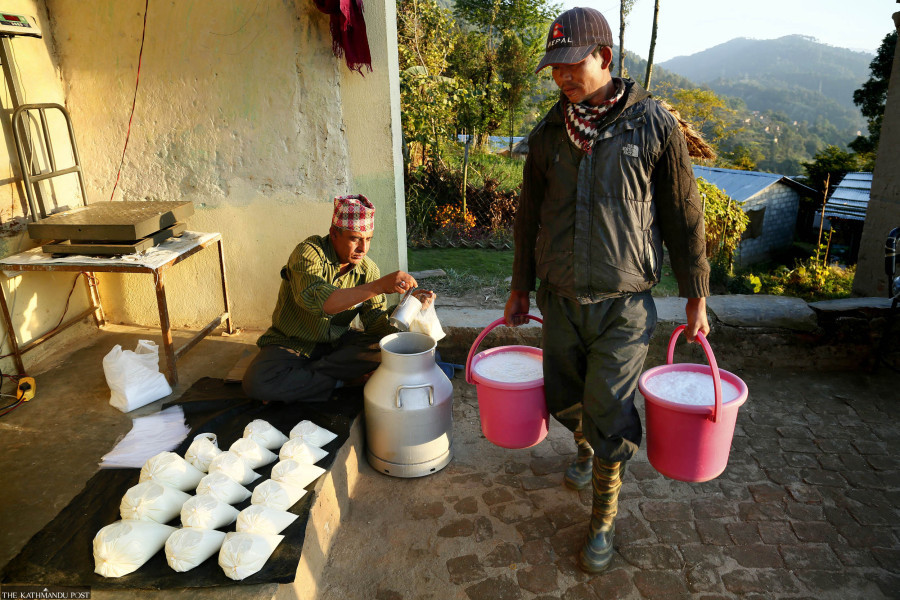
bookmark
Krishana Prasain
Published at : February 23, 2024
Updated at : February 23, 2024 06:42
Kathmandu
In April last year, the Nepali dairy industry surprisingly requested the government to lift the restriction on the import of skimmed milk powder or full cream milk powder to avert possible shortages of milk in the domestic market. Dairies cited reasons such as the Covid pandemic and the prevalence of lumpy skin disease in cattle as the reasons behind the drop in domestic milk production.
Commercial animal husbandry was badly affected by the pandemic and then the lumpy skin disease as many farmers left the occupation after incurring massive losses.
After 10 months, there is surplus milk output. As dairy companies are struggling to sell the milk in the market, they have converted the milk into powder and butter. But the market for powdered milk and butter too has subdued, leaving tonnes of the products piling in warehouses.
Both state-owned and private dairy companies said that the ongoing economic slowdown has dampened dairy demand, resulting in stopped cash flow and rising liabilities to farmers as products remained unsold for the last five months.
Now, it’s the turn of unpaid farmers to take action.
Dairy farmers on Thursday decided to launch an agitation against the government for non-payment of dues.
The state-owned Dairy Development Corporation and privately-owned dairy industry have not paid around Rs6 billion to dairy farmers, whose primary source of income is the earnings from milk sales.
Farmers say they haven’t been paid for the last five months.
On Thursday, 15 dairy farmers' associations held a press meeting to announce a phase-wise protest, demanding that their outstanding dues be paid at the earliest.
The protest comes on the heels of ongoing protests in the construction sector which has, too, suffered from the slowdown. The government has been struggling to pay the construction sector after its revenue stream dried due to the slowdown in economic activities.
“We have announced a protest, which will start from Kathmandu on February 25, and if we are still not paid, the protest will gradually spread across the country,” said Ganesh Chandra Timilsina, president of National Peasants' Coalition Nepal, a national farmers’ organisation.
A sit-in will be organised for two days starting February 26. The farmers have decided to hold a peace march by enforcing transportation strikes on the major highways on February 29.
“If the government fails to settle the dues by March 4, the protest will spill nationwide,” said Timilsina.
He said that dairy farmers have been drawing the attention of the government to their concerns for weeks. “We haven’t heard from the government.”
Amid high inflation and without receiving payments, farmers said they have been facing challenges in managing household expenses and feeding the livestock.
“Farmers are unable to pay the interest on their loans,” said Timilsina.
In some districts, farmers have dumped the milk in the street to protest against the government.
The farmer’s representatives, particularly commercial farmers, from all seven provinces, have assembled in Kathmandu to protest.
“The protest will not stop until our payment is released,” said Timilsina.
Farmers say that they have been badly hit by the lumpy skin disease. More than 50,000 cattle have died from the lumpy skin disease that affected all of the country's 77 districts last year, causing billions in losses to the farmers.
The dairy sector is hit by the ongoing economic crisis.
“We owe around Rs1 billion to farmers across the country,” said Prahlad Dahal, president of Nepal Dairy Association, the organisation of private dairy companies. “It’s been two months that we have been unable to make payments.”
Dahal said that dairy products, especially powdered milk and butter, are piling up due to the decline in consumption.
“With goods remaining in stock, the cash flow of private dairies has stopped,” he added.
The dairy industry, however, is hoping that the situation will normalise as summer, which increases milk consumption, has begun.
The state-owned Dairy Development Corporation said due to the ongoing economic slowdown, consumption of dairy products has dropped sharply, putting them in a difficult situation.
Sanjeev Jha, managing director of the corporation, said they have an unsold stock of butter and powdered milk worth Rs1.10 billion. “We won’t be able to pay farmers until we clear out the stock.”
According to Jha, they owe Rs950 million to dairy farmers for the last two months, especially to the farmers in eastern Nepal.
The corporation said that its butter storage capacity is 550 tonnes. “The storage is now full. We have also rented additional spaces to store the surplus butter,” Jha said.
The country currently produces more than 6 million litres of milk daily. Around 25 percent of this is purchased by the corporation and the rest by the private sector.
As the private sector has stopped buying milk from farmers, this has put pressure on the corporation. “We are unable to cope with the pressure,” said Jha.
The monthly purchase of raw milk during the “flush” season by the corporation, the largest player in Nepal’s dairy, stands at Rs350 million.
The flush season for milk — when production by animals goes up due to better fodder and water availability, besides lower temperatures and humidity — is normally from October to March.
April to November is lean season for milk production when the purchase hovers at around Rs220 million, the corporation said.
Last year, the country saw an unexpected surge in milk production during the typically lean season of August to September. The corporation converted 50,000 litres of surplus milk into powder in August last year, but it remains unsold.
The corporation said that it has been paying more than Rs6 million daily to the farmers.
Issuing a press statement on Tuesday, the corporation said that due to the ongoing economic slowdown, people’s buying capacity has eroded, resulting in a huge pile-up of dairy products.
The corporation said it may reduce the price of dairy products to increase consumption.
“We are also doing homework for exporting the dairy products,” said the press statement.
The corporation has also requested the Ministry of Agriculture and Livestock Development for a subsidised loan against the stock of powdered milk and butter as collateral so that it would be able to settle the farmers' dues.
In March last year, the government raised the farmer’s price of raw milk to Rs65.5 per litre from Rs56.4 per litre. The price was increased after farmers complained they were not getting a reasonable rate for their products.
The retail price of milk was then raised by Rs14 per litre to Rs100.
According to the Nepal Dairy Association, currently, 3.1 million litres of milk arrive in the market. Out of which, 500,000 litres is surplus.
Krishana Prasain
Krishana Prasain is a business reporter for The Kathmandu Post covering markets. Before joining The Kathmandu Post in 2018, she spent 3 years in New Business Age magazine covering business.


Most Read from Money

Why does an hour long flight to Dhangadhi cost more than a flight to New Delhi?
Nepal travel agents threaten to stop selling Thailand trips over visa rules
Malaysia rejects Nepal’s demand to open recruitment to all manpower agencies

No school, but a graduation cap for women dairy farmers
Nepal arrests four medical service providers as Malaysia recruitment row deepens
Editor's Picks




E-PAPER | October 24, 2026

×