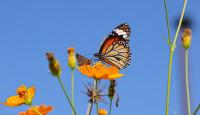
Nepal has launched a nationwide effort to count its butterflies, sending more than 100 volunteers to 25 locations to document species, estimate their numbers and record the habitats where they are found.
The month-long ‘Big Butterfly Count’, which began on September 1 and runs through September 30, comes as researchers say the country still lacks comprehensive and up-to-date data on butterflies, whose diversity and abundance can offer clues to the health of ecosystems.
The campaign is being organised by Butterfly Watchers Nepal and Greenalaya Nepal, which have been working on butterfly research and conservation. This is the fourth nationwide count, said Siddhartha Sapkota, founder of Greenalaya Nepal.
Participants are surveying sites in Kathmandu Valley and across the country, including Chitwan, Makwanpur, Dolakha, Sunsari, Dhanusha, Kaski, Tanahun, Rupandehi, Surkhet and Kanchanpur.
The teams include students of environmental science, zoology and forestry, as well as wildlife photographers and butterfly enthusiasts. Each observation is photographed and uploaded to the iNaturalistbiodiversity database, along with information about the species and its habitat.
The timing is intended to maximise the number of observations. Post-monsoon vegetation provides abundant food and breeding conditions for butterflies, making them easier to spot, said Sija Thapa, who coordinates the count in Rupandehi.
“This is when butterflies are particularly abundant. The landscape is green after the monsoon, and it is also their breeding season,” Thapa said.
The previous nationwide count recorded more than 129 species. Organisers hope the latest survey will add to the country’s patchy record of butterfly distribution and abundance.
Nepal has 695 recorded butterfly species, according to existing records, although Mahendra Singh Limbu, who has studied butterflies in the country for five decades, believes the actual number is closer to 700.
The Annapurna Conservation Area has the country’s highest recorded diversity, with more than 392 species. Godawari, on the southern edge of Kathmandu Valley, has yielded records of more than 350 species.
Godawari is also known for two rare species, the Grey hawk-streak and Kaiser-i-Hind. Several species found in Nepal have the country’s name in their common names, including the Nepal Wall, Nepal Skipper and Nepal Meadow Blue. The Manang Meadow Blue is also found only in Nepal.
Nepal is home to representatives of all six recognised butterfly families: Hesperiidae, Papilionidae, Pieridae, Lycaenidae, Riodinidae, and Nymphalidae.
The country’s largest butterfly is the golden birdwing, with a wingspan of up to 194 millimetres. The species is listed under the Convention on International Trade in Endangered Species of Wild Fauna and Flora.
For researchers, however, the value of the survey extends beyond building a species list.
Butterflies are important pollinators, particularly for wild plants as well as crops, oilseeds and fruit trees. Their sensitivity to environmental changes also makes them useful indicators of ecosystem health and climate change, said butterfly researcher Sanej Prasad Suwal.
Pollination is essential to the production of about 80 percent of the world’s food, Suwal said. Butterflies also have potential value for ecotourism because of their diversity and visual appeal.
For conservationists, one of the biggest gaps is knowing where species occur and how their populations are changing.
“Without enough information about butterfly diversity, it is difficult to develop appropriate policies, plans and programmes,” said Krishnadweep Chaudhary, coordinator of the count in Makwanpur.
The survey is designed to fill some of that gap. Volunteers photograph each butterfly they encounter and upload the image and location to iNaturalist. Experts in Nepal and abroad can then help identify or verify species when necessary.
After the campaign ends, the photographs and records will be analysed before the results are published, giving researchers a broader snapshot of Nepal’s butterfly diversity and distribution.




 19.08°C Kathmandu