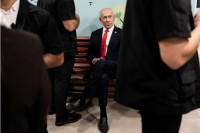
The election leaves Netanyahu’s path to power uncertain but keeps the risk of further escalation with Iran alive, unsettling oil markets.Israel’s Prime Minister Benjamin Netanyahu sits on a bench after voting at a polling station in Jerusalem on the day of Israel's legislative election. Reuters
Israel’s big election has delivered a predictably messy result. On Tuesday, voters pushed Benjamin Netanyahu’s far-right coalition tangibly below the 61 seats needed for a parliamentary majority, but there may still be a way for the long-term prime minister to limp on. If so, it’s consequential for Middle East stability, and a vindication for oil traders’ recent jitters.
With over 70 percent of votes counted, Netanyahu’s coalition has 54 seats, 10 less than it managed in 2022. Opponent Gadi Eisenkot’s anti-Netanyahu coalition has only 47. But parties representing Arab Israelis, who also oppose the government, are forecast to nearly double their seats to the high-teens. That should add up to a clear rejection of the incumbents.
Two big factors complicate matters, though. First, Arab parties rarely form coalitions with the rest – in fact, Eisenkot’s bloc includes right-wing politicians like Avigdor Lieberman who have explicitly ruled such a deal out. Second, Netanyahu’s Likud party looks likely to be the biggest faction – even if it comes at the expense of his far-right coalition allies.
What happens next is unclear. President Isaac Herzog may invite either Eisenkot or Netanyahu to form a new government, even though both would require currently hard-to-envisage deals to reach a majority. If both fail Israel could hold another election. Yet delays arguably help the incumbent – Netanyahu will remain caretaker prime minister for months, and having secured a majority of Israeli Jewish votes he may fancy his chances next time around.
A decisive majority for Eisenkot might have led to a rethink on areas that appear to have driven a recent spike in Israeli emigration, such as Netanyahu’s judicial reforms and his costly subsidies to the ultra-orthodox Haredi community. But the wider upshot might have been a government that took a different approach to US President Donald Trump’s call to “finish the job” in Iran.
Judging by Netanyahu’s initial comments overnight about the need to “remove the existential threat of Iran once and for all”, the scope for the US and Israel to escalate remains on the table. That will worry Saudi Arabia, the target of repeated recent attacks from Iran-aligned Yemeni Houthis, and its Gulf neighbours. Not least because Trump and Netanyahu’s Iran war has thus far been a strategic failure, achieving little more than a blockade of the Strait of Hormuz.
Oil prices are driven by far more than Israeli politics. But Brent crude has hovered above $100 a barrel since early September, compared to $70 before the Iran war started in February, as investors price in further escalation. It ticked up to $115 a barrel on Wednesday - and may well now stay there for some time.




 16.02°C Kathmandu